
Reviewed · POMPEII & HERCULANEUM TOURS
Pompeii Small Group Tour with an Archaeologist
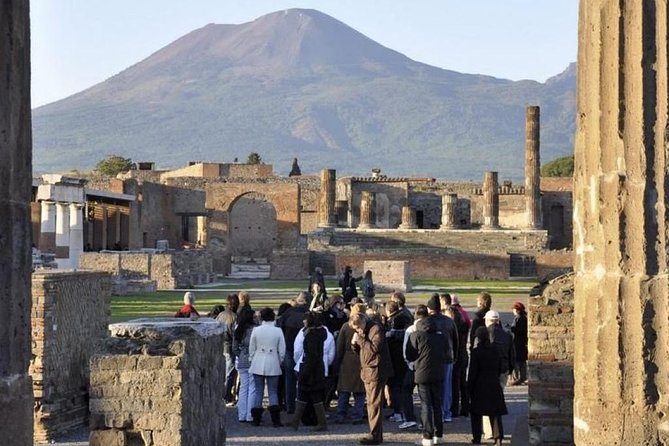
Pompeii is far too large to understand by simply following a map, and this two-hour archaeologist-led tour gives you a sensible path through its most important remains. You move from the Basilica and Forum to private houses, baths, a brothel, and theaters, while the guide explains how ordinary Roman life fit into these worn streets.
I like the way the tour balances famous sights with human details, especially the plaster casts in the Forum granaries and the decorated House of Menander. I also like that you can stay inside the ruins after the guided walk and continue at your own pace. The main drawback is the 20-person group limit: that is small enough to work, but not intimate, and delays with headsets or a late start can eat into a short tour.
Key points to know
- A working archaeologist leads the way: Guides including Alessandra, Paolo, Teresa, Vincenzo, and Amedeo have received especially strong praise for clear explanations, humor, and thoughtful pacing.
- The route covers Pompeii’s major themes: public life at the Forum, wealthy homes, bathing, entertainment, religion, and the eruption’s human cost.
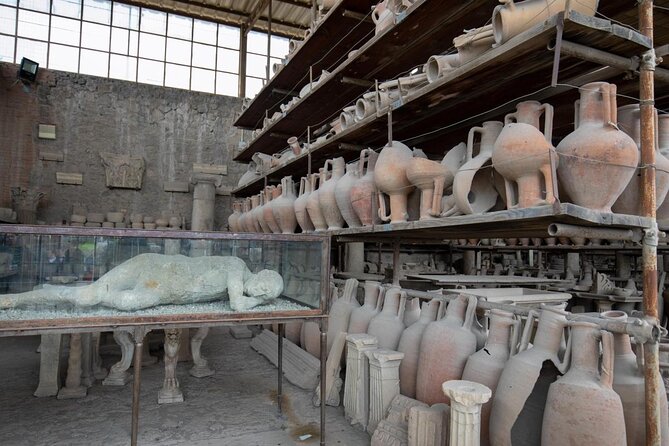
- The plaster casts are the emotional center: You see casts of people, a dog, and a tree in the Forum granaries.
- The tour ends inside the site: You can continue exploring after the official two-hour visit instead of being led straight out.
- Expect rough walking: Ancient paving stones, ramps, steps, and a few steeper stretches call for sturdy shoes.
- The price is modest for guided access: At $35.67 per person, the tour can be a strong buy if you want context rather than a silent walk through ruins.
Why an archaeologist changes Pompeii
Pompeii is not one tidy monument. It is an entire Roman town, with streets, homes, shops, public buildings, baths, theaters, and religious spaces spread across a large archaeological park. On your own, you can admire the walls and mosaics, but it is easy to miss why one building mattered or how the parts fitted together.
This tour gives you a practical framework. The guide points out the public center first, then shows how Pompeii’s residents lived at home, washed, ate, worked, entertained themselves, and worshipped. That order helps the site feel like a town instead of a pile of disconnected ruins.
The guide is a licensed professional with an archaeological background. Individual guides vary, but names praised for this experience include Alessandra, Paolo, Teresa, Vincenzo, Amedeo, Julia, Antonio, Rafaela, Jola, and Alfredo. Alessandra is described as having advanced archaeological training, while Paolo has worked at one of the sites affected by the eruption. You should not book expecting a particular person unless the operator confirms it, but the repeated strength of the guiding is one of the tour’s best reasons to choose it.
The group can include up to 20 people. That keeps the price down, but it is not the same as a private tour. You may wait briefly while everyone gathers around a mosaic or listens to an explanation. Headsets are supplied for groups of 16 or more, which helps, though one poor experience involved a delayed start and malfunctioning headsets. Most visits appear to run smoothly, but a two-hour tour leaves little room for avoidable delays.
Other Roman sites within reach of Pompeii:
- Pompeii: Entry Ticket and Guided Tour with an Archaeologist
★ 4.8 · 19,459 reviews - Pompeii: Entry Ticket with Optional Audio Guide
★ 4.2 · 12,360 reviews - Pompeii: Small Group Tour with an Archaeologist
★ 4.8 · 12,264 reviews
Meeting at Porta Marina Superiore
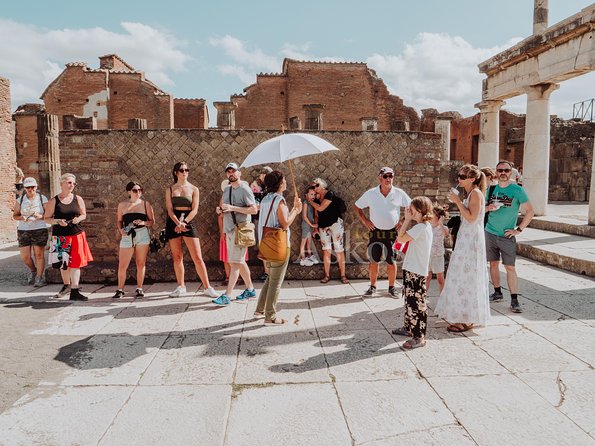
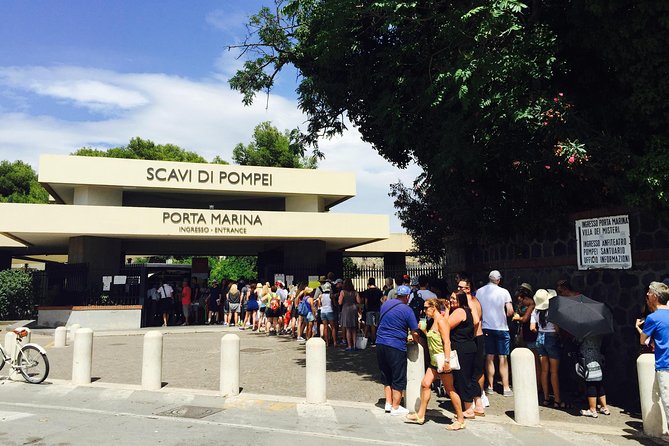
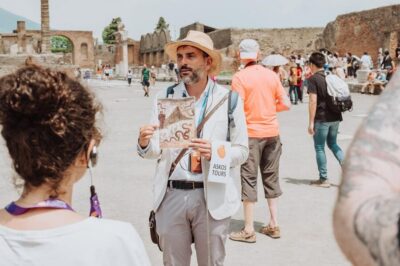
You meet at the Pompeii archaeological park entrance called Porta Marina Superiore, at Via Villa dei Misteri 2. Look for a guide holding an Askos Tours sign. The tour includes the Pompeii Express entrance ticket, so the guide handles the entry process and takes the group directly into the ruins.
The meeting point matters because Pompeii has more than one entrance and the site is large. Arrive early enough to find Porta Marina Superiore without rushing. If you arrive very late, catching up can be impossible because the ruins are broad and mobile reception may be weak. The operator has a strict no-refund policy for cancellations or changes made within 24 hours, and significant late arrival can also mean losing the guided portion.
The tour runs in rain or shine. Pompeii offers little shade in many areas, so bring water, sunscreen, and sunglasses in warm weather. Wear shoes with good grip rather than thin sandals. The ground is uneven, and ancient streets can be tiring even when the walking pace is sensible.
The Basilica and Forum explain Pompeii’s public life
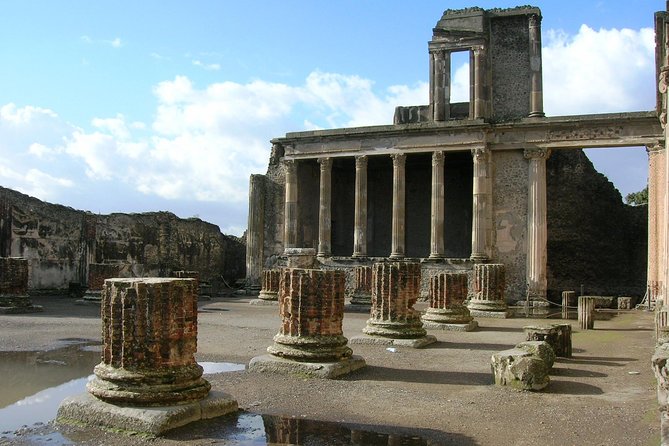
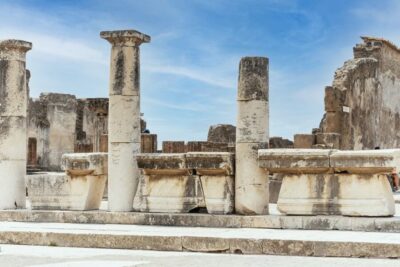
The first major stop is the Basilica, an open portico used for business, legal matters, and commercial activity. Its surviving columns and broad scale help you picture Pompeii as a working town, not simply a residential district.
From there, you reach the Forum, the city’s main square. This is the place where civic, religious, and commercial life met. The guide can give the damaged buildings around the square a purpose and a name, which is useful because the Forum’s open space can otherwise feel bare compared with the painted houses.
The opening section is also where you learn how the city was organized. Expect explanations about architecture, public life, and the eruption, with time for questions. The strongest guides make this material easy to follow without turning the tour into a long classroom lecture.
One caution: the Forum is a natural place for a large group to pause, and stopping everyone together can slow the pace. One poor experience involved a long stationary talk near the entrance, leaving too little time for the site. That is not the expected outcome, but you should understand that the quality of the visit depends partly on how the guide manages the group.
The Forum granaries and the casts of the dead
The granaries beside the Forum hold one of Pompeii’s most affecting displays. Here you see marble tables, fountain features, and plaster casts made from cavities left in the volcanic material after bodies decomposed. The casts include human victims, a dog, and a tree.
This is not a cheerful stop, but it is essential. The casts bring the eruption down to a personal scale. They remind you that Pompeii was not merely preserved architecture. It was a community caught in a disaster.
Your guide’s explanation matters here. A good explanation can add archaeological context without treating the casts as spectacle. You have time to look closely, ask questions, and consider the human cost before moving back onto the main street.
Same base, a different kind of day:
- Pompeii: Skip-the-Line Entrance Ticket with Audio Guide
★ 4.0 · 2,509 reviews - Naples: Pompeii and Mt. Vesuvius with Lunch and Wine Tasting
★ 4.5 · 2,454 reviews - Pompeii: Archaeological Park Tour with Ticket on request
★ 4.5 · 2,283 reviews - Discover the Ancient Ruins of Pompeii: Day Trip from Rome
★ 3.5 · 2,247 reviews
The main street and House of Menander
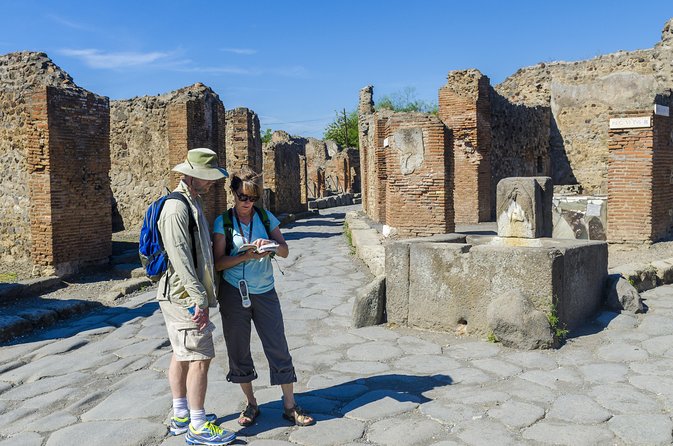
Walking along Pompeii’s original paved roads is one of the pleasures of the tour. Raised stepping stones, worn surfaces, and old wheel tracks show how people moved through the city. They also make clear why comfortable footwear is not optional.
The House of Menander is one of Pompeii’s grander private residences. Its architecture, decoration, and surviving contents show the resources of a wealthy household. This is where the tour shifts from public institutions to domestic life.
Look for the way rooms are arranged around open spaces and how painted decoration helped signal status. You may not remember every Roman term the guide uses, but you will come away with a clearer sense of how wealth was displayed inside a home.
Guides tend to choose certain details for longer explanations, and the exact emphasis can vary. That can be a benefit: one guide may focus on decoration, another on household use or current archaeology. The tradeoff is that no two tours will necessarily linger over every feature.
Stabian Baths show the practical side of Roman life
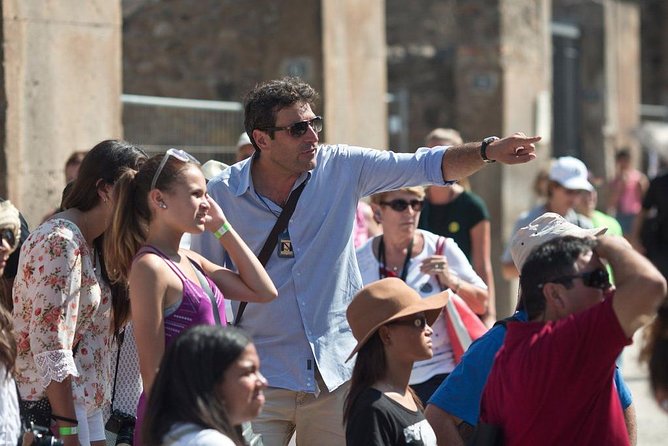
The Stabian Baths are the oldest thermal complex in Pompeii and occupy a large area near the Brothel Lane, the Holconius crossroads, and Via Stabiana. The remains help explain how bathing was built into Roman social life.
You see the scale and arrangement of a public facility rather than just a single room. The guide can explain how the baths worked and why they mattered to daily life. This stop adds useful variety after the houses and Forum, since it shows a service used by a broad part of the town.
The baths are also a good reminder that Pompeii was a functioning city with infrastructure. Water, heat, exercise, social contact, and grooming all had a place in the urban routine. You get more from the ruins when you view them as parts of a living system.
The Lupanar and the House of the Faun
The Lupanar is Pompeii’s best-known brothel. Its small rooms and surviving painted material attract plenty of attention, but the guide’s context helps keep the stop from becoming a quick joke or a sensational detour. It is a useful place to consider the gap between modern assumptions and Roman social customs.
Next comes the House of the Faun, one of Pompeii’s largest and most impressive private homes. Its size and decoration point to a household with serious wealth. The famous name comes from the faun sculpture associated with the residence, though the main value of the stop is seeing how grand a Roman urban house could be.
These two stops work well together. The Lupanar shows a commercial and intimate side of city life, while the House of the Faun displays elite private life. Pompeii’s appeal comes partly from that contrast. Within a short walk, you encounter people with very different money, status, and daily routines.
The Odeon and Teatro Grande finish the route
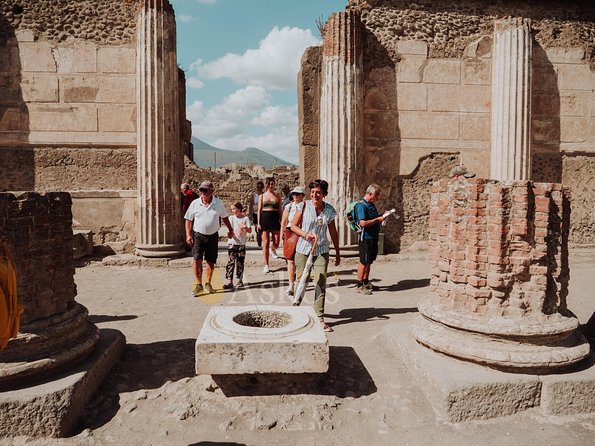
The brief look at the Teatro Piccolo, or Odeon, introduces a smaller performance space. It gives you a sense of the city’s taste for music, poetry, and spoken performance.
The final major stop is Teatro Grande, Pompeii’s largest theater and one of the route’s strongest closing points. Its curved seating and stage area show how entertainment worked on a public scale. After the narrow streets and enclosed houses, the theater opens the experience outward again.
Ending here makes practical sense. You finish with a large, memorable structure and remain inside the archaeological park. The tour does not provide transportation afterward, and the guide may point you toward exits or additional places to see, but make sure you ask for clear directions before separating. One useful improvement would be a final reminder about the best way out, since the site can be confusing.
What $35.67 buys you
At $35.67 per person, this is a reasonable price for a licensed guide, the Pompeii Express entrance ticket, and a focused two-hour route. The value is strongest if Pompeii is your first visit or if you want someone to explain what you are seeing rather than simply identify buildings.
The tour does not include food, drinks, or transportation. Those omissions are easy to plan around, but carry water because there is no promise of a convenient refreshment stop during the walk.
You are paying for interpretation and time management as much as entry. Pompeii is big enough that a guide can show you key places in two hours that might take much longer to locate alone. Afterward, you can stay inside and explore independently, making the paid portion a useful orientation rather than your entire Pompeii visit.
A private or smaller tour may suit you better if you want to stop for long periods, photograph every room, or move at your own pace. For most people, however, the combination of a modest price and a clear route makes this a sensible middle ground between going alone and paying for a private guide.
Who will enjoy this tour most
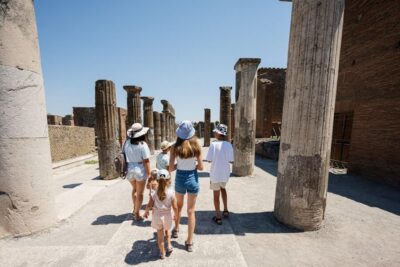
This experience suits first-time visitors who want a clear introduction to Pompeii. It also works well for families, since guides such as Amedeo and Alfredo have been praised for involving children and teenagers instead of speaking only to the adults.
History fans will appreciate the archaeological background and discussion of current excavation and preservation work. The tour also suits anyone arriving by train or visiting Pompeii as part of a wider Naples or Rome trip, since the guided route gives you a strong overview without requiring a full day.
It is less suitable if you have serious mobility limits. The site includes steps, ramps, uneven paving, and some slightly steep climbs. Mobility scooters are not allowed, and the operator recommends asking about a suitable private tour if you have mobility concerns. Service animals are allowed. Other dogs must weigh no more than 10 kilograms, measure no more than 40 centimeters in height, remain leashed, and be carried inside buildings.
Practical tips for a better visit
- Arrive early at Porta Marina Superiore and look for the Askos Tours sign.
- Wear sturdy walking shoes with good soles.
- Bring a small bottle of water, especially in summer.
- Pack sunscreen and sunglasses because shade is limited.
- Bring identification for anyone under 18.
- Ask the guide where to find the exits and which areas are worth seeing afterward.
- If you want more than the main highlights, plan extra time inside the ruins after the tour.
- Do not count on joining the group after a major delay. Pompeii is too large for an easy catch-up.
Should you book the Pompeii archaeologist tour?
Book it if you want Pompeii to make sense quickly. The route covers public buildings, wealthy homes, baths, entertainment, sex work, and the eruption’s victims, giving you a useful cross-section of the ancient city. The strongest guides, including Alessandra, Paolo, Teresa, and Vincenzo, are known for combining facts with stories and humor.
Skip it in favor of a private option if you need a very slow pace, have mobility problems, or dislike sharing stops with up to 19 other people. For everyone else, $35.67 is a fair buy, especially because you can remain inside afterward and continue on your own.
FAQ
How long does the Pompeii tour last?
The guided tour lasts approximately two hours.
Where does the tour begin?
You meet at Porta Marina Superiore, the main archaeological entrance at Via Villa dei Misteri 2, Pompei. Look for a guide holding an Askos Tours sign.
Where does the tour finish?
The tour finishes inside the Pompeii archaeological park.
Is the Pompeii entrance ticket included?
Yes. The Pompeii Express entrance ticket is included in the tour price.
How large is the group?
The tour allows a maximum of 20 people per guide. Headsets are provided for groups of 16 or more.
Is the tour suitable for people with mobility issues?
The tour is not recommended for people with mobility issues because the route includes steps, ramps, uneven ground, and some slightly steep climbs. Mobility scooters are not allowed.
What happens if I need to cancel?
You can receive a full refund if you cancel at least 24 hours before the local start time. Cancellations or changes made less than 24 hours before the start time are not accepted for a refund.
Just added in Pompeii
- Pompeii Ruins Private Tour with Optional Skip-the-Line Entry★ 4.9 · 732 reviews
- Pompeii 3hours Villa of Mysteries tour with an Archaeologist★ 4.8 · 486 reviews
- Pompeii: Exclusive Tour with Archaeologist and Entry Tickets★ 4.9 · 634 reviews
- Pompeii: Small-Group Tour of Pompeii and Herculaneum★ 4.8 · 867 reviews
- Pompeii: Group Tour with an Archeologist Guide★ 4.4 · 490 reviews
- Pompeii: Skip-the-Line Tickets and Tour with Archaeologist★ 4.9 · 467 reviews
- Pompeii: Skip-the-Line Guided Tour with Expert Archaeologist★ 4.8 · 196 reviews
- Pompeii: Skip-the-line-Ticket and Guided Tour★ 4.6 · 1,152 reviews
Pompeii & Herculaneum Tours, compared.
Entry Ticket and Guided Tour with an Archaeologist
Read our review →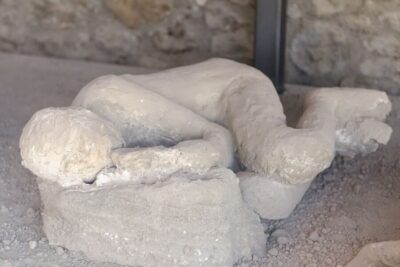



Pompeii and Mount Vesuvius Day Trip from Rome with Pizza Lunch
Read our review →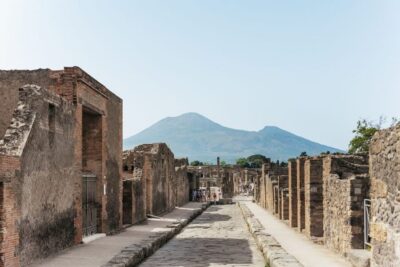
Pompeii Day Trip with Optional Vesuvius and Lunch
Read our review →Browse the lists this tour appears in