
Reviewed · POMPEII & HERCULANEUM TOURS
Pompeii: Small-Group Tour of Pompeii and Herculaneum
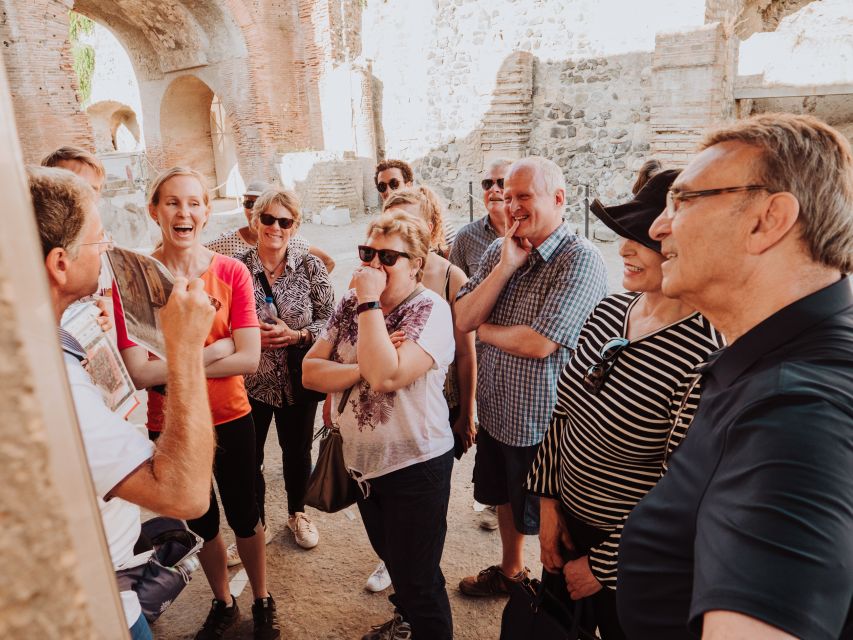
Pompeii gives you the broad Roman city, but Herculaneum often delivers the sharper shock. Its wooden doors, upper floors, mosaics, paintings, and household details survived because a deep mud flow sealed the town. This tour lets you compare both sites in one day with an archaeologist at your side.
I like the small-group format, capped at 20 people, and I like the way the two ruins complement each other. Guides such as Diego, Paolo, Vincenzo, Alfredo, and Amedeo have been praised for explaining daily life, excavation work, and the meaning behind what you see. The main drawback is the short 30-minute break after two hours at Pompeii, which may not give you enough time for a proper meal and rest.
Key points to know before booking
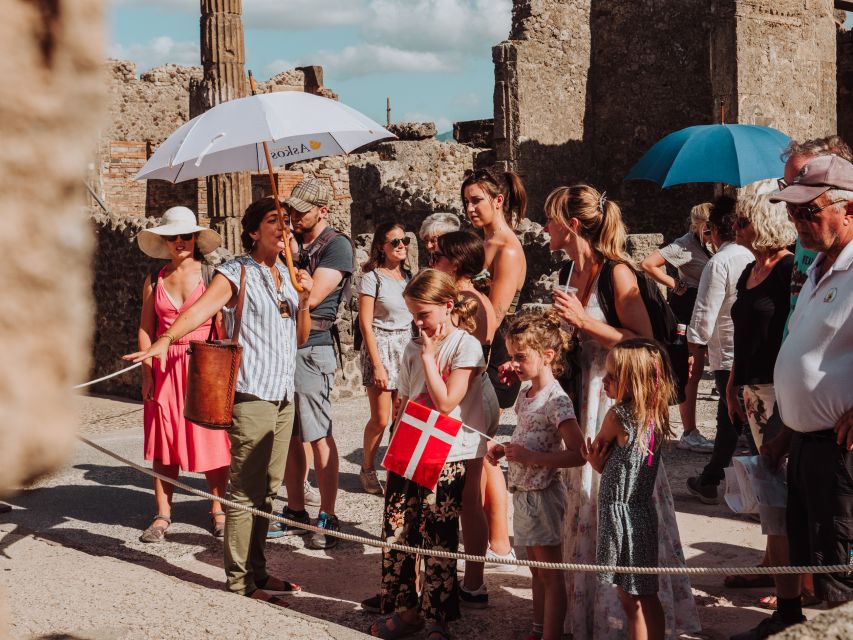
- Two major Roman sites in one morning and afternoon: Spend about two hours at Pompeii, then another two hours at Herculaneum.
- An archaeologist leads the walks: Guides bring context to walls, streets, homes, inscriptions, paintings, and burial remains.
- Herculaneum is smaller but better preserved: Expect intact mosaics, carbonized wood, upper floors, and vivid wall decoration.
- The train transfer is part of the day: You travel from Pompeii to Ercolano by Circumvesuviana, with the tour ending at Herculaneum.
- The lunch break is brief: Thirty minutes works for a quick sandwich, but not for a relaxed sit-down meal.
- Come ready to walk outdoors: Wear sturdy, comfortable shoes and bring water, sun protection, and rain gear.
Why seeing both Pompeii and Herculaneum makes sense
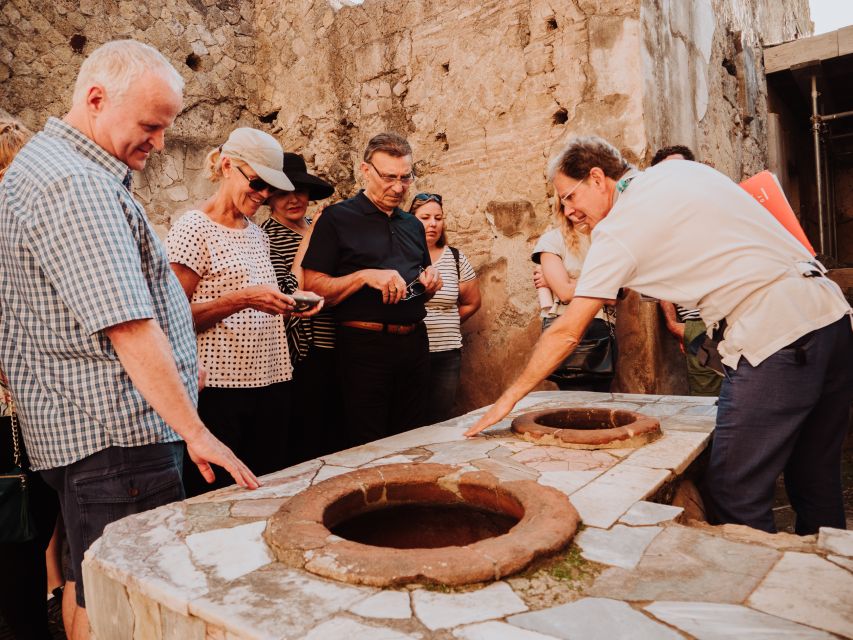
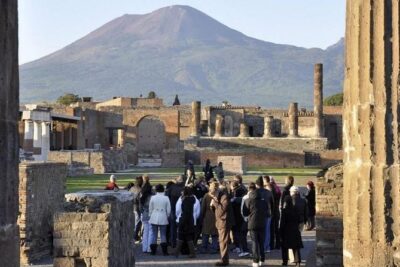
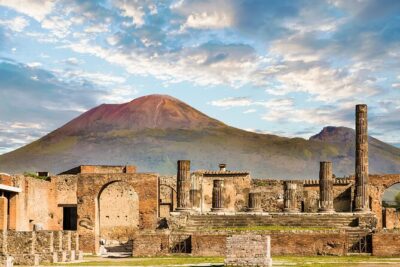
Pompeii and Herculaneum were Roman towns destroyed by the eruption of Vesuvius in 79 A.D. They were not preserved in exactly the same way, and that difference is the reason this combined tour works so well.
At Pompeii, pumice and ash covered the city to a depth of roughly four meters. The huge site gives you a sense of streets, neighborhoods, shops, public buildings, and ordinary movement through a Roman town. You can picture a place where people lived, worked, worshipped, ate, argued, and went about their business before the eruption stopped everything.
Herculaneum was covered by an avalanche of mud around 20 meters thick. That heavy, wet material sealed the town more tightly. As a result, the ruins often feel more intimate and detailed. You may see second floors, preserved wooden objects, mosaics, paintings, and carbonized timber that are less common at Pompeii.
I would not treat Herculaneum as a smaller version of Pompeii. It offers a different kind of evidence. Pompeii shows the shape of a whole city. Herculaneum lets you look more closely at the homes and possessions of wealthier Roman residents. Seeing both helps you understand why each site matters.
Other Roman sites within reach of Pompei Campania:
- Pompeii: Entry Ticket and Guided Tour with an Archaeologist
★ 4.8 · 19,459 reviews - Pompeii: Small Group Tour with an Archaeologist
★ 4.8 · 12,264 reviews - Pompeii: Skip-the-Line Entrance Ticket with Audio Guide
★ 4.0 · 2,509 reviews
Meeting at Porta Marina Inferiore
The tour begins at Piazza Porta Marina Inferiore, 1, beside the Pompeii entrance called Porta Marina Inferiore. Look for the guide on the left side of the entrance, near the Arte bus stop, holding an Askos Tours sign.
The meeting point is a few minutes from the Pompei-Villa dei Misteri Circumvesuviana station. That is useful if you arrive by local train, but allow time to get your bearings. Pompeii has several entrances and plenty of tour activity around them, so the exact spot can feel less obvious than expected.
Bring your passport or identity card. The provider asks for identification, and it is best to have it ready rather than tucked deep inside your luggage.
The tour is offered in English or Italian. If your group has more than 10 people, headsets are provided. That detail matters at a busy archaeological site, where a guide speaking beside a road or among a crowd can otherwise be difficult to hear.
Two hours inside Pompeii
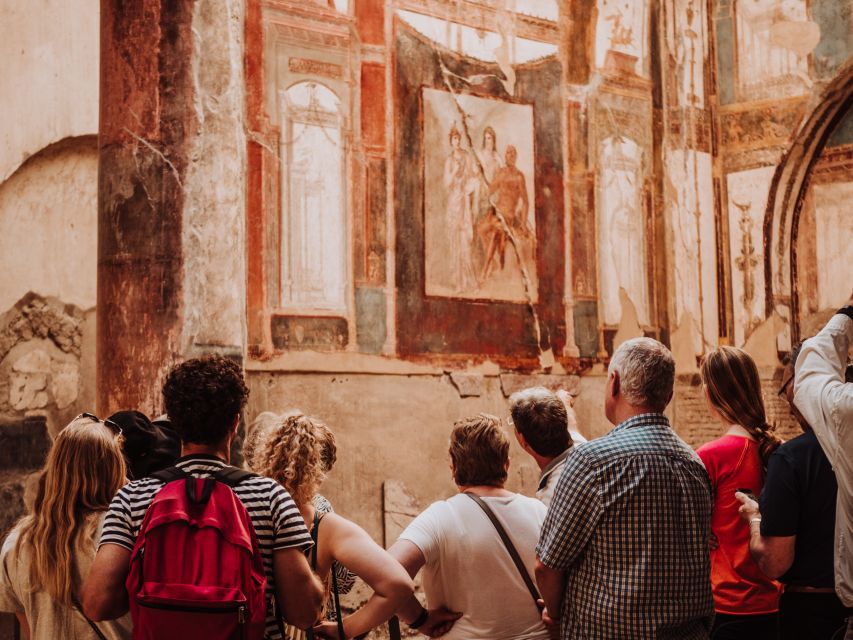
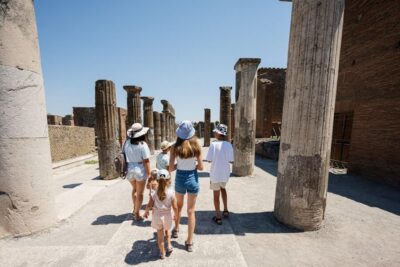
The first guided walk lasts about two hours. That is enough time for a focused introduction to the city, but not enough to cover every street and building. This is a strength for most people. Pompeii is enormous, and a guide helps you avoid spending your limited time wandering without knowing what deserves attention.
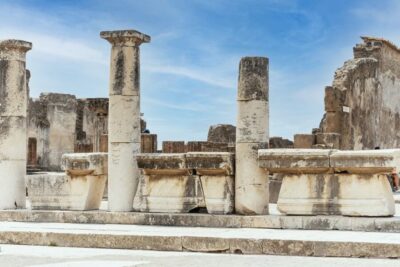
Expect your archaeologist to point out the physical clues that make the ruins understandable. A bare wall becomes part of a house. A worn street becomes evidence of Roman movement. A painted surface, shop area, or inscription begins to say something about the people who used the place.
The strongest part of the guiding is the connection between objects and daily life. Several guides, including Diego, Paulo, Antonio, Amedeo, and Vincenzo, have been singled out for making complex subjects clear and entertaining. That style suits Pompeii because the site can otherwise feel like a huge collection of broken walls.
The plaster casts are among the most emotionally difficult sights. They preserve the forms of people caught in the eruption, and seeing them in person gives the disaster a human scale. Your guide can provide historical and archaeological context, but the scene may still feel heavy. This is not a light sightseeing stop, despite the jokes and lively explanations that can make the walking easier.
The ruins are exposed to the weather. In summer, heat builds quickly over the stone streets, and shade is limited in some areas. Guides have made an effort to keep groups in the shade when possible, but you should still bring a hat, sunglasses, and water. Comfortable clothing and good shoes are essential.
The 30-minute break and the real lunch issue
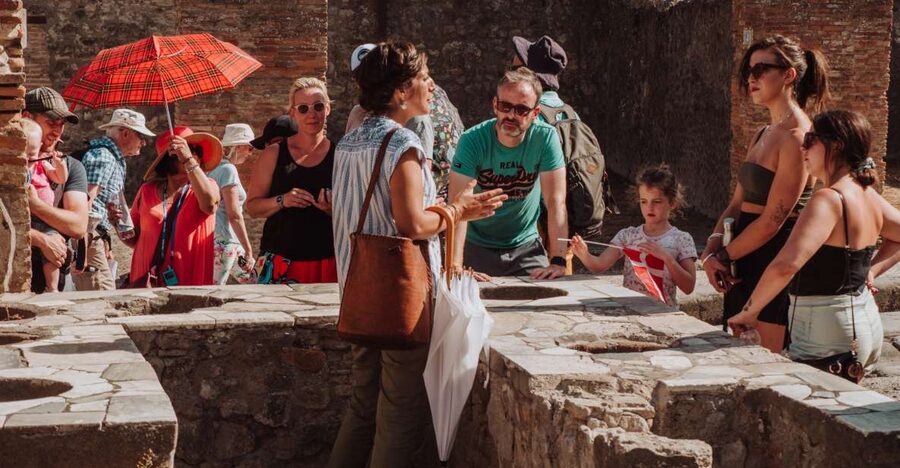
After Pompeii, the planned break is about 30 minutes. You can use it to find a quick sandwich, visit the toilet, browse souvenir shops, or catch your breath before the next site.
This is the least generous part of the schedule. After two hours of walking in sun and uneven terrain, many people will want to sit down, cool off, and eat a proper meal. Thirty minutes may cover a fast snack, but it can feel rushed if nearby restaurants are full.
I would plan for a quick lunch rather than a leisurely one. Pack something if that suits you, and keep water close. Do not count on having time for a relaxed restaurant stop. The short break also means you should use the toilet before the train transfer if needed.
The tradeoff is clear: combining both sites in 5.5 hours saves you from arranging separate visits, but the schedule has little slack. If lunch is a major part of your sightseeing day, a private tour or separate full visits may suit you better.
Same base, a different kind of day:
- Naples: Pompeii and Mt. Vesuvius with Lunch and Wine Tasting
★ 4.5 · 2,454 reviews - Pompeii: Skip-the-line-Ticket and Guided Tour
★ 4.6 · 1,152 reviews - Pompeii: Guided Tour with Skip-the-Line Entry
★ 4.9 · 812 reviews - Pompeii: Skip-the-Line Entry Ticket with Digital Guide App
★ 4.1 · 770 reviews
The Circumvesuviana ride to Ercolano
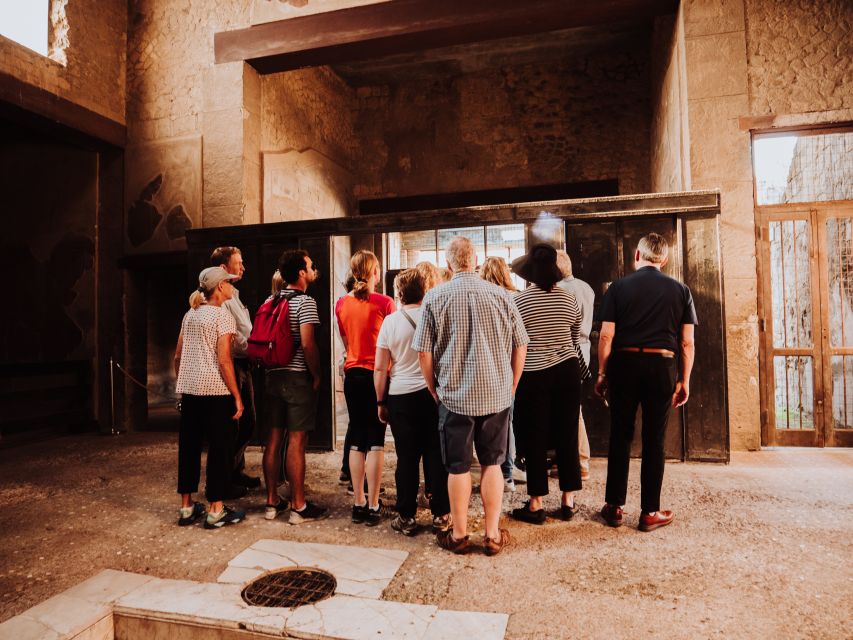
After Pompeii, the group travels by Circumvesuviana train toward Ercolano. The train ride itself is described as about 20 minutes, while the itinerary allows roughly 30 minutes for the transfer. That extra time helps cover moving from the site to the station, boarding, and getting organized as a group.
This is not a private coach transfer. Local train travel can be affected by delays, and one tour group had a longer day because of a medical emergency on the line. On another occasion, the company used a private minibus when train service caused trouble. That shows some flexibility, but you should still allow extra time if you have evening plans.
The train ride gives your guide a chance to continue the story. One guide used the journey to talk about growing up on a farm in the countryside, adding a personal connection to the modern region around Vesuvius. The ride is also a useful pause between two long site visits.
The tour does not return you to Pompeii. It ends at Parco Archeologico di Ercolano. One practical point matters here: returning from Herculaneum to Pompeii may involve the local train and a walk uphill of roughly 25 minutes, or your own rented car arrangements. If you are staying in Naples or continuing elsewhere, ending in Ercolano may be convenient. If your car or hotel is near Pompeii, plan the return before you book.
Herculaneum’s preserved homes and wooden details
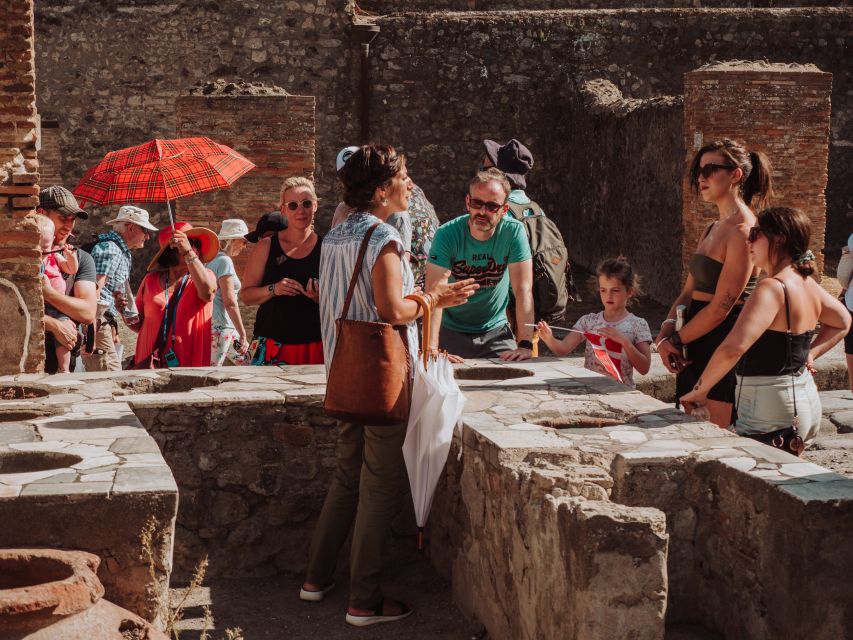
The second guided walk lasts about two hours. Herculaneum is smaller than Pompeii, so the visit feels more concentrated. You spend less time crossing a vast urban area and more time looking closely at domestic spaces and decorative details.
This is where the tour earns its place. Herculaneum’s mud burial protected features that reveal the comfort and taste of Roman homeowners. You can see intact paintings, mosaics, carbonized wooden objects, and upper levels of buildings. These details make the site feel less like a ruin and more like a paused neighborhood.
The contrast with Pompeii is especially useful. After seeing broad streets and public life at Pompeii, you can look at Herculaneum as a place of private life and wealth. The remains suggest how floors, walls, furniture, and decoration shaped the experience of a Roman home.
Guides such as Alfredo, Sergio, Paolo, and Amedeo have been praised for explaining not only what survived, but also how excavation and preservation affect what you see today. That matters because many ancient sites can look self-explanatory when they are not. A mosaic is beautiful, but the story of where it was found and how it fits into a home makes it far more meaningful.
Herculaneum can also be physically demanding. You will still walk over ancient surfaces and spend a long time on your feet. It is smaller than Pompeii, not effortless. The tour is not suitable for wheelchair users or people with mobility impairments.
What the archaeologist adds
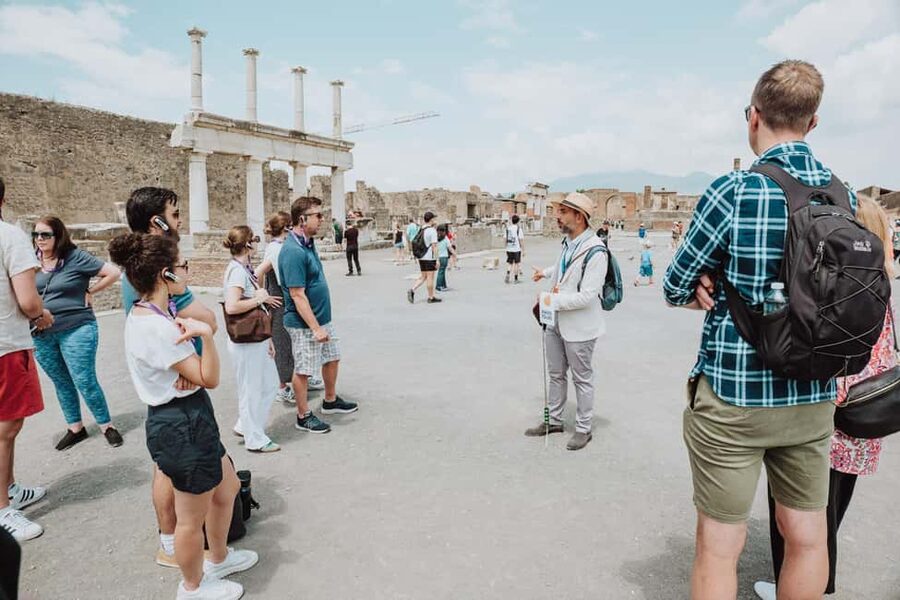
I would strongly favor a guide for these ruins. Pompeii and Herculaneum contain plenty of visual drama, but much of their meaning is not obvious from the stones alone.
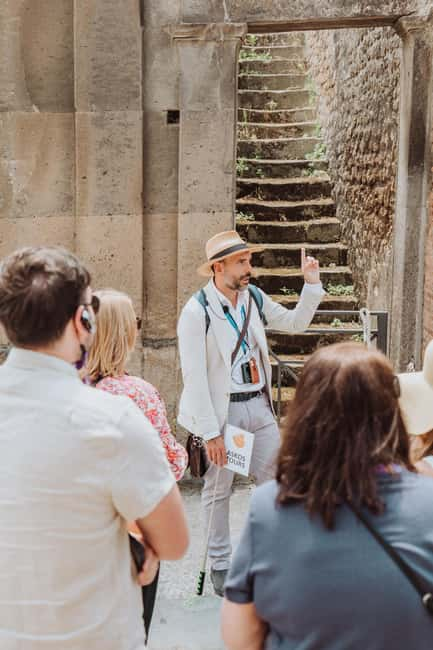
A good guide tells you where to look, then explains why it matters. You might hear about Roman household life, public customs, inscriptions, building methods, Vesuvius, or the excavation process. The best guides also leave room for questions instead of delivering one long speech.
The repeated praise for guides including Diego, Julia, Paulo, Antonio, Vincenzo, Rafael, Ricardo, and Amedeo points to the biggest strength of this tour: the human delivery. Names and guide assignments can change, so you should not book on the promise of one particular person. Still, the pattern is encouraging. Several guides are described as funny, clear, passionate, and able to answer questions with ease.
The headsets help when the group is close to the maximum of 20 people. That is not a tiny private group, but it is small enough for a guide to keep the visit organized. A group this size also moves more slowly than a couple or private party, especially at entrances, on the train, and during breaks.
Value, timing, and who should choose it
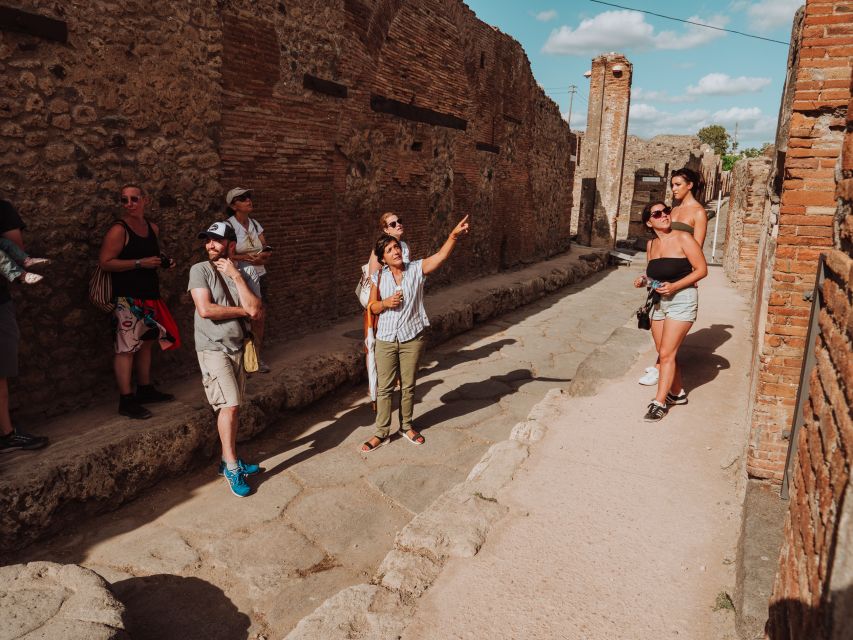
The total tour price is not provided here, so I cannot judge the exact cost against competing products. The value is easiest to understand in terms of what you receive: guided walks at both sites, admission tickets, an archaeologist guide, and the transfer between Pompeii and Herculaneum.
Herculaneum adult admission is listed at €16, while EU citizens aged 18 to 25 pay €2. The tour handles entry tickets for the two archaeological sites, which saves you from working out separate admissions and waiting in the ticket process. Check the final booking details for the complete price and inclusions.
I see good value if you are visiting from Naples, making a day trip from Rome, or have only one day for the two ruins. You get the major highlights without having to plan separate routes, interpret a huge site alone, or worry about how to move between Pompeii and Ercolano.
This tour suits you best if:
- You want historical explanation rather than a self-guided walk.
- You have a single day for both sites.
- You can manage several hours of outdoor walking.
- You are happy with a quick lunch break.
- You prefer a group tour to arranging a private guide.
You may want another format if you need a wheelchair-accessible visit, want a long lunch, dislike local trains, or prefer to explore at your own pace. A private option would give you more control over timing, though it will usually cost more.
Practical advice for a smoother visit
Wear shoes with good support. Ancient paving can be uneven, and the day involves two sites plus a station transfer. Light clothing is useful in summer, but bring a raincoat or poncho because sudden showers are possible.
Pack water, sunglasses, and a hat in warm weather. A small snack can make the short break much easier, especially if you do not want to spend your entire pause searching for food.
Meet early enough to find Porta Marina Inferiore without rushing. Look for the Askos Tours sign near the Arte bus stop, and do not assume every person holding a clipboard is your guide.
Keep your afternoon open after the tour. The scheduled duration is 5.5 hours, but train delays, group movement, and questions can stretch the day. Since the tour ends at Herculaneum rather than Pompeii, check your onward route before you start.
Should you book the Pompeii and Herculaneum tour?
I would book it if you want the clearest introduction to both sites in one day. The archaeologist guide is the main reason to choose this experience. You will see more than walls and streets because the commentary connects the remains to Roman homes, work, death, wealth, and excavation.
The short lunch break is the one real weakness. Treat it as a snack stop, bring water, and expect a full day on your feet. If you can accept that tradeoff, this is a practical way to see Pompeii’s scale and Herculaneum’s remarkable preservation without trying to solve the history on your own.
FAQ
How long does the tour last?
The scheduled duration is 5.5 hours. It includes about two hours at Pompeii, a 30-minute break, the train transfer, and about two hours at Herculaneum.
Where does the tour begin?
Meet at Piazza Porta Marina Inferiore, 1, on the left side of the Pompeii entrance called Porta Marina Inferiore. The meeting point is near the Arte bus stop.
How will I recognize the guide?
Look for a guide holding an Askos Tours sign.
Is the meeting point close to a train station?
Yes. It is a few minutes from the Circumvesuviana station called Pompei-Villa dei Misteri.
What language is the tour offered in?
The tour is available in English and Italian.
Are entry tickets included?
Entry tickets for both Pompeii and Herculaneum are provided as part of the activity.
How do I get from Pompeii to Herculaneum?
The group uses the Circumvesuviana train to Ercolano. The train ride is described as about 20 minutes, with around 30 minutes allowed for the transfer.
Where does the tour finish?
The tour finishes at Parco Archeologico di Ercolano.
Is transportation back to Pompeii included?
No. The tour ends at Herculaneum and does not provide a return to Pompeii.
Is the tour suitable for wheelchair users?
No. The activity is not suitable for wheelchair users or people with mobility impairments.
Just added in Pompei Campania
- Pompeii 3hours Villa of Mysteries tour with an Archaeologist★ 4.8 · 486 reviews
- Pompeii: Skip-the-Line Entry & Audioguide★ 3.8 · 225 reviews
- Pompeii: Skip-the-line-Ticket and Guided Tour★ 4.6 · 1,152 reviews
- Pompeii: Guided Tour with Skip-the-Line Entry★ 4.9 · 812 reviews
- Pompeii: Afternoon to Sunset Guided Tour with Ticket★ 4.9 · 484 reviews
- Pompeii: Skip-the-Line Entry Ticket with Digital Guide App★ 4.1 · 770 reviews
- Pompeii: Tour with Archaeologist Guide & Skip-the-Line Entry★ 4.5 · 478 reviews
- Pompeii: Day Tour of Pompeii and Vesuvius with Bus Transfer★ 4.2 · 250 reviews
Pompeii & Herculaneum Tours, compared.
Entry Ticket and Guided Tour with an Archaeologist
Read our review →
Pompeii and Mount Vesuvius Day Trip from Rome with Pizza Lunch
Read our review →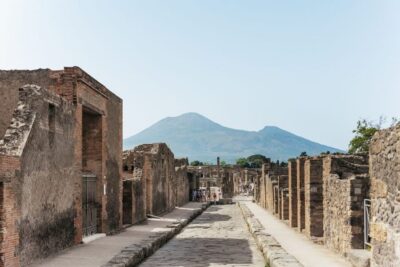
Pompeii Day Trip with Optional Vesuvius and Lunch
Read our review →Browse the lists this tour appears in