
Reviewed · HOP-ON HOP-OFF BUS TOURS
Rome:Hop-On Hop-Off Panoramic Open Bus Ticket 3 Circuits x 1
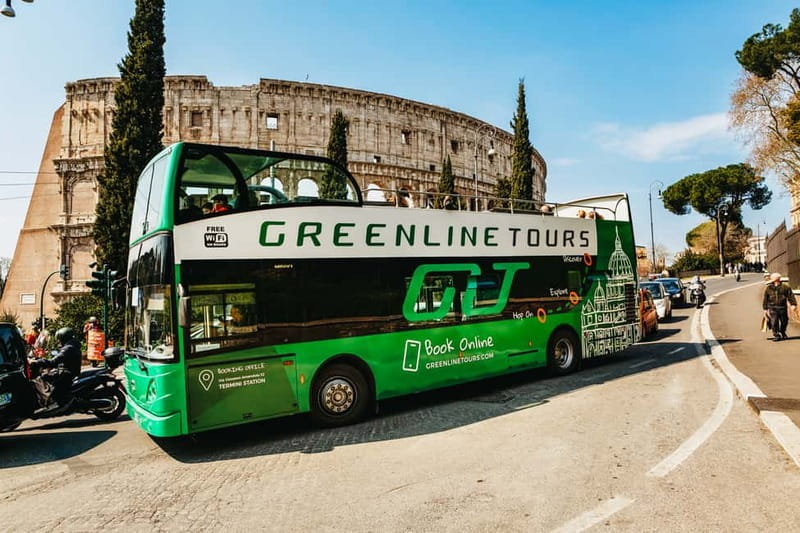
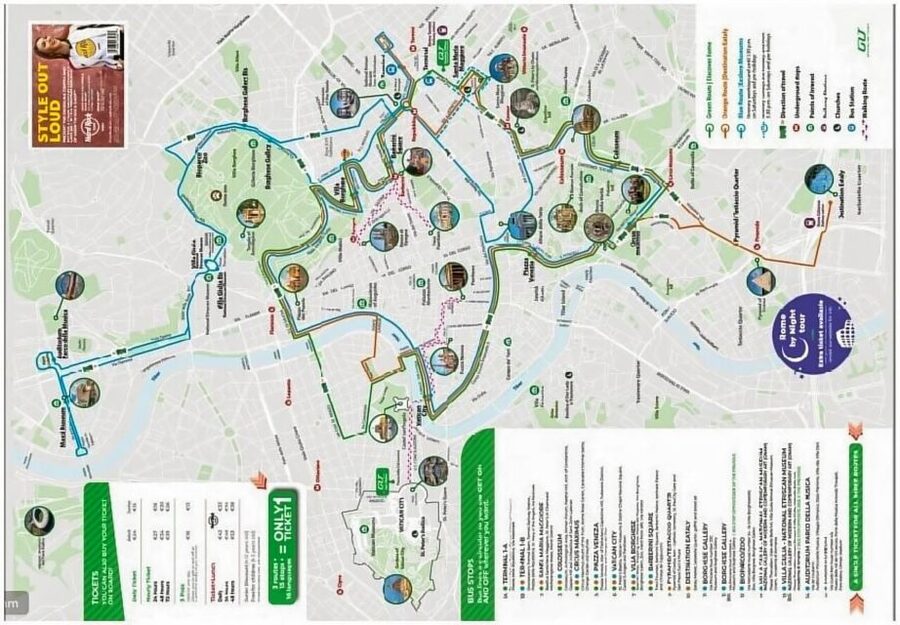
Rome is easier to understand from the upper deck of a moving bus. In one ride, you can pass the Colosseum, Circus Maximus, Piazza Venezia, Vatican City, Villa Borghese, Testaccio, and several museums without spending your first day studying a transit map. This is especially useful after a long flight or when Rome’s walking distances begin to catch up with you.
I like the wide choice of stops, including the major sights and less obvious areas such as Eataly, Garbatella, Testaccio, MAXXI, and Villa Giulia. I also like the three-route ticket, which lets you use the bus as both a sightseeing ride and a way to reach different parts of town. The main catch is that the audio can be hard to hear, and some headphone sockets may not work, so this is not a substitute for a focused guided visit inside Rome’s monuments.
Key points at a glance

- Three routes in one ticket: Use the Green, Orange, and Blue routes, with access designed for Rome’s main sights, food districts, and less visited museums.
- A strong first-day plan: The full circuit gives you a useful sense of Rome’s size and helps you decide where to return on foot.
- Buses about every 20 minutes: Waiting times are generally manageable, though traffic can affect the schedule.
- Sixteen audio languages: Commentary is available in Italian, English, French, German, Dutch, Spanish, Arabic, Chinese, Japanese, Russian, Portuguese, Hindi, Korean, Greek, Hebrew, and Polish.
- More than the usual ancient sights: Stops include Testaccio, Eataly, Villa Giulia, Auditorium Parco della Musica, MAXXI, and Bioparco.
- Good value at about $20: The ticket includes unlimited rides, Wi-Fi, live tracking, and audio, but attraction entry fees are extra.
Why a bus helps you read Rome
Rome’s famous sights are spread across a surprisingly large area. The Colosseum is not next door to St. Peter’s Basilica, and Villa Borghese, Testaccio, and the northern museum district take you well beyond the compact historic center.
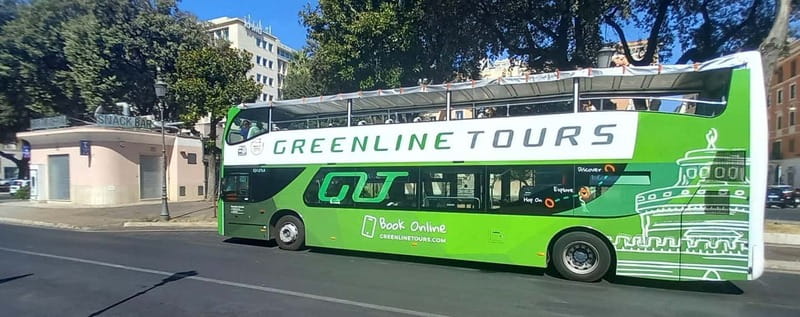
An open-top bus gives you a useful overview without asking your feet to do all the work. You can watch the city change from imperial ruins to Baroque streets, grand Renaissance buildings, busy shopping avenues, and quieter residential districts. The upper deck is best for views, but the lower deck is the sensible choice in strong sun, rain, or cooler weather.
I would use this activity early in a Rome visit. Take one full circuit first, listen to the commentary, and note the places you want to explore later. The bus does not replace walking through the Forum or standing beneath the Colosseum, but it helps you decide how to spend your limited sightseeing time.
You can board at Piazza dei Cinquecento, near the corner of Via Cavour, at Terminal 1/A. This is a practical starting point near Termini Station. The route ends back at the same general meeting point, so the ride works as a loop even if you do not get off.
Other sightseeing routes around Rome:
- Rome: City Sightseeing Hop-on Hop-off Bus with Audioguide
★ 4.0 · 16,045 reviews - City Sightseeing Rome Hop-On Hop-Off Bus Tour
★ 3.5 · 5,446 reviews - Rome: Hop-on Hop-off Sightseeing Bus Tour with Audioguide
★ 4.0 · 4,329 reviews
Green Route: Rome’s essential monuments
The Green Route is the main sightseeing circuit and the one I would choose for a first look at Rome. It passes the major ancient and religious sights, along with several central neighborhoods.
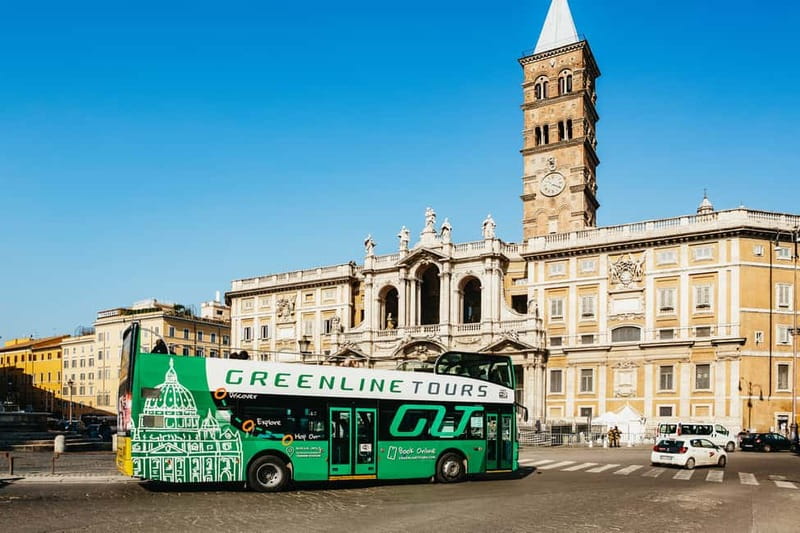
Santa Maria Maggiore is one of Rome’s major basilicas, and the stop at Piazza dell’Esquilino puts you near the church and the Esquilino district. The itinerary lists this as a pass-by point, so check the exact boarding arrangement if you plan to get off here. It is a good area to connect with Rome’s early Christian and monumental side.
The Colosseum is the headline stop. The bus approaches along Via di San Gregorio, close to the entrance to the Palatine area. From here, you can walk toward the amphitheater, the Roman Forum, and Palatine Hill. Remember that your bus ticket does not include entry to any of these sites. If you have a timed admission, allow enough time to walk from the bus stop and find the correct entrance.
Nearby Circus Maximus offers a different view of ancient Rome. The large open valley once held chariot races, and today it gives you room to appreciate the scale of the old city. The stop is at the Belvedere Romolo e Remo on Via del Circo Massimo. I like this stop as a pause between the Colosseum and central Rome, though it is less visually complete than the Colosseum because the ancient structure is mostly gone.
Piazza Venezia is another useful stop. The bus reaches Via del Teatro Marcello, near civic numbers 32 to 34. From here, you can walk toward the grand square, Capitoline Hill, the Pantheon area, and Via del Corso. It is also a handy point for exploring the historic center on foot.
Via del Corso is one of the best places to leave the bus and wander. The route description points to boutique shops, cafés, and side streets leading to small piazzas. You can walk toward the Trevi Fountain or the Spanish Steps from the central area, but keep in mind that the bus does not stop directly at every sight. The last stretch is on foot, which is part of the fun and part of the work.
Vatican City and the Baroque center
The Vatican stop is at Lungotevere Tor di Nona 7. This puts you near the river and within reach of St. Peter’s Square and St. Peter’s Basilica. The bus provides a useful approach, but it does not include basilica, Vatican Museums, or other entrance tickets.
I would not plan to see the Vatican and the Colosseum on the same tight schedule just because the bus connects them. Both areas need time, and queues or reserved entry times can shape your whole day. Instead, use the bus to reach the area, then give the Vatican a separate block of time.
Piazza Barberini, on Via Barberini, is another central stop. It works well for reaching the Spanish Steps and Trevi Fountain area on foot. The stop is valuable because Rome’s central streets can be confusing when you are trying to connect several famous sights in one walk.
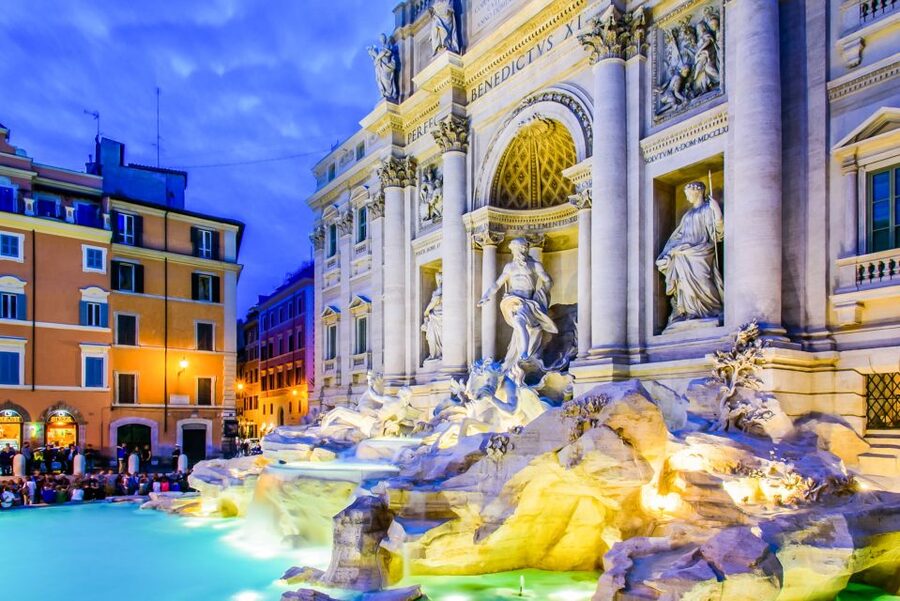
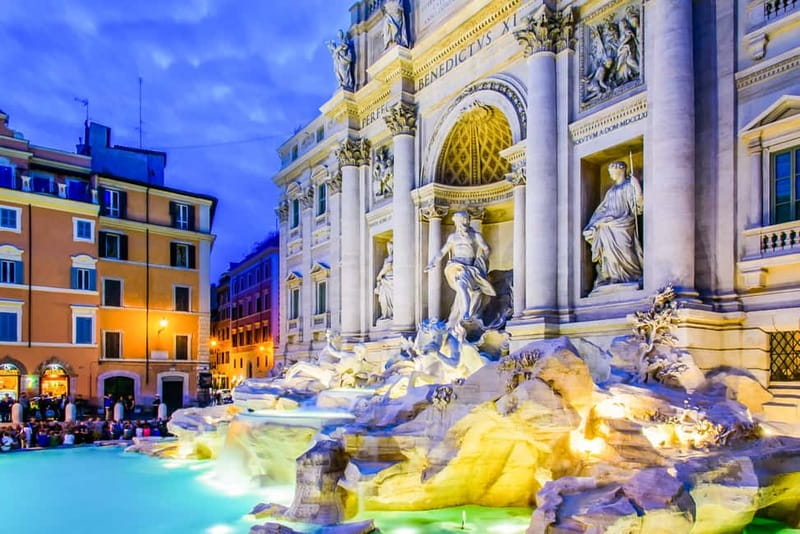
A coin toss at the Trevi Fountain may be a classic Rome ritual, but the more useful benefit of this stop is orientation. You can see how the central streets connect, then walk toward the Spanish Steps, Via del Corso, or the Pantheon area. The bus gets you close, not directly to every doorstep.
Orange Route: food, Testaccio, and Eataly
The Orange Route focuses on Italian food and districts south of the historic center. Its strongest points are the Testaccio area and Eataly.
The Pyramid and Testaccio stop is near the Pyramid of Cestius, the Non-Catholic Cemetery, the old city gate, and the route toward St. Paul Outside the Walls. Testaccio is especially useful if you want a side of Rome that feels less tied to the postcard sights. The area is linked with food and everyday city life, while the pyramid adds one of Rome’s more unusual ancient landmarks.
Eataly gives the route a modern food stop. The nearby Garbatella district and its street art add a different mood from the Colosseum and Vatican. You can use this route to break up a day of monuments with food shopping, cafés, and a look at a less formal part of the city.
This route is also a reminder that the ticket is not only for taking photographs of famous buildings. You can use it to sample different parts of Rome’s identity. The drawback is simple: if your visit is short, you may prefer to spend your limited bus time on the main Green Route and walk the center instead.
A few more things to do in Rome
- Vatican: Museums & Sistine Chapel Entrance Ticket
★ 4.5 · 144,003 reviews - Rome: Pantheon Fast-Track Ticket and Official Audio Guide
★ 4.3 · 21,008 reviews - Vatican Museums & Sistine Chapel Skip-the-Line Entry Ticket
★ 4.4 · 13,838 reviews - Rome: Vatican Museums & Sistine Chapel Skip-The-Line Ticket
★ 4.2 · 11,708 reviews
Blue Route: parks, art, and northern Rome
The Blue Route reaches several cultural stops north of the center. It is the best choice if you have already seen the basic ancient sights or if museums are high on your list.
The Borghese Gallery stop is on Via Pinciana. The gallery is known for its art collection, but entry is separate and requires its own arrangements. Villa Borghese itself is a pleasant change from traffic and stone streets, though the bus stop is not a replacement for spending time inside the park.
Bioparco di Roma is the city zoo, located on Via Mercadante. This can suit families or anyone looking for a lighter stop between churches and archaeological sites. The route also reaches Villa Giulia, near Piazza Thorvaldsen, where you can find the National Etruscan Museum and the National Gallery of Modern and Contemporary Art.
The northern stops continue to Auditorium Parco della Musica on Via de Coubertin and MAXXI on Via Guido Reni. These make the Blue Route useful for modern architecture, exhibitions, and Rome’s newer cultural side. MAXXI is particularly different from the ancient center, so I would use this circuit when you want to see how Rome extends beyond its imperial and Baroque image.
The Blue Route is less useful if you only have a few hours. It covers attractions that deserve their own time, and you may spend more time riding than exploring if you try to squeeze in every stop.
Audio commentary, Wi-Fi, and the ride itself
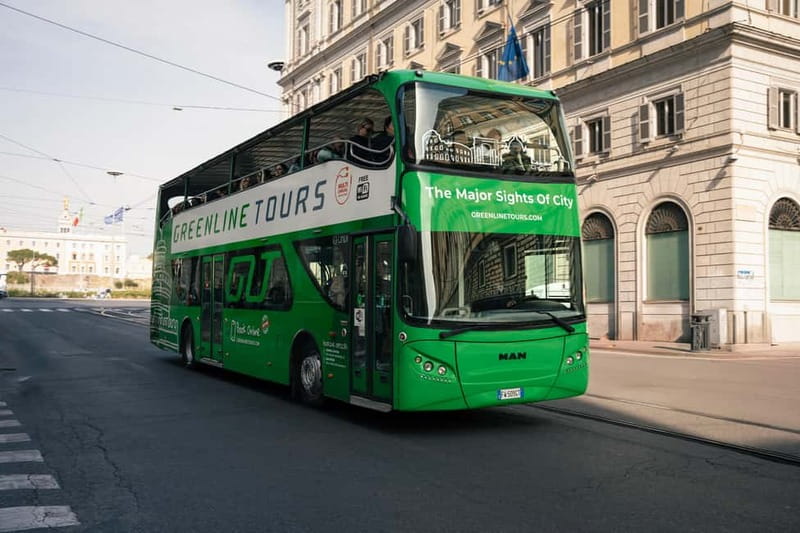
The audio guide comes in 16 languages, which is a real advantage for a mixed-language group. You can listen in English, Italian, French, German, Dutch, Spanish, Arabic, Chinese, Japanese, Russian, Portuguese, Hindi, Korean, Greek, Hebrew, or Polish.
The commentary gives you context as the bus moves past each area. It is not the same as having a guide beside you, but it helps you understand what you are seeing and gives you ideas for later stops. The audio setup is simple, with single-use earphones provided.
Sound quality is the weak spot. Some passengers have found the volume too low, especially when people nearby are talking, and some audio ports may not work. If you are sharing with a companion, bring your own compatible headphones if possible, but still expect to use the supplied system. The audio is useful, just not perfectly polished.
Free Wi-Fi and live bus tracking add practical value. The tracking feature is especially handy when you have finished at a sight and want to know how long until the next bus. The stated frequency is about every 20 minutes, although Rome traffic can change the real wait.
An onboard assistant is available, and the staff are generally part of the experience rather than just ticket checkers. Keep the original booking available on your phone. A screenshot is not accepted.
How to get the best value from a $20 ticket
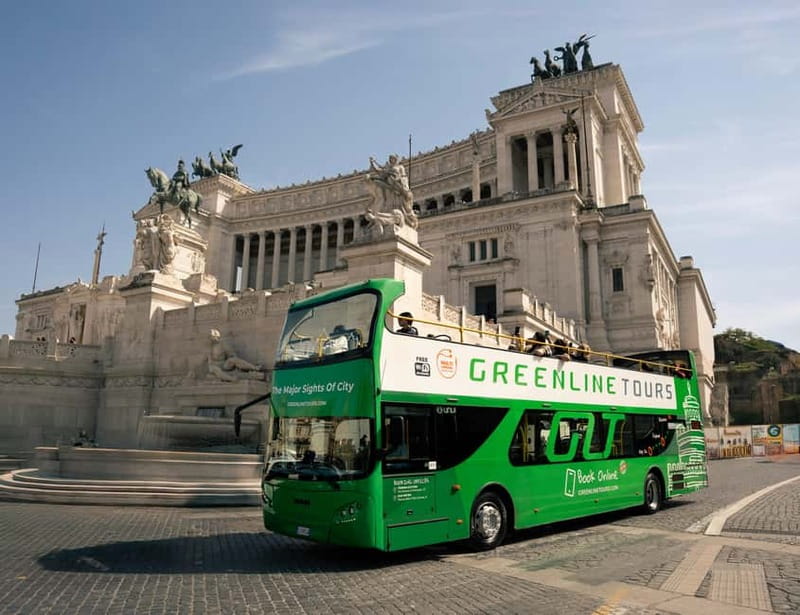
At around $20 per person, the ticket is good value if you use it more than once. A single ride gives you an overview, but repeated boarding is where the pass earns its keep.
For a 9-hour option, I would choose two or three priority stops and avoid trying to cover the entire city. A 24-hour ticket gives you more breathing room and is likely the best fit for most short visits. The 48-hour and 72-hour choices make sense if you want to use the bus as occasional transport between walking days, museum visits, and major landmarks.
The pass is particularly useful for:
- A first day in Rome, when you want to understand the layout.
- Families who need regular seated breaks.
- Anyone who wants to limit long walks between distant sights.
- Visitors staying near Termini who want a simple starting point.
- People interested in both famous monuments and districts such as Testaccio or Garbatella.
It is less useful if you plan to spend the whole day inside one museum, have already mapped Rome well, or prefer public transport for direct point-to-point journeys. It also does not pay for entry to attractions, meals, drinks, or special guided visits. Think of it as a moving city introduction and a flexible transport option, not a complete sightseeing package.
Practical details before you board
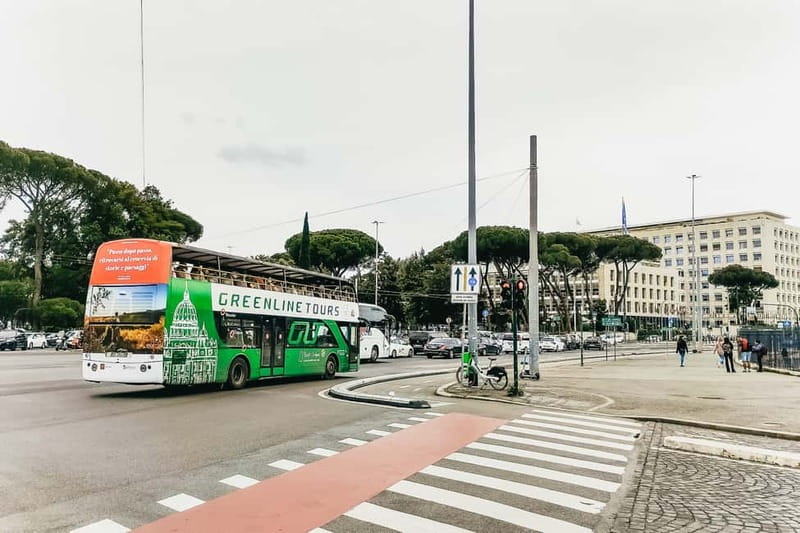
Wear comfortable shoes even though you will be sitting for part of the day. Most stops require walking to the sight, and Rome’s streets are not kind to tired feet. Sunglasses and a sun hat are sensible on the open upper deck.
Large bags and luggage are not allowed, and pets are not permitted except for assistance dogs. Alcohol, drugs, explosive substances, and alcoholic drinks on the vehicle are also prohibited.
The activity is not suitable for wheelchair users. If accessibility is important for your plans, confirm your transport choices before booking rather than assuming the open-top format will meet your needs.
Free cancellation is available up to 24 hours before the activity for a full refund, and you can reserve now and pay later. The ticket is valid from the time you first validate it, for the period you choose: 9 hours, 24 hours, 48 hours, or 72 hours.
Should you book the Rome hop-on hop-off bus?
I would book it for a first day, a short Rome visit, or a trip that includes children, older relatives, or anyone who needs regular breaks. The combination of major sights, Testaccio, Eataly, parks, and museums gives you more range than a basic ancient-monuments loop.
Choose the 24-hour option if you want the best balance of flexibility and price. Use the first circuit to get oriented, then hop off at the Colosseum, Vatican, Piazza Venezia, or Villa Borghese when you are ready to explore.
Skip it if you want a detailed personal guide, need wheelchair access, or intend to visit only one neighborhood. The audio may be faint, the traffic can slow the route, and attraction tickets are not included. For everyone else, this is a practical way to see Rome’s scale, rest your feet, and build a better plan for the days ahead.
FAQ
Where does the Rome hop-on hop-off bus start?
The Green Line Tours route starts at Piazza dei Cinquecento, on the corner of Via Cavour, at Terminal 1/A.
Where does the activity end?
The route returns to the starting point at Piazza dei Cinquecento and Via Cavour.
How long is the ticket valid?
You can choose a ticket valid for 9 hours, 24 hours, 48 hours, or 72 hours after you first validate it.
How often do the buses run?
Buses are scheduled approximately every 20 minutes.
Which languages are available for the audio guide?
The audio guide is available in Italian, English, French, German, Dutch, Spanish, Arabic, Chinese, Japanese, Russian, Portuguese, Hindi, Korean, Greek, Hebrew, and Polish.
Which routes are included?
The ticket includes access to the Green Route, Orange Route, and Blue Route.
Are attraction entrance tickets included?
No. Entrance tickets for places such as the Colosseum, Vatican attractions, museums, and other sites are not included.
Is Wi-Fi available on the bus?
Yes. Free Wi-Fi is included onboard, along with live bus tracking.
Can I bring luggage or large bags?
No. Luggage and large bags are not allowed on the bus.
Is the tour suitable for wheelchair users?
No. The activity is listed as not suitable for wheelchair users.
Just added in Rome
- Civitavecchia Private Transfer: From the Port to Rome Airport★ 5.0 · 309 reviews
- Civitavecchia Shore Excursion: Best of Rome Private Tour★ 5.0 · 247 reviews
- Civitavecchia Private Transfer from ship to FCO airport or Rome★ 5.0 · 245 reviews
- Food Tasty and History Tour in Civitavecchia★ 5.0 · 256 reviews
- Palatine Hill and Roman Forum Tour with Fast-Track Entrance★ 4.2 · 417 reviews
- Tivoli: Villa D’Este & Villa Adriana Pass & App Audioguide★ 4.4 · 364 reviews
- Tivoli: Villa D’Este Entry Ticket and App Audio Guide★ 4.3 · 191 reviews
- Vatican Museums & Sistine Chapel Skip-the-Line Guided Tour★ 4.6 · 254 reviews
Hop-On Hop-Off Bus Tours, compared.

City Sightseeing Hop-on Hop-off Bus with Audioguide
Read our review →
Hop-on Hop-off Bus Tour: 24, 48 or 72-Hour Ticket
Read our review →
City Sightseeing Hop-On Hop-Off Bus with Audio Guide
Read our review →
City Sightseeing Rome Hop-On Hop-Off Bus Tour
Read our review →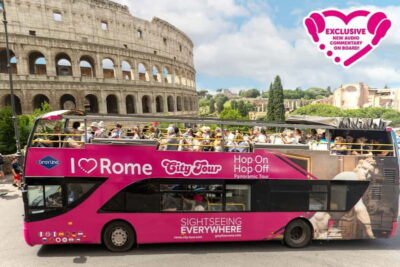
Hop-on Hop-off Sightseeing Bus Tour with Audioguide
Read our review →
Stresa: 3 Borromean Islands Hop-On Hop-Off Boat Tour
Read our review →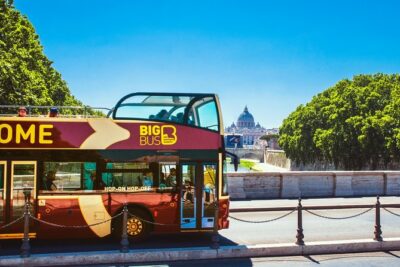
Big Bus Hop-on, Hop-off Open-Top Sightseeing Tour
Read our review →
Gray Line Milan Open Tour Hop-On Hop-Off Bus Tour
Read our review →Browse the lists this tour appears in