

Reviewed · HOP-ON HOP-OFF BUS TOURS
Rome: City Sightseeing Hop-on Hop-off Bus with Audioguide
Rome reveals itself well from the upper deck of an open-top bus. You get quick views of the Colosseum, Vatican, Spanish Steps, and grand piazzas without wrestling with a city map every few minutes. The full loop takes about 100 minutes, so you can stay aboard for a useful first look at the city or jump off and explore.
I like the flexibility of the 24, 48, and 72-hour passes, especially if you are still finding your bearings. I also like that the Jubilee Line is included, giving you another way to cover Rome. The main catch is that traffic, street closures, and special events can change the route, and the audio commentary may occasionally cut short.
Key points at a glance
- A 100-minute full loop gives you a quick overview without leaving the bus.
- Eight main hop-on, hop-off stops put you near major sights from Santa Maria Maggiore to the Vatican.
- The Jubilee Line is included, a useful extra for seeing more of central Rome.
- Audio commentary comes in eight languages, with headphones supplied on the open bus.
- The starting price is $15 per person, but the best value depends on how long you use the pass.
- A 1 Loop ticket is not hop-on, hop-off, so choose the ticket type carefully.
Why an open-top bus works in Rome
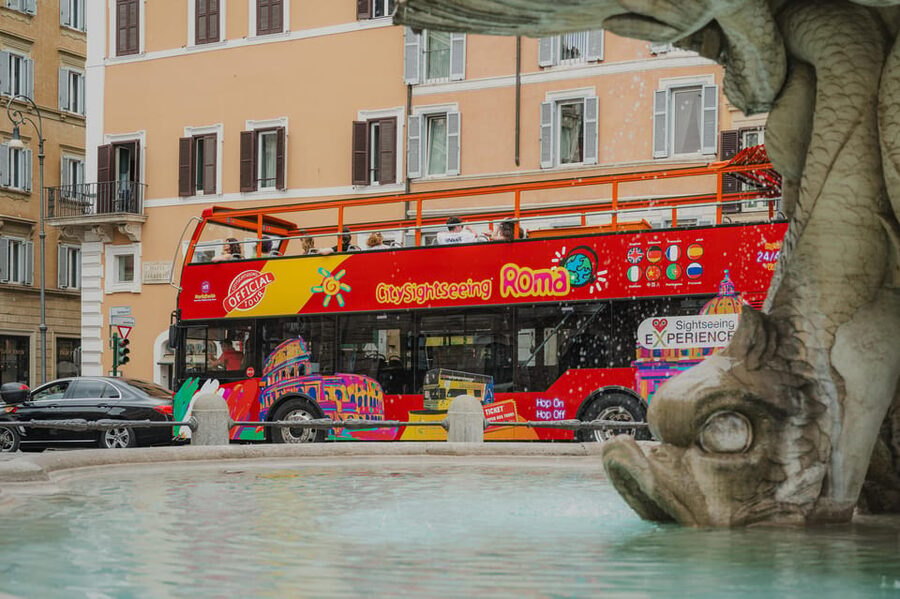
Rome is spread across several hills and historic districts. Its headline sights are not all within one easy walking circuit, and a day spent crossing the city on foot can use up more energy than you expect.
This bus gives you a practical first layer of Rome. You can see how the Colosseum relates to Piazza Venezia, how the Vatican sits across the river from the old center, and how the Spanish Steps and Piazza Barberini fit into the northern part of the route.
The open upper deck is the main attraction. You get a better view of facades, monuments, domes, and streets than you would from a regular city bus. On the other hand, Rome traffic can slow the ride, and the upper deck offers little protection from strong sun or bad weather.
I would use the bus as a sightseeing and orientation tool, not as a replacement for walking. The best Rome days mix both. Ride a full loop first, note the places you want to explore, then use the pass to return to selected stops.
Other sightseeing routes around Rome:
- Rome:Hop-On Hop-Off Panoramic Open Bus Ticket 3 Circuits x 1
★ 4.0 · 15,405 reviews - City Sightseeing Rome Hop-On Hop-Off Bus Tour
★ 3.5 · 5,446 reviews - Rome: Hop-on Hop-off Sightseeing Bus Tour with Audioguide
★ 4.0 · 4,329 reviews
Starting at Via Marsala near Termini
The listed starting point is Via Marsala, 7, close to Roma Termini. You can also begin at any stop on City Sightseeing Rome Line A, which makes the ticket more useful if you are already near another part of the center.
Starting near Termini is convenient for many visitors arriving by train. It also places you close to Santa Maria Maggiore, one of Rome’s important basilicas, though the bus passes by rather than providing an attraction entry.
If you board at another stop, check the route direction and the next bus before you get off. The whole loop takes around 100 minutes, and waiting for a later bus can affect how much time you have for sightseeing.
The ticket choices need attention. A 1 Loop ticket lets you ride the circuit once, but it is specifically not a hop-on, hop-off tour. The 1 day, 24-hour, 48-hour, and 72-hour options are the ones to consider if you want to leave the bus, visit an area, and continue later.
Santa Maria Maggiore and San Giovanni in Laterano
The first section passes Basilica Papale di Santa Maria Maggiore and Basilica di San Giovanni in Laterano. Both are major religious landmarks, and their position near the beginning of the route gives you an early sense of Rome’s scale and variety.
Santa Maria Maggiore is one of the city’s best-known basilicas, with a grand exterior that works well from the upper deck. San Giovanni in Laterano adds another major church to the route, showing that Rome’s religious story extends well beyond the Vatican.
The limitation is simple: these are pass-by views. If you want to go inside, you must get off and allow time for your visit. The bus is useful for deciding which sights deserve a closer look, but it does not include attraction tickets.
The Colosseum and Circus Maximus

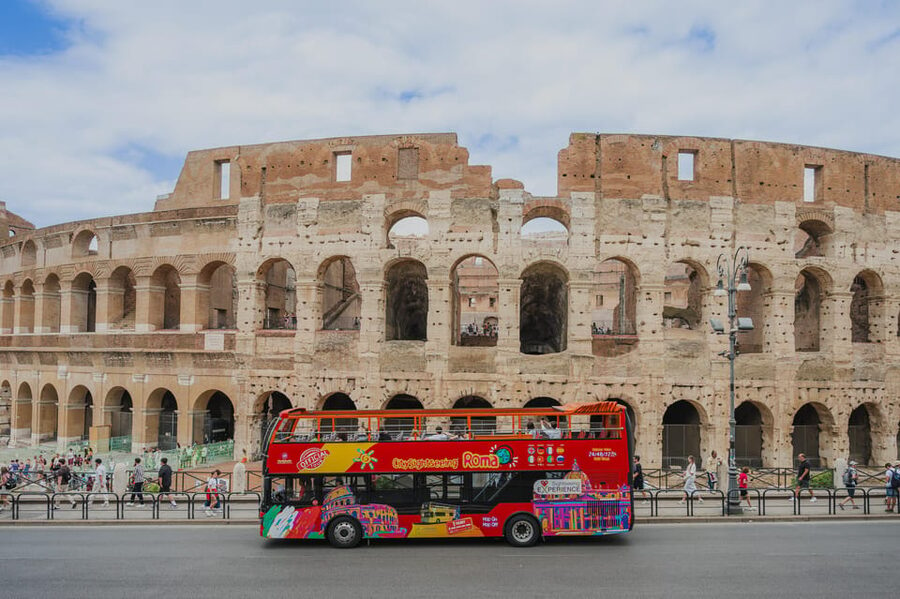
The Colosseum is the route’s big visual moment. Even from the bus, you get a strong view of the ancient amphitheater and a chance to photograph it without committing to an entry time.
The route also passes Circus Maximus, the long open site once used for chariot racing. It can be harder to read from a moving bus because the remains are less visually complete than the Colosseum, but the stop helps you understand how much open space existed at the heart of ancient Rome.
One practical warning matters here: the route may not always allow a Colosseum stop. Special events and local traffic controls can change the service, and one recent ride was enjoyable despite the disappointment of not being able to get off there. If entering the Colosseum is a priority, arrange a separate attraction ticket and confirm the current bus route rather than relying on the sightseeing bus alone.
The bus does not include admission to the Colosseum or any other attraction. Think of this part as a convenient way to reach the area and see the monument from outside.
A few more things to do in Rome
- Rome: Fettuccine Pasta Cooking Class in Rome’s City Center
★ 4.8 · 2,414 reviews - Vatican City: Vatican Museums & Sistine Chapel Entry Ticket
★ 4.3 · 2,185 reviews - Rome: City Highlights Open-Top Bus Night Tour
★ 4.1 · 2,038 reviews - Rome City Small Group Bike Tour with quality Cannondale EBike
★ 5.0 · 1,380 reviews
Piazza Venezia and Largo di Torre Argentina
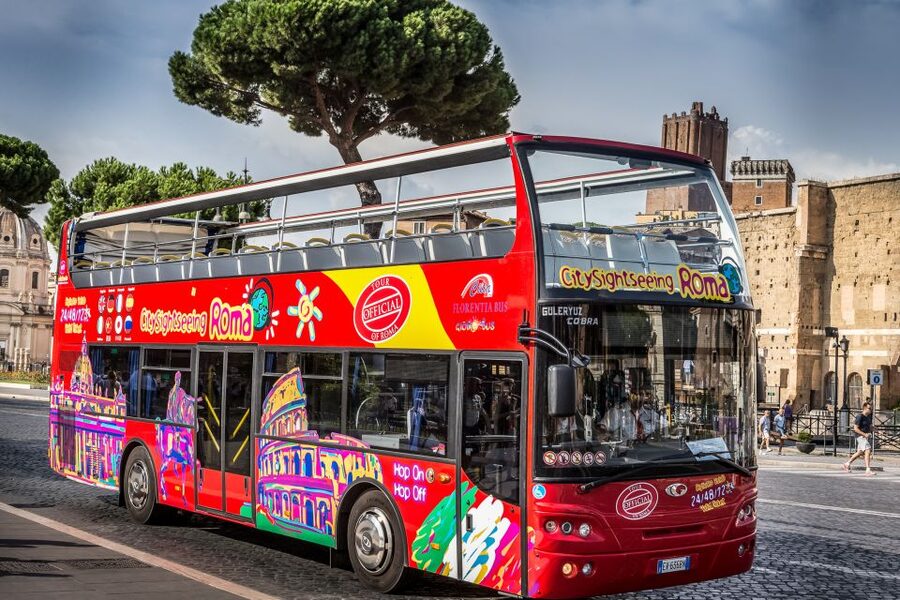
Piazza Venezia brings you into one of Rome’s most imposing central spaces. The broad piazza and monumental architecture make a strong contrast with the narrow lanes and smaller squares elsewhere in the city.
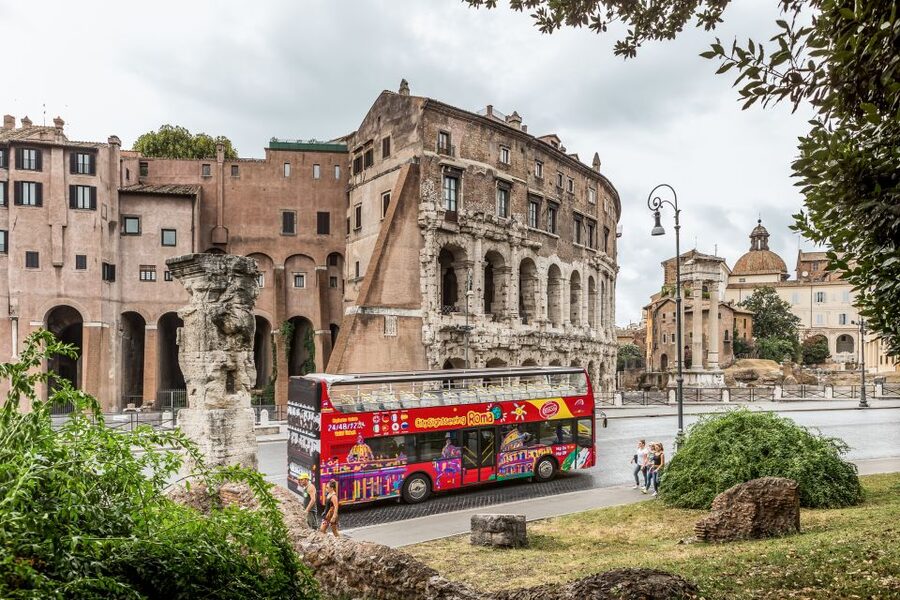
Next comes Largo di Torre Argentina, an archaeological area with ancient ruins in the middle of the modern city. From the bus, you get the useful Rome experience of seeing layers of history sharing the same streets.
These stops are good places to combine bus sightseeing with a walk. Piazza Venezia connects naturally with several central areas, while Largo Argentina is close to the historic center. Still, do not assume every named location is a separate formal bus stop. The route lists several nearby landmarks, but the operating service uses a smaller number of main stops.
Piazza Navona and Vatican City
Piazza Navona is one of the most rewarding places to leave the bus. Its broad shape, fountains, and surrounding buildings make it easy to explore on foot, and it offers the kind of people-watching and café pause that a bus tour cannot provide.
The route then continues toward Vatican City, with the bus passing near Castel Sant’Angelo. This is a useful approach to St. Peter’s Basilica and the Vatican area, but the ticket does not include entry to either the basilica or the Vatican Museums.
Use the bus to reach the area, then plan your walking time carefully. Vatican City can take far longer than a quick photo stop, especially if you have a scheduled attraction visit. The bus gives you transport and a view, but it does not solve the need for separate admission planning.
The route’s Vatican stop is listed as Vatican City, with Castel Sant’Angelo identified as the nearby point. That makes the stop especially useful for seeing two major sights in the same general area.
Villa Borghese, the Spanish Steps, and Trevi Fountain
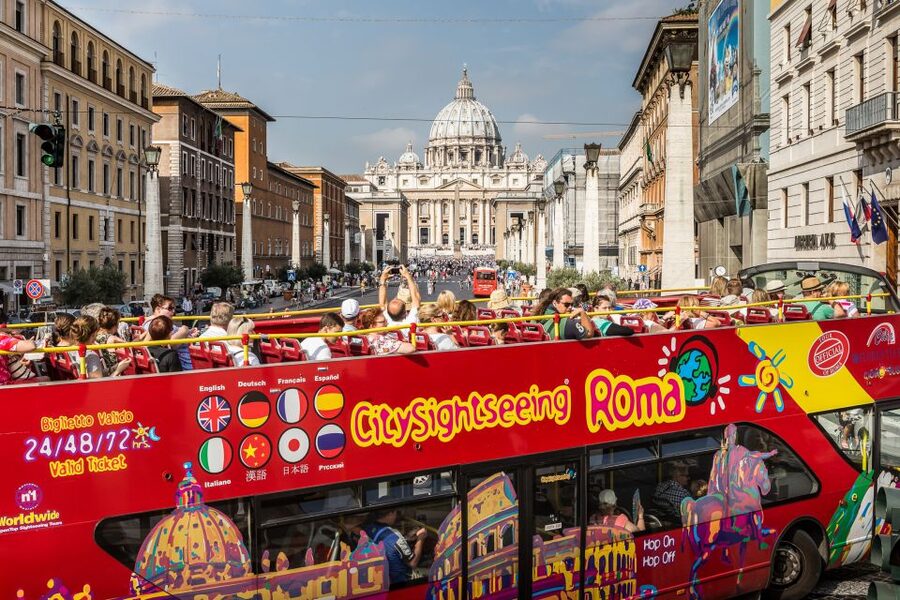
The northern section passes Villa Borghese and reaches Piazza di Spagna, close to the Spanish Steps and the Trevi Fountain. This is one of the most attractive stretches for an upper-deck ride because the route links parks, grand streets, fountains, and busy central squares.
Villa Borghese gives you a change of pace from the stone-heavy center. If you get off here, you can explore the park area before continuing toward Piazza di Spagna.
The Spanish Steps and Trevi Fountain are listed together under the Piazza di Spagna area. That does not mean the bus stops directly beside both monuments. You should expect some walking, and the route may be affected by street controls in this heavily visited part of Rome.
This is also an area where the bus may be most useful for saving your legs. You can explore the steps and fountain on foot, then use the next bus to avoid walking all the way back toward Termini.
Piazza Barberini and the return to Termini

Piazza Barberini is another central stop, near the upper end of the historic center. It links the route toward the Spanish Steps with the return journey to Roma Termini.
The final portion passes back through the central city before arriving at Via Marsala. If you stay aboard for the complete loop, this last section completes the broad picture of Rome. If you are using a 24-hour or longer pass, you can also treat Termini as a practical reset point before starting another ride.
A full loop is especially useful on your first day. You can see the main sequence of sights, listen to the commentary, and decide which sections deserve more time. On later rides, hop off only where you have a clear plan.
The Jubilee Line adds useful flexibility
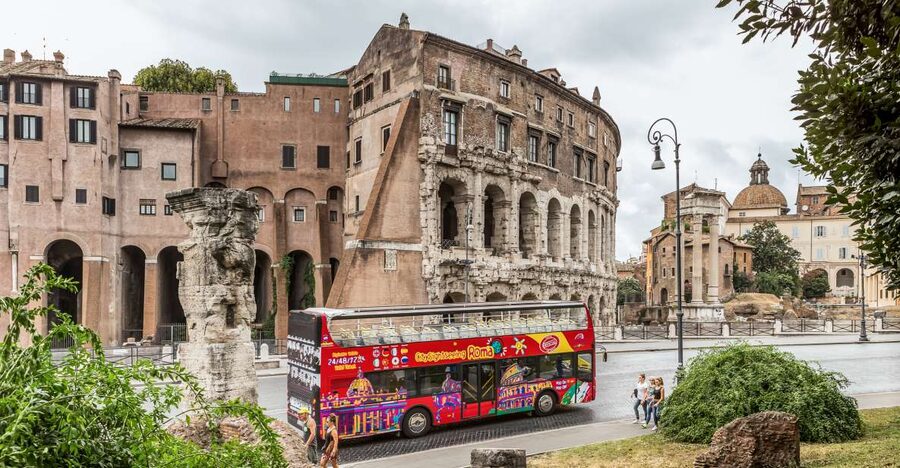
The Jubilee Line is included with this City Sightseeing ticket and is operated by Vatican & Rome Open. It is an important extra because it gives you another route option beyond the main Line A circuit.
The supplied information does not give a full Jubilee Line stop list, so I would check the current map and timetable before planning a specific connection. The route can change, and some stops are not guaranteed during special events.
The inclusion still improves the value of the pass. If you buy a longer ticket and use both available routes, you can cover more of Rome without paying separately for another sightseeing circuit. Just remember that different-colored buses or routes may operate, so confirm that the bus you board accepts your City Sightseeing ticket.
Audio commentary, Wi-Fi, and the sightseeing app
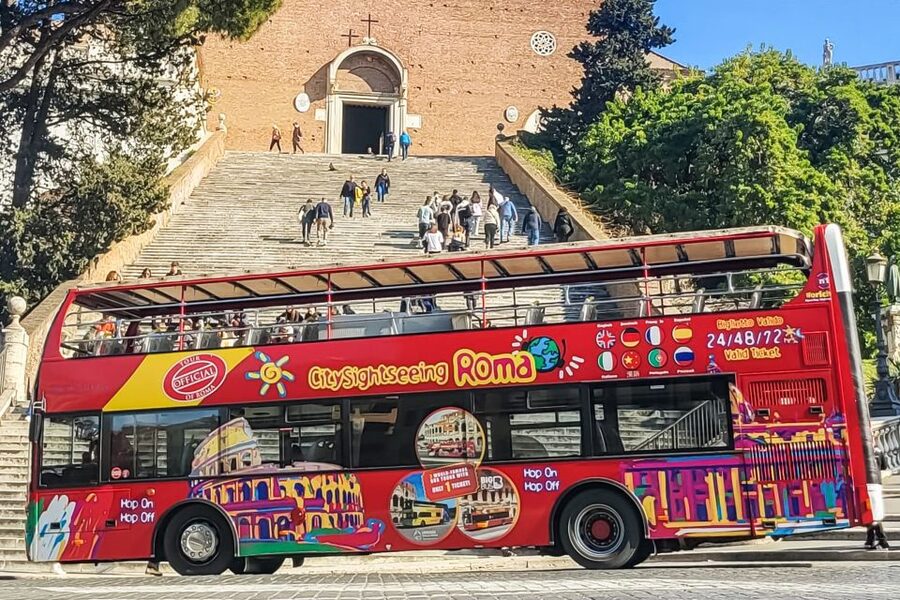
The open bus includes headphones, Wi-Fi, and audio commentary in Spanish, Chinese, English, French, German, Italian, Russian, and Portuguese. The sightseeing app is included as another way to support your route planning.
The commentary adds context while you look at the city, which is useful when a monument passes quickly. It also lets you enjoy the ride without hiring a private guide or joining a fixed walking group.
The audio is not flawless. Commentary can be interrupted or fail to finish before the bus moves on, so I would not rely on it for every historical detail. Treat it as a helpful soundtrack rather than a complete guidebook.
There are no named personal guides for this experience. It is a self-guided bus tour, with recorded information and the driver handling the route. That makes it easy to use, but less personal than a small walking tour.
Is $15 good value?
The advertised price is $15 per person, with ticket lengths ranging from a single loop to 1 day, 24 hours, 48 hours, or 72 hours. Since the price can depend on the option and date, check the exact ticket before booking.
A single loop can make sense if you have very little time and mainly want a broad view. It is not a hop-on, hop-off product, so do not choose it if you expect to get off repeatedly.
The longer passes offer better value when you plan to use the bus as transport between several walking stops. A 48-hour ticket is particularly practical if you want to spend one day seeing the full route and another day returning to the Vatican, Colosseum area, or Spanish Steps.
The value drops if you remain seated for only part of one ride and do not use the extra route. Traffic can also reduce the number of stops you manage in a day. Your best savings come from using the pass between distant areas rather than taking it for a short ride that you could easily walk.
Who should book this Rome bus tour?
I would recommend it to first-time visitors, families, people with limited time, and anyone who wants a gentle overview before tackling Rome on foot. It is also useful if you prefer to choose your stops as you go rather than follow a fixed group itinerary.
It suits visitors who like flexibility more than detailed guiding. The 48-hour and 72-hour options give you room to pause for meals, explore a basilica, and return to the bus later.
I would be more cautious if you want guaranteed direct access to every major monument. The route can change, the Colosseum stop may not always be available, and attraction entry is not included. A walking tour or public transport plan may work better for a focused visit inside the sights.
Free cancellation up to 24 hours before the activity and reserve-now, pay-later booking make planning less risky. Still, check the current operating details because special events can alter stops and route times.
Should you book it?
Book this tour if you want a simple way to see Rome’s main sights, save your legs between distant areas, and keep your schedule loose. The strongest choice for most people is a 24-hour or 48-hour pass, since a single loop does not allow hopping off.
Do not book it as your only sightseeing plan. Use it to understand Rome’s layout, then spend real time on foot at Piazza Navona, the Vatican area, the Colosseum, the Spanish Steps, and the nearby streets. That combination gives you the bus’s broad view and Rome’s close-up character.
FAQ
Where does the Rome hop-on, hop-off bus start?
The listed starting point is Via Marsala, 7, near Roma Termini. You can also start at any stop on City Sightseeing Rome Line A.
How long does the full bus loop take?
The full loop takes about 100 minutes.
Is the tour really hop-on, hop-off?
The 1 day, 24-hour, 48-hour, and 72-hour tickets are hop-on, hop-off options. The 1 Loop ticket is not a hop-on, hop-off tour.
How many main stops are available?
The route has eight main stops, with nearby landmarks including Santa Maria Maggiore, the Colosseum, Piazza Navona, Vatican City, Piazza di Spagna, and Piazza Barberini.
Is the Colosseum entrance included?
No. The bus ticket does not include attraction tickets, including entry to the Colosseum.
Is the Vatican entrance included?
No. The bus passes near Vatican City and Castel Sant’Angelo, but attraction admission is not included.
What languages are available for the audio guide?
Audio commentary is available in Spanish, Chinese, English, French, German, Italian, Russian, and Portuguese.
Are headphones provided?
Yes. Headphones are included on the open bus.
Is Wi-Fi available?
Yes. Wi-Fi is included on the open bus.
Is the Jubilee Line included?
Yes. The Jubilee Line, operated by Vatican & Rome Open, is included with the City Sightseeing ticket.
Can the route change?
Yes. Special events can change the route, and some stops may not be guaranteed.
Just added in Rome
- Civitavecchia Private Transfer: From the Port to Rome Airport★ 5.0 · 309 reviews
- Civitavecchia Shore Excursion: Best of Rome Private Tour★ 5.0 · 247 reviews
- Civitavecchia Private Transfer from ship to FCO airport or Rome★ 5.0 · 245 reviews
- Food Tasty and History Tour in Civitavecchia★ 5.0 · 256 reviews
- Palatine Hill and Roman Forum Tour with Fast-Track Entrance★ 4.2 · 417 reviews
- Tivoli: Villa D’Este & Villa Adriana Pass & App Audioguide★ 4.4 · 364 reviews
- Tivoli: Villa D’Este Entry Ticket and App Audio Guide★ 4.3 · 191 reviews
- Vatican Museums & Sistine Chapel Skip-the-Line Guided Tour★ 4.6 · 254 reviews
Hop-On Hop-Off Bus Tours, compared.

Hop-on Hop-off Bus Tour: 24, 48 or 72-Hour Ticket
Read our review →
City Sightseeing Hop-On Hop-Off Bus with Audio Guide
Read our review →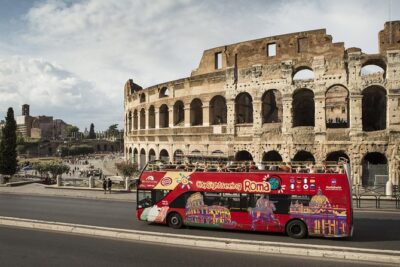
City Sightseeing Rome Hop-On Hop-Off Bus Tour
Read our review →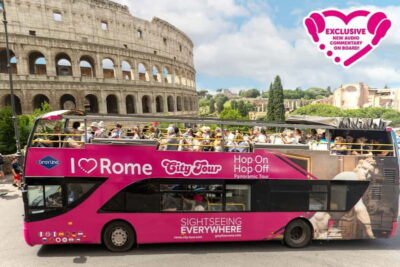
Hop-on Hop-off Sightseeing Bus Tour with Audioguide
Read our review →
Stresa: 3 Borromean Islands Hop-On Hop-Off Boat Tour
Read our review →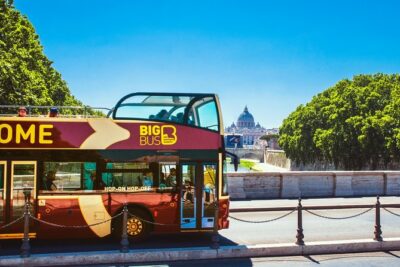
Big Bus Hop-on, Hop-off Open-Top Sightseeing Tour
Read our review →
Gray Line Milan Open Tour Hop-On Hop-Off Bus Tour
Read our review →Browse the lists this tour appears in