
Reviewed · MUSEUMS
Rome: Leonardo da Vinci Exhibition Entrance Ticket
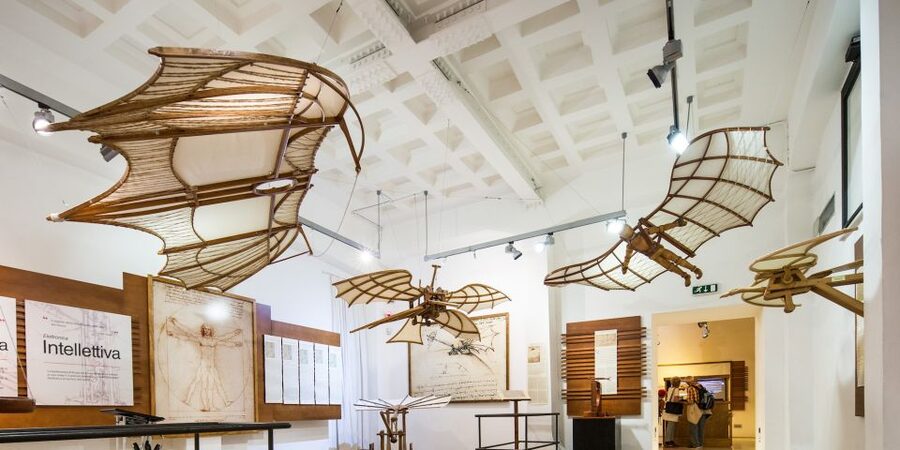
Leonardo da Vinci’s drawings can seem almost magical on paper, but this Rome exhibition gives them gears, wings, pulleys, bridges, and moving parts. At Palazzo della Cancelleria, you can handle many full-scale models and see how his ideas worked, not just admire them behind glass.
I like the hands-on design, especially the chance to build a version of Leonardo’s bridge. I also like the mix of engineering, art, science, and military design, plus the cool underground rooms, which offer a welcome break from Rome’s summer heat. The main drawback is its modest size: many visitors finish in 45 to 60 minutes, though careful readers can spend closer to two hours.
Key points before you go
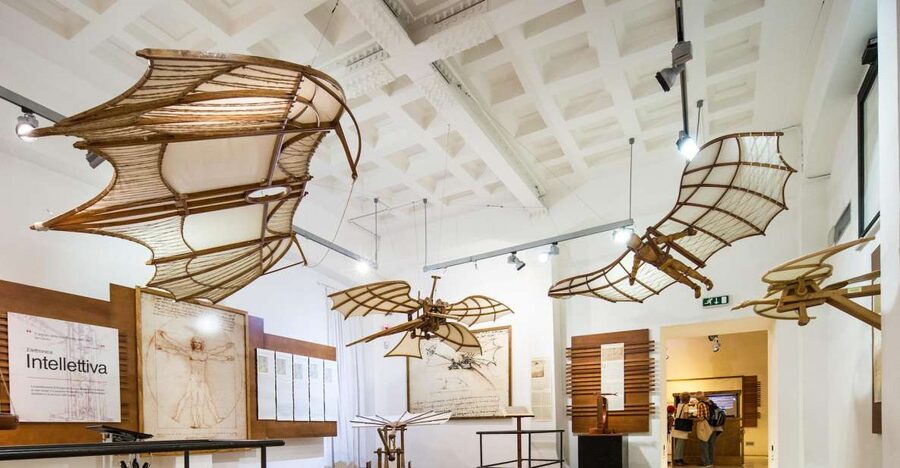
- Sixty-five full-scale machines: See working models based on Leonardo’s drawings, including flying machines, instruments, military designs, and water studies.
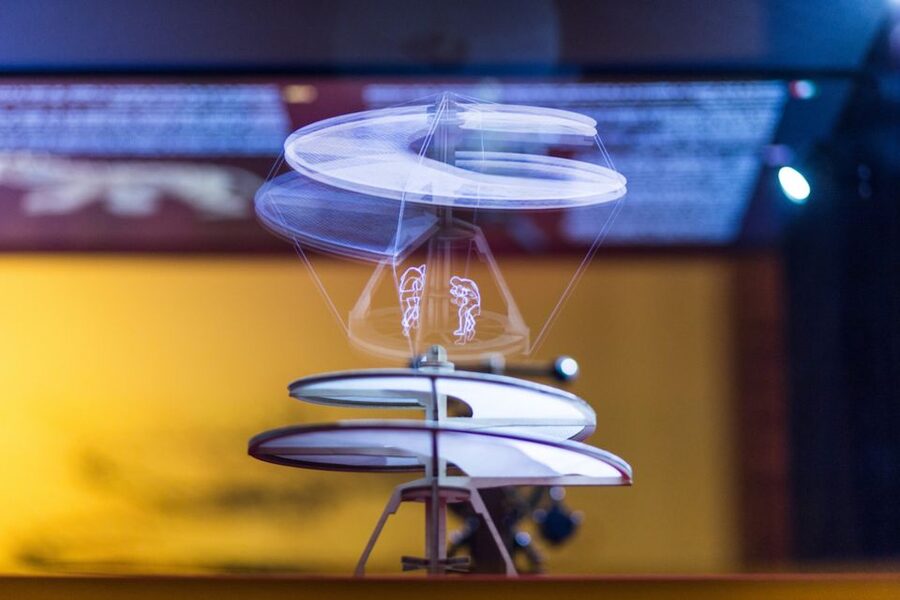
- Nine 3D holograms: Watch paintings and inventions appear in a more theatrical format than a standard museum display.
- Seven interactive installations: Touch, test, and operate many of the models rather than simply viewing them.
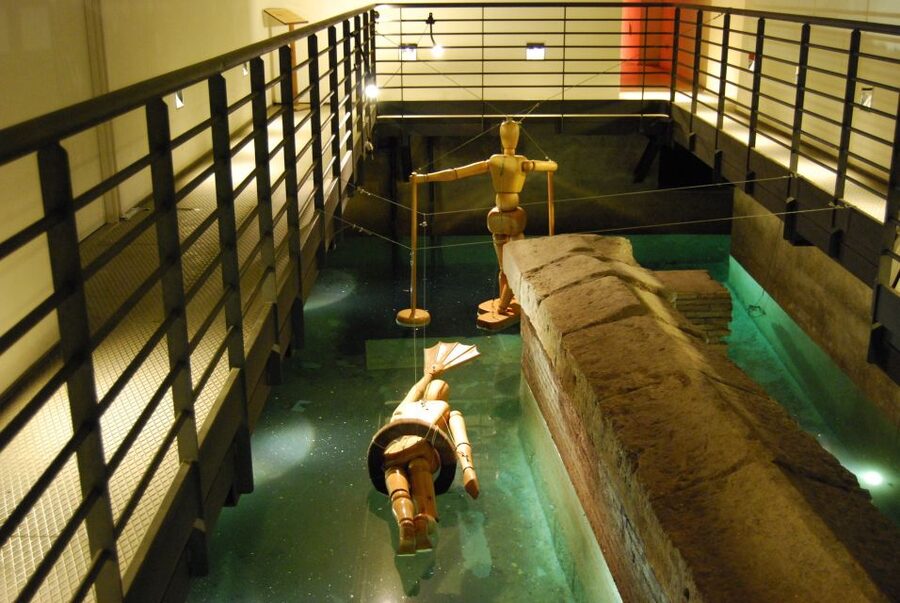
- A Roman tomb under the museum: The tomb of architect Auro Irzio dates to 43 BC and sits beneath an underground natural pond.
- Audio guide worth considering: It costs extra, but adds background and detail that can make the models easier to understand.
- A short, flexible visit: The ticket is valid for one day, entry is available until one hour before closing, and the museum is near Campo de’ Fiori and Piazza Navona.
Why Leonardo’s machines are the main attraction
This is not primarily a gallery of original Renaissance paintings. It is an exhibition about Leonardo as an engineer and inventor, using modern reproductions to show how his mind worked.
You begin with the pleasure of seeing a sketch become a physical object. A drawing of a mechanical device can be hard to read, even when the idea is brilliant. A full-size model makes the purpose clearer. You can see where a lever moves, how a gear transfers force, or how a structure might support weight.
The exhibition includes more than 65 machines based on Leonardo’s designs. The range matters. You are not shown only one famous invention and a few decorative extras. The displays cover aviation, science, military technology, musical instruments, architecture, transport, and water engineering.
I found this range especially useful for understanding Leonardo as more than the painter of the Mona Lisa and The Last Supper. His interests crossed several fields at once. He was drawing bodies, studying water flow, imagining flight, designing weapons, and thinking about structures with the same restless curiosity.
Many models are designed to be touched or operated. That makes this a good choice if you learn by doing. It also gives children a reason to look closely. The experience is less formal than a traditional art museum, though adults who enjoy engineering will find plenty to study.
Other museums and galleries in Rome:
- Vatican: Museums & Sistine Chapel Entrance Ticket
★ 4.5 · 144,003 reviews - Vatican Museums & Sistine Chapel Tour with Optional Basilica
★ 4.3 · 67,413 reviews - Vatican Museums, Sistine Chapel & St Peter’s Basilica Guided Tour
★ 4.5 · 39,149 reviews
Four sections built around water, air, fire, and earth
The exhibition is arranged in four broad sections connected to Water, Air, Fire, and Earth. These themes help keep the material from becoming a jumble of unrelated inventions.
The water displays show Leonardo’s interest in movement, flow, and control. You may see machines and studies linked to canals, pumps, bridges, and other ways of working with water. The hands-on pieces help explain why he paid such close attention to currents and mechanical force.
The air section turns toward flight. Leonardo’s flying machines are among the most memorable models because they show both his imagination and the limits of his time. You can compare the original drawings with the built versions and think through what the designs attempted to solve.
Fire brings in military and mechanical work. Here, the models show a more practical and sometimes more ambitious side of Leonardo’s thinking. His inventions were not all peaceful or artistic. Some were intended for defense, warfare, or large-scale engineering.
Earth connects with architecture, construction, transport, and the physical world around him. The sections are not large rooms packed with hundreds of objects. Instead, they create a manageable path through a wide range of ideas.
One small warning: the room numbers and route can be confusing. The numbering does not always seem to flow naturally from one room to the next, and the audio guide does not always follow the same order as the exhibition. Take a moment at the entrance to understand the layout rather than rushing from one number to the next.
The models you can touch and test
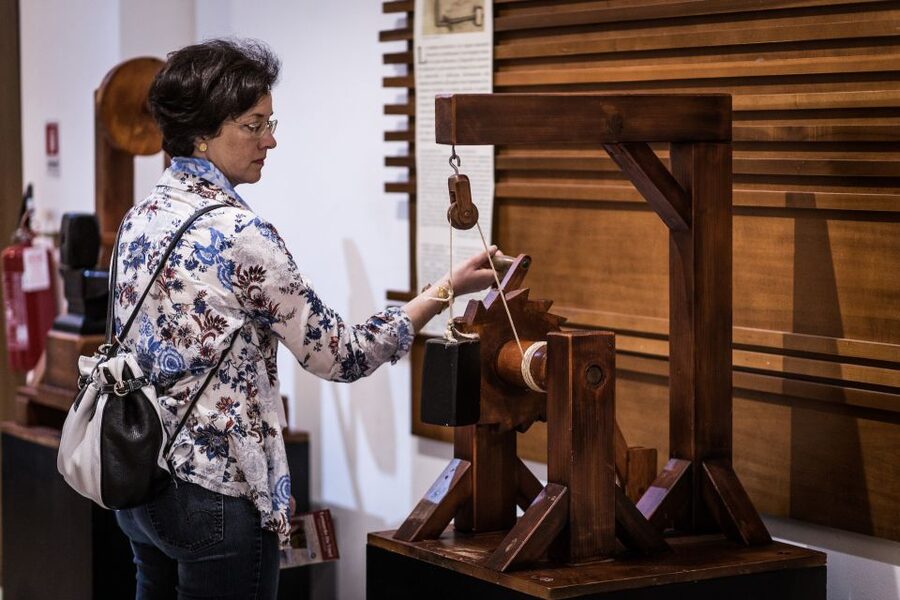
The interactive element is the exhibition’s strongest feature. You are allowed to touch and play with almost all the machines, and that changes the pace completely.
At a conventional museum, I might spend a few seconds reading a label and moving on. Here, I am more likely to turn a handle, test a mechanism, or study a structure from several angles. The physical action helps explain the principle behind the invention.
The bridge-building activity is a good example. Leonardo designed a bridge that could be assembled without traditional fasteners, and the exhibition lets you try creating your own version. It is simple enough to understand quickly, yet it shows why balance, shape, and pressure matter.
Some models are in better condition than others. A few may show signs of wear from repeated handling, which is hardly surprising in a museum built around interaction. You should also watch your footing. One detailed account of the visit noted trip hazards and unclear markings about what can and cannot be touched, so young children need supervision.
The hands-on format works best for families with school-age children and for adults who enjoy mechanical puzzles. It may be less satisfying if you want a quiet, original-art collection or a long museum visit filled with rare historic objects.
Holograms, drawings, and Leonardo’s wider work
Nine holograms add a theatrical layer to the exhibition. They present Leonardo’s paintings and inventions in 3D, giving the displays a more modern feel than the wooden and metal models alone.
The holograms are useful when you want a quick visual explanation. They can show an invention in operation or bring attention to a famous work of art without requiring a long wall of text. They also help younger visitors stay engaged.
Seven interactive installations focus on Leonardo’s drawings and ideas. These displays connect the lines on the page with the object in front of you. That connection is important because Leonardo’s notebooks were not simple instruction manuals. They contain studies, questions, partial designs, and repeated attempts to solve problems.
The exhibition includes a copy of The Last Supper. It is not the reason to buy this ticket, since Rome is not Milan and this is not the original refectory painting. Still, it helps place Leonardo’s engineering work beside his better-known artistic career.
You will also find examples connected to scientific and engineering instruments, music, flying machines, military devices, and water studies. The variety is the point. The exhibition gives you a broad look at a man who refused to stay inside one profession.
A few more things to do in Rome
- Rome: Pantheon Fast-Track Ticket and Official Audio Guide
★ 4.3 · 21,008 reviews - Rome:Hop-On Hop-Off Panoramic Open Bus Ticket 3 Circuits x 1
★ 4.0 · 15,405 reviews - Vatican Museums & Sistine Chapel Skip-the-Line Entry Ticket
★ 4.4 · 13,838 reviews - Rome: Vatican Museums & Sistine Chapel Skip-The-Line Ticket
★ 4.2 · 11,708 reviews
The underground setting and the 43 BC tomb
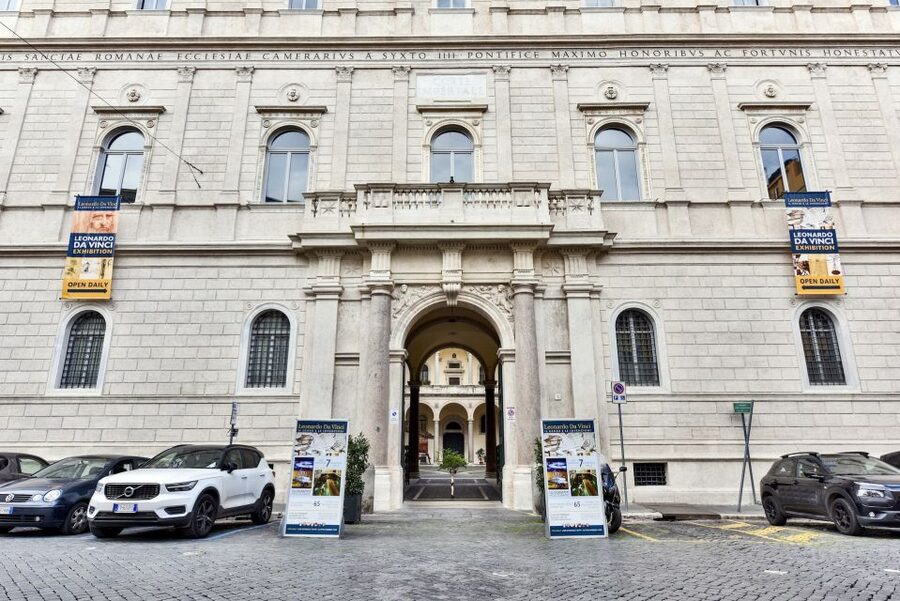
The exhibition sits inside Palazzo della Cancelleria, a building worth noticing before you even reach the displays. The palace is owned by the Vatican, and its architecture gives the visit a sense of place beyond the exhibition itself.
The museum rooms are underground, which has two practical effects. First, the space feels separate from the busy streets near Campo de’ Fiori and Piazza Navona. Second, it stays cooler than the street, making it a smart stop during a hot afternoon.
One unusual feature is the tomb of the architect Auro Irzio, dating from 43 BC. The tomb is beneath an underground natural pond, adding an unexpected Roman archaeological detail to a visit otherwise focused on Renaissance invention.
This is not a full ancient-Rome archaeological tour. The tomb is a memorable extra rather than the central attraction. Still, it gives the visit more variety and reminds you that Rome often puts several layers of history in the same building.
How long the visit takes
Plan on 45 to 60 minutes if you move steadily and focus on the main machines. That makes the exhibition easy to fit between other stops in central Rome.
If you read every explanation, watch the short videos, try the interactive models, and use the audio guide, you can stay for close to two hours. The exhibition is not huge, but the number of objects gives you reasons to pause.
I would allow at least an hour. A rushed 30-minute visit would let you see the main items, but it would miss much of the value of an interactive museum. The best approach is to schedule it as a flexible stop rather than as the centerpiece of an entire day.
The ticket is valid for one day, and entry is available until one hour before closing. Check the available start times when booking, since the stated duration covers the day of validity rather than a fixed guided tour.
Is the audio guide worth the extra cost?
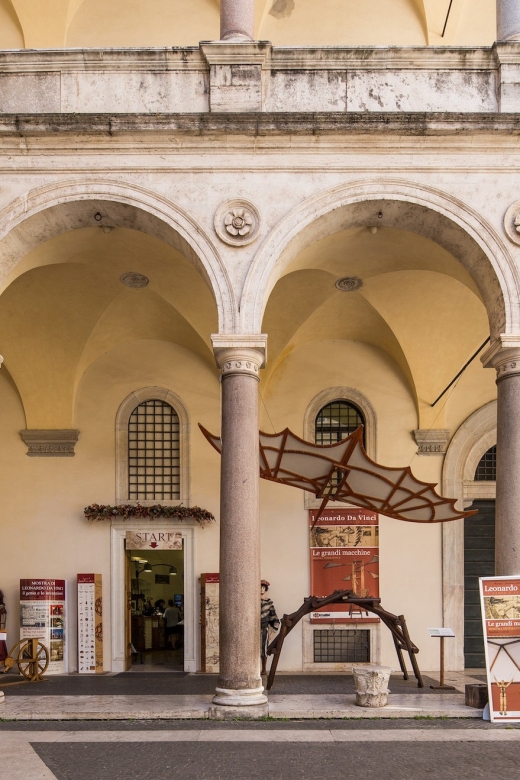
The audio guide is not included in the basic entrance ticket, but it is worth considering if you want more than a quick look at the machines.
The displays provide useful explanations, including English information, but the audio guide adds context and more detailed discussion. It can help you understand what a model was meant to do and how it connects to Leonardo’s drawings.
There is one practical flaw: the audio guide sequence does not always match the room order. You may need to check the model or exhibit number before starting each explanation. That is a small inconvenience, not a reason to skip it.
I would choose the audio guide if Leonardo’s engineering work interests you or if you want to understand the principles behind the inventions. Families may prefer to explore freely, especially if children are more interested in turning handles than listening to long explanations.
Location near Campo de’ Fiori and Piazza Navona
The entrance is at Piazza della Cancelleria 1, near Campo de’ Fiori and Piazza Navona. That makes it easy to combine with a walk through central Rome.
You can visit before or after seeing the nearby squares, churches, fountains, and cafés. Since the exhibition is fairly short, it works well as a break between larger Roman sights.
The building itself can be easy to overlook if you are focused only on the major attractions. Look for the Palazzo della Cancelleria address rather than expecting a large museum façade covered with obvious signs.
There is no guide included with the entrance ticket. The experience is self-guided, with labels, interactive displays, holograms, and the optional audio guide providing the information.
Is the $10 ticket good value?
At about $10 per person, this is one of the easier Rome museum purchases to justify. You are paying for a compact exhibition with more than 65 full-scale machines, nine holograms, seven interactive installations, and the unusual underground tomb.
The value depends on what you want. If you spend only 30 minutes walking through, the ticket is still reasonable, but the experience will feel brief. If you take your time with the models and explanations, the price compares well with other central Rome attractions.
The biggest value is not the number of rooms. It is the chance to interact with the displays. You are getting an experience that asks you to test ideas rather than simply look at objects.
The staff are described as welcoming and helpful, and the gift shop offers Leonardo-themed items that differ from the usual Rome souvenirs. That can be useful if you want a small, practical memento connected to the visit.
Who will enjoy this exhibition most?
I would recommend it to:
- Families with children who enjoy hands-on displays
- Adults interested in engineering, science, architecture, or transport
- Leonardo fans who want more than his famous paintings
- Visitors seeking a cool indoor stop during a hot day
- People with a spare hour near Campo de’ Fiori or Piazza Navona
- Anyone who prefers a smaller museum to Rome’s enormous, crowded collections
Use more caution if you have limited mobility or if you are visiting with very young children. The experience is wheelchair accessible, but some interactive areas may have trip hazards, and the touch instructions are not always immediately clear.
Art lovers should also set their expectations correctly. You will see a copy of The Last Supper and references to Leonardo’s paintings, but the main focus is his inventions and studies, not a collection of original masterpieces.
Booking and practical details
The experience provider is Mostra di Leonardo da Vinci. The ticket includes exhibition entry and a gadget, but not a guide.
You can cancel up to 24 hours before the visit for a full refund, and a reserve-now, pay-later option is available. The ticket offers skip-the-ticket-line entry, which is useful when you want to spend your limited Rome time inside the exhibition rather than waiting outside.
The location is wheelchair accessible. For the smoothest visit, arrive early enough to get oriented, especially if you plan to use the audio guide. The ticket allows entry until one hour before closing, but a late arrival may leave too little time to try the displays properly.
Should you book the Leonardo da Vinci exhibition?
Book it if you want an affordable, short, and interactive look at Leonardo’s engineering mind. The full-scale machines are the real reason to come, and the chance to handle many of them makes the visit more memorable than a standard display of reproductions.
I would especially choose it for a family, an engineering enthusiast, or anyone needing a cool indoor stop near Piazza Navona. Add the audio guide if you want fuller explanations.
Skip it if your Rome plans already include several major art museums and you only want original paintings. This is a compact, hands-on exhibition, not a grand national museum. For roughly $10 and about an hour, though, it offers a clear and entertaining look at how Leonardo’s drawings can become working ideas.
FAQ
Where is the Leonardo da Vinci exhibition in Rome?
It is at Mostra di Leonardo da Vinci, Piazza della Cancelleria 1, near Campo de’ Fiori and Piazza Navona.
How much does entrance cost?
The listed price is $10 per person.
How long is the ticket valid?
The ticket is valid for one day. Check availability for the possible starting times.
How long does the visit take?
A quick visit can take about 45 to 60 minutes. If you study the displays, watch videos, use the audio guide, and try the machines, you may spend up to two hours.
Is this a guided tour?
No. A guide is not included. The exhibition is self-guided, and an audio guide is available for an additional cost.
Is an audio guide available?
Yes. An audio guide can be requested for an extra fee. It provides additional explanations about the models and Leonardo’s work.
Can I touch the exhibits?
You can touch and play with almost all the machines on display. Some areas may have different instructions, so check the signs and supervise children.
Is the exhibition suitable for children?
Yes, the interactive displays can work well for children, particularly school-age children. Young children should be watched closely because some areas have trip hazards and unclear touch markings.
Is the exhibition wheelchair accessible?
Yes, the activity is listed as wheelchair accessible.
Can I cancel the booking?
Yes. You can cancel up to 24 hours in advance for a full refund. A reserve-now, pay-later option is also available.
Just added in Rome
- Civitavecchia Private Transfer: From the Port to Rome Airport★ 5.0 · 309 reviews
- Civitavecchia Shore Excursion: Best of Rome Private Tour★ 5.0 · 247 reviews
- Civitavecchia Private Transfer from ship to FCO airport or Rome★ 5.0 · 245 reviews
- Food Tasty and History Tour in Civitavecchia★ 5.0 · 256 reviews
- Palatine Hill and Roman Forum Tour with Fast-Track Entrance★ 4.2 · 417 reviews
- Tivoli: Villa D’Este & Villa Adriana Pass & App Audioguide★ 4.4 · 364 reviews
- Tivoli: Villa D’Este Entry Ticket and App Audio Guide★ 4.3 · 191 reviews
- Vatican Museums & Sistine Chapel Skip-the-Line Guided Tour★ 4.6 · 254 reviews
Museums, compared.
Vatican: Museums & Sistine Chapel Entrance Ticket
Read our review →
Vatican Museums & Sistine Chapel Tour with Optional Basilica
Read our review →
Vatican Museums, Sistine Chapel & St Peter’s Basilica Guided Tour
Read our review →
Skip-The-Line Uffizi Gallery Timed Entry Ticket
Read our review →
Vatican Museums & Sistine Chapel Skip-the-Line Entry Ticket
Read our review →
Browse the lists this tour appears in