

Reviewed · POMPEII & HERCULANEUM TOURS
Herculaneum: Skip-the-Line Guided Tour with Archaeologist
Herculaneum gives you a sharper look at Roman daily life than many ancient sites. The town is smaller than Pompeii, but its preserved homes, carbonized wood, bright mosaics, and painted walls make the past feel unusually close. An archaeologist guide such as Luciano, Diego, Teresa, or Angelo can explain why the eruption affected Herculaneum differently from Pompeii.
I especially like the skip-the-line entry, which saves time at a busy archaeological site, and the way the tour focuses on real homes rather than only grand public ruins. Guides have used books, photographs, and before-and-after images to make damaged buildings easier to understand. The main consideration is pace: two hours is enough for the major sights, but not enough for a slow look at every corner.
Key points at a glance
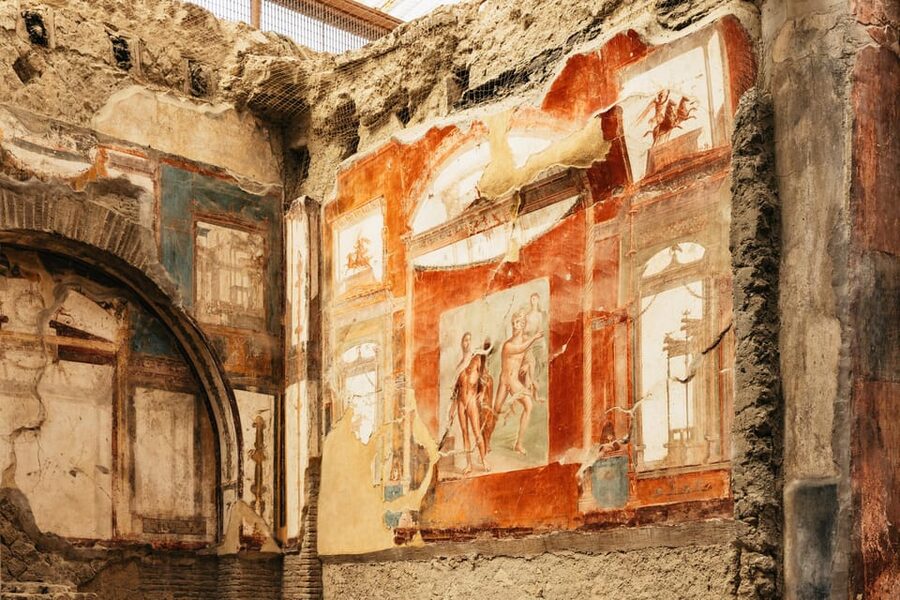
- A compact Roman town with remarkable preservation: See mosaics, painted rooms, ceramics, marble, and carbonized wood in settings that still suggest everyday life.
- A guide with archaeological training: Askos Tours uses archaeologist guides, including Luciano, Diego, Teresa, Angelo, and others who explain the eruption and excavation in practical terms.
- The waterfront tells the darkest story: More than 300 human remains were found near the old shore, where people tried to escape by sea.
- Two hours covers the main highlights: Expect the thermal baths, Temple of the Augustales, House of Neptune and Amphitrite, Gymnasium, Forum area, and several private houses.
- You can stay after the guided walk: Your admission is valid for the day, allowing extra time to explore at your own speed.
- Plan for sun, rain, and uneven ground: Wear closed-toe shoes, bring sunscreen and a hat, and carry a raincoat if the forecast is poor.
Why Herculaneum feels different from Pompeii
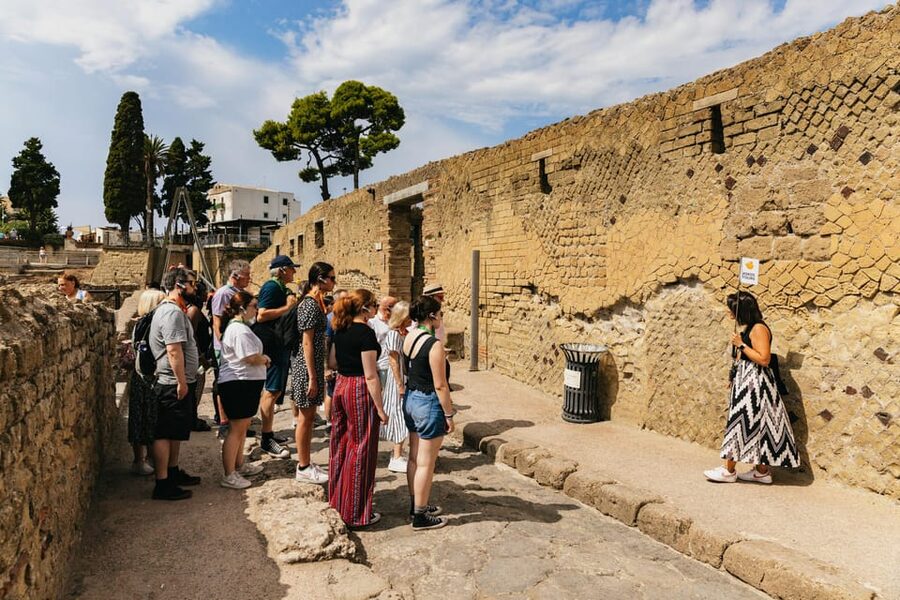
Herculaneum was a Roman port town for wealthy residents, merchants, and local nobility. Mount Vesuvius destroyed it in the first century, but the eruption buried the town under a thick flow of volcanic material. That burial helped preserve materials that usually disappear, including wooden doors, beams, furniture, and vivid wall decoration.
Pompeii is larger and offers a grander sense of an entire city. Herculaneum is more compact, so you can focus on the details of Roman homes and social life without walking such long distances between sights. I find the difference useful: visiting both sites gives you two views of the same disaster, but they are not interchangeable.
A good guide makes that contrast clear. Luciano Leone has been especially strong at explaining what happened before and after the eruption, using photographs and visual comparisons. Other guides, including Diego, Roberta, Alfredo, Anna, and Teresa, have also led tours praised for clear English, humor, and an ability to turn archaeological evidence into everyday stories.
You should expect some interpretation rather than a simple march through ruins. The guide may explain how rooms were used, why certain homes were larger than others, and how the eruption and excavation changed what survives. That context is the main reason to choose a guided visit instead of walking through with only a map.
Other Roman sites within reach of Naples:
- From Naples: Pompeii Ruins & Mount Vesuvius Day Tour
★ 4.3 · 11,459 reviews - Naples or Sorrento: Full-Day Pompeii and Mount Vesuvius Tour
★ 4.6 · 4,235 reviews - Pompeii & Mt.Vesuvius Day Tour from Naples with Pizza Lunch
★ 4.0 · 2,901 reviews
Meeting at Via dei Papiri Ercolanesi
The meeting point is the ticket office at the Herculaneum ruins on Via dei Papiri Ercolanesi. Look for the guide holding an Askos Tours sign. This is important because the meeting point shown in a booking app may not always match the ticket office precisely. One visitor found the map location roughly 300 meters away, so I would check the exact meeting instructions before setting off.
The tour includes admission, so you do not need to buy a separate standard entrance ticket for this experience. Adult admission at the site is listed as 16 euros, with a 2 euro rate for EU citizens aged 18 to 25. At about $53 per person, the tour costs more than entry alone, but the difference pays for the archaeologist guide, the organized route, skip-the-line access, and headsets.
Transportation is not included. You need to arrange your own way to Herculaneum from Naples or elsewhere in Campania. Food and drinks are also your responsibility. Since the site is exposed and the walk lasts two hours, bring water even though it is not listed as part of the tour.
Entering the ruins and understanding the eruption
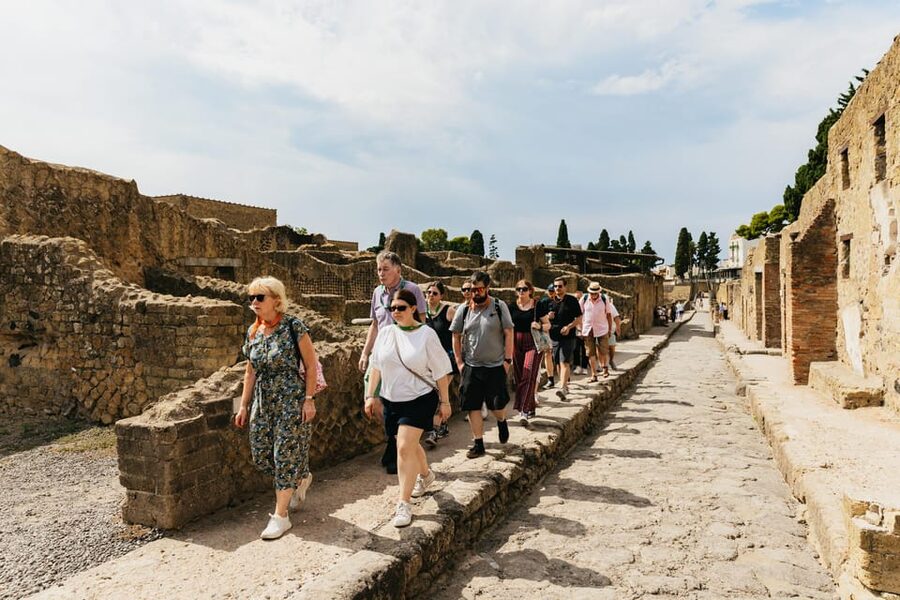
The tour begins with the broad story of Herculaneum, its position near the Bay of Naples, and the eruption that ended city life almost 2,000 years ago. This opening matters because Herculaneum can look like a series of broken walls until you understand how the town was organized and why the preservation is so unusual.
The guide will also explain the difference between the disaster here and the one at Pompeii. Herculaneum was covered in a heavy, hot mass of volcanic material. The force and heat caused immense damage, but the deep covering also protected wooden features and household objects from later weathering and theft.
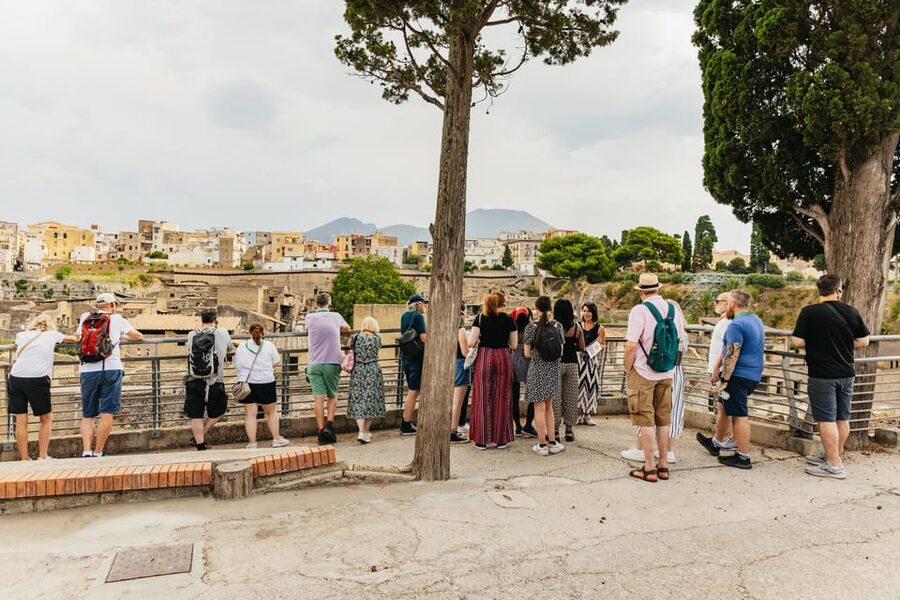
The waterfront is one of the most affecting parts of the visit. More than 300 people died near the ancient shore while trying to escape by sea. The remains are a sober reminder that Herculaneum was not simply abandoned or gradually lost. Its residents faced a sudden catastrophe, and the evidence is still visible in a way that can be difficult to forget.
This part of the tour may be intense for children. The site welcomes families, but younger visitors can tire during a history-heavy walk. One family found the tour worked well for an eight-year-old, while an older child became bored after already spending an afternoon at Pompeii. If you are traveling with children, the guide’s storytelling style will matter a great deal.
Casa dei Cervi and the homes of the wealthy
Casa dei Cervi, the House of the Deer, helps show how prosperous residents lived. The name refers to decorative features associated with the house, and the building gives you a sense of the space and finish available to Herculaneum’s upper class.
Here, pay attention to the layout rather than rushing toward one spectacular object. Roman homes were designed around social status, movement, and display. Courtyards, decorated rooms, wall paintings, and garden elements worked together to show wealth to guests.
This is where a guide can point out the difference between a house that merely survives and a house that communicates something about its owner. Ask about who might have used each room, how private and public areas were separated, and what the surviving decoration says about fashion and money.
The drawback is that a two-hour route cannot give every house equal time. You will see selected rooms and hear the main points, but you may want to return afterward if domestic architecture interests you.
A few more things to do in Naples
- Naples: Naples Underground Entry Ticket and Guided Tour
★ 4.4 · 21,781 reviews - Naples: Catacombs of San Gennaro Entry Ticket & Guided Tour
★ 4.6 · 7,941 reviews - Naples: Spanish Quarters Underground Guided Tour
★ 4.8 · 5,064 reviews - Naples: Street Food Walking Tour with Local Guide
★ 4.8 · 4,256 reviews
Casa di Nettuno ed Anfitrite and the sparkle of Roman decoration
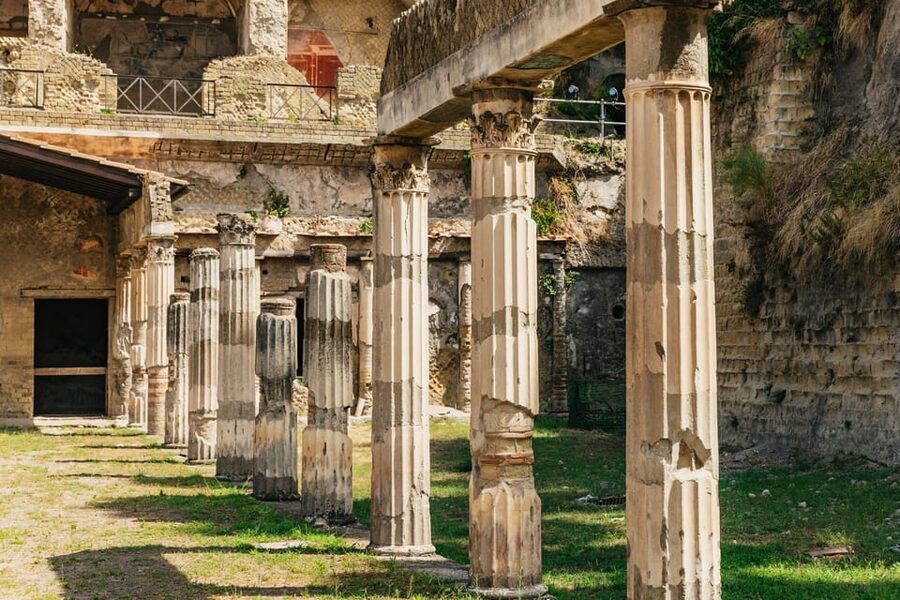
The House of Neptune and Amphitrite is one of Herculaneum’s signature stops. Its mosaic decoration brings color and pattern into a town that can otherwise appear dominated by gray stone and brown volcanic material.
The house is useful because it shows that Roman interiors were not plain. Ceramic vessels, marble details, painted walls, and mosaics were part of daily surroundings for those who could afford them. The decoration also tells you about taste, mythology, and the owner’s wish to impress.
Your guide can help you notice smaller features that a quick solo visit might miss. Look closely at the way decorative panels fit into walls and how the rooms connect. The pleasure here is not just seeing a famous mosaic, but understanding how it functioned within the home.
If you are hoping for an unhurried photography stop, the group format may feel brisk. Stay close enough to hear through the headset, and save extra pictures for the time after the tour.
The House of Skeletons and the waterfront evidence
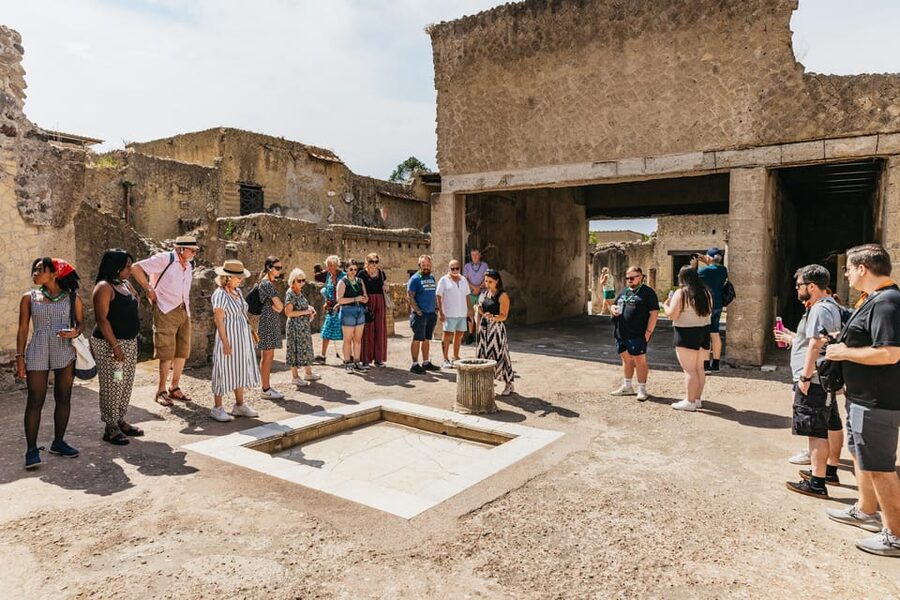
The House of Skeletons offers another view of private life, but its name points to the darker side of the site. The eruption did not merely damage buildings. It trapped people, possessions, and household spaces together under volcanic material.
The guide can help place the building within the larger story of the evacuation. That makes the visit more than a collection of rooms. You begin to see how the homes, streets, and shore formed one living town before the disaster.
Herculaneum asks you to move between beauty and tragedy. In one room you may study a fine mosaic; a short distance away, the evidence of death changes the mood entirely. I appreciate guides who do not turn this into theatrical storytelling, but explain the evidence with care and let you take in the site at your own pace.
Casa dell’Albergo and Casa del Salone Nero
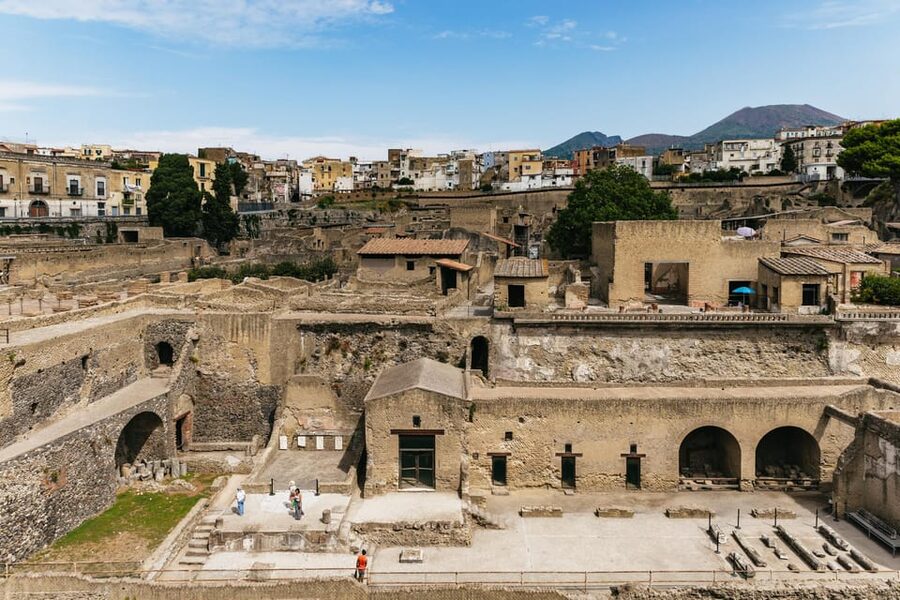
Casa dell’Albergo and Casa del Salone Nero add more examples of Herculaneum’s domestic architecture. The names refer to buildings and decorated rooms that help show the range of Roman interiors, from practical spaces to rooms designed for display.
The House of the Black Room, or Casa del Salone Nero, is especially useful for seeing how wall color and painted decoration shaped a room. A guide may explain how the surviving surfaces give clues about the room’s importance and the household’s resources.
These stops reward attention to details such as thresholds, wall finishes, floor patterns, and surviving construction materials. You may also see carbonized wood, a rare survival that makes the ancient town feel less abstract. Wood usually disappears over time, but Herculaneum’s burial conditions preserved pieces of doors, furniture, and structural elements.
The route can feel information-heavy. Guides such as Luciano have been described as packing a great deal into two hours, sometimes using books and photographs to show how the town once looked. That approach is excellent if you want substance, but you may prefer a quieter visit if you dislike constant commentary.
The Temple of the Augustales and the public side of town
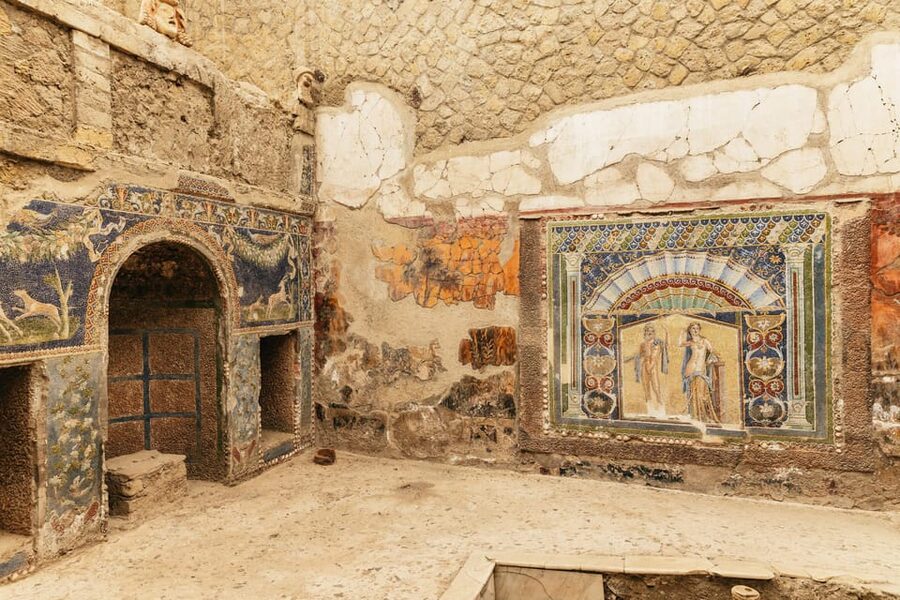
The Sacellum of the Augustales, also called the Temple of the Augustales, shifts attention from private houses to civic and religious life. This building was connected with the imperial cult, an important part of Roman public identity and local status.
The stop helps balance the tour. Without public buildings, it is easy to imagine Herculaneum as only a collection of villas. The Temple of the Augustales shows how residents expressed loyalty, organized community life, and displayed social standing.
Your guide may also take you toward the Forum area, where public activity once centered. The forum is not preserved in exactly the same way as every private house, so this is a place where explanation carries extra weight. You need the guide to help reconstruct the missing pieces and understand what the surviving walls imply.
Thermal baths, the Gymnasium, and Roman routines
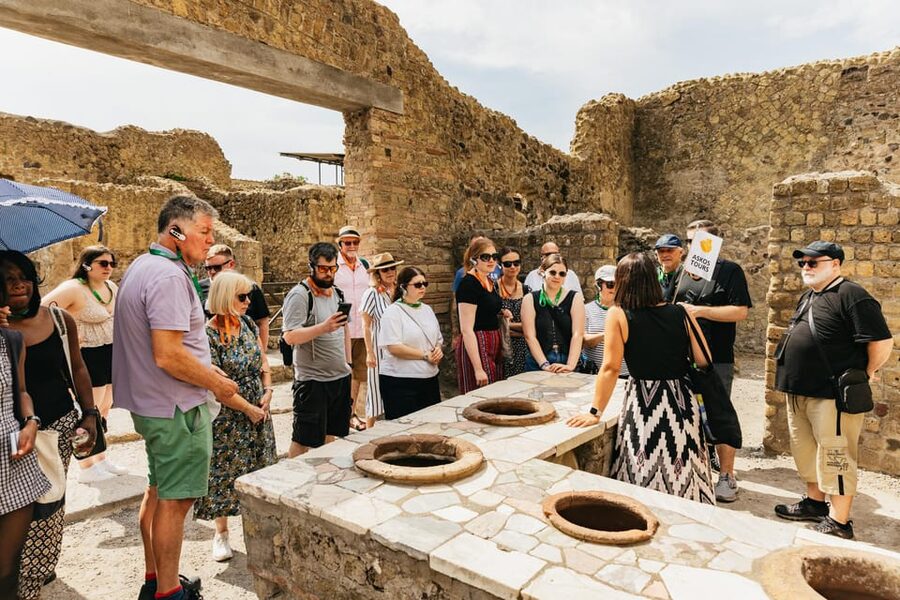
The thermal baths reveal how important public bathing was in Roman society. These were not simply places to wash. They were social spaces, with different rooms and functions arranged around a shared routine.
At the Gymnasium, you may see how education, exercise, and civic identity fit into city life. One guide has taken groups into a tunnel toward the center of the Gymnasium, where a swimming pool would have been, giving visitors a less obvious view of the complex. Access and exact movement can depend on site conditions, so treat this as a possible feature rather than a guarantee.
The baths and Gymnasium are good stops for understanding the ordinary rhythm of the town. They remind you that Herculaneum was not frozen as an archaeological display in ancient times. It was a working community with places for exercise, bathing, worship, trade, and household life.
How the two-hour format works
Two hours is a sensible length for a first visit. The route covers many of the main sights without asking you to spend half a day listening to a single lecture. Headsets help you hear the guide while moving through rooms and narrow streets.
Group sizes can be around 15 to 20 people. That is manageable, but not intimate. If you drift to the back, the audio may occasionally drop out, especially when the guide moves quickly from one room to another. Stay near the guide and signal if you cannot hear.
The tour is conducted rain or shine. Herculaneum is exposed, so sun protection matters in warm weather, while a raincoat is sensible during unsettled weather. Closed-toe shoes are strongly preferable because the ruins have uneven surfaces and open sandals can be awkward.
The site is not suitable for wheelchair users or people with mobility impairments. Large bags and luggage are not allowed, and children must be accompanied by an adult. Bring a passport or valid ID, since the activity information specifically requires it.
Staying after the guided walk
A major value point is the chance to remain at Herculaneum after the two-hour tour. The included admission is valid for the day, so you can revisit a house, spend longer with the mosaics, or explore the site and museums independently afterward.
This extra time changes how I judge the price. The guided portion gives you structure and historical context, while the remaining hours allow for a slower look. If you book a later tour, check the site’s closing time carefully. One afternoon group had little time left after the tour ended, while a morning booking gives you more freedom to stay.
I would choose a morning slot if you want to explore independently afterward. A later time can work well if you are fitting Herculaneum around other plans, but do not assume you will have hours of quiet wandering once the guide finishes.
Is $53 a fair price?
For simple entrance access, no, $53 is not the cheapest way to see Herculaneum. Adult admission alone is listed at 16 euros, so the tour premium is substantial.
For a first visit, I think the price can be justified. You get admission, skip-the-line access, a two-hour archaeological explanation, and headsets. The site contains many buildings and layers of evidence, and a guide can direct you to the rooms that make the visit worthwhile.
The value depends on your style. If you enjoy reading signs and forming your own route, buy entry separately and spend longer alone. If you want the eruption, architecture, and Roman routines explained in clear language, the guide is likely worth the extra cost.
Askos Tours offers English, Italian, German, Spanish, and French tours. Guides vary in style, but names frequently associated with strong sessions include Luciano Leone, Diego, Teresa, Angelo, Alfredo, Anna, and Roberta. You cannot choose a particular guide from the supplied details, so book for the tour format rather than a guaranteed individual.
Should you book this Herculaneum tour?
Book it if you want a well-organized first visit, especially if Herculaneum is competing with Pompeii on a tight schedule. The archaeologist guide, focused route, and skip-the-line entry help you make sense of a large amount of material in two hours.
I would be especially happy choosing it for a first-time visit, a history-minded family, or anyone who wants to see why Herculaneum differs from Pompeii. Book a morning departure if you want time to continue exploring afterward.
Skip it if you need step-free access, dislike group pacing, or prefer complete independence. Also think twice if you are already planning several long archaeological tours and want a quiet afternoon. For most visitors who want context rather than just ruins, though, this is a strong and practical way to meet Herculaneum.
FAQ
Where does the Herculaneum tour meet?
Meet at the ticket office of the Herculaneum ruins on Via dei Papiri Ercolanesi. The guide will hold an Askos Tours sign.
How long does the guided tour last?
The guided visit lasts two hours. Starting times vary, so check availability when booking.
Is admission to Herculaneum included?
Yes. The tour includes admission fees and skip-the-line access to Herculaneum.
Is transportation from Naples included?
No. Transportation, food, and drinks are not included. You need to arrange your own transport to the meeting point.
What languages are available?
The live guide is available in English, Italian, German, Spanish, and French.
Is the tour suitable for wheelchair users?
No. The activity is not suitable for wheelchair users or people with mobility impairments. Large bags and luggage are also not allowed.
Just added in Naples
- Boat excursion with lunch on board to discover Ischia★ 5.0 · 474 reviews
- Tour of the island of Ischia in schooner★ 5.0 · 208 reviews
- Vesuvius National Park Skip-the-Line Ticket★ 3.8 · 221 reviews
- Naples: The Holy Mile 3-Hour Guided Tour★ 4.9 · 711 reviews
- Procida: Boat Tour with Swimming Stops and Underwater Photos★ 5.0 · 322 reviews
- Pompeii and Vesuvius Full-Day Tour from Amalfi Coast★ 4.4 · 319 reviews
- From Naples: Pompeii and Herculaneum Tour with Lunch★ 4.3 · 444 reviews
- From Naples: Pompeii & Herculaneum with Archaeologist Guide★ 4.8 · 665 reviews
Pompeii & Herculaneum Tours, compared.
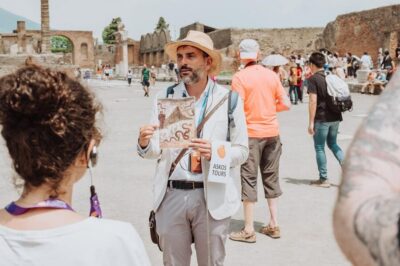
Entry Ticket and Guided Tour with an Archaeologist
Read our review →

Pompeii and Mount Vesuvius Day Trip from Rome with Pizza Lunch
Read our review →
Pompeii Day Trip with Optional Vesuvius and Lunch
Read our review →Browse the lists this tour appears in