
Reviewed · COLOSSEUM & ROMAN FORUM TOURS
Rome: Colosseum and Ancient Rome Guided Walking Tour
The best part of this tour is the way it connects Rome’s three major ancient sites in one walk. You begin at the Colosseum, then cross the old heart of public Rome before climbing Palatine Hill, where emperors once lived and the city opens below you.
I like the live storytelling, especially when the guide turns broken walls and half-standing columns into scenes from Roman life. I also like the practical design: entry tickets and headsets are included, and skip-the-ticket-line access helps you avoid the ticket queue, though not the security check. The main drawback is the walking. This is not a gentle sightseeing stroll, and it is not suited to wheelchair users or people with mobility impairments.
Key points to know before booking
- Three major sites in one tour: The Colosseum, Roman Forum, and Palatine Hill are covered together.
- Guides bring energy: David, Radu, Alessandra, Adriano, and others are praised for humor, clear explanations, and patience with questions.
- Allow time for security: Skip-the-ticket-line entry does not skip the Colosseum’s metal detector queue.
- Expect plenty of steps: Comfortable shoes are essential, and the Palatine Hill portion includes uphill walking.
- Great views from Palatine Hill: The terrace gives you a broad look across Rome and the ancient ruins.
- A solid first visit: The tour gives you a useful framework before you return to explore Rome on your own.
Why this three-site route works so well
Rome’s ancient center can feel confusing at first. You see arches, stones, temples, and fragments, but without context it is easy to admire the ruins without understanding their purpose. This route gives each site a role in the larger story.
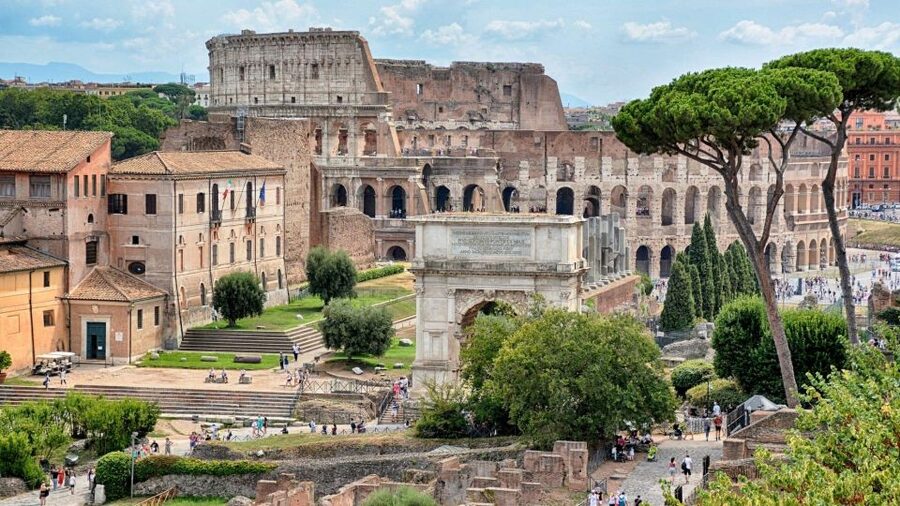
The Colosseum shows Rome’s public spectacle and engineering. The Roman Forum shows government, religion, trade, and daily civic life. Palatine Hill adds the world of emperors and elite power. Taken together, the sites explain how Rome worked, rather than presenting three isolated monuments.
The tour lasts about 2.5 hours. The supplied schedule lists a short opening period, about 75 minutes at the Colosseum, 45 minutes in the Forum, and 45 minutes at Palatine Hill. Those listed blocks total longer than the advertised duration, so I would leave extra time around the appointment. The exact order can change, too. You might visit the Forum and Palatine Hill before entering the Colosseum.
That flexibility is not a major problem, but it matters if you have a lunch booking or another timed attraction afterward. I would avoid scheduling anything immediately after the tour.
Other ways into ancient Rome:
- Colosseum, Roman Forum & Palatine Guided Tour
★ 4.7 · 63,148 reviews - Rome: Colosseum, Palatine Hill and Roman Forum Guided Tour
★ 4.8 · 32,814 reviews - Rome: Guided Tour of Colosseum, Roman Forum & Palatine Hill
★ 4.7 · 27,897 reviews
Meeting the guide near the Colosseum
The meeting location can vary with the option you book. The listed starting point is around Largo Gaetana Agnesi, and the tour finishes near the Roman Forum on Via della Salara Vecchia. Check your confirmation carefully, and arrive early enough to find the group.
One practical warning: the meeting point can be harder to spot than the Colosseum itself. One visitor arrived late and was helped by the guide, but you should not count on that. The meeting time may change slightly, with advance notice from the operator.
Once the group is assembled, the guide gives an introduction before leading you toward the archaeological area. Headsets are supplied, which is important in a crowded place. Without them, you may miss half the explanation while trying to keep up with the group.
Guides are available in English, Spanish, German, and French. The most praised guides include David, Radu, Alessandra, Adriano, Arian, and Frederica. Their styles vary, but the strongest pattern is clear: expect a guide who uses humor, answers questions, and keeps the group moving without making the visit feel rushed.
Entering the Colosseum
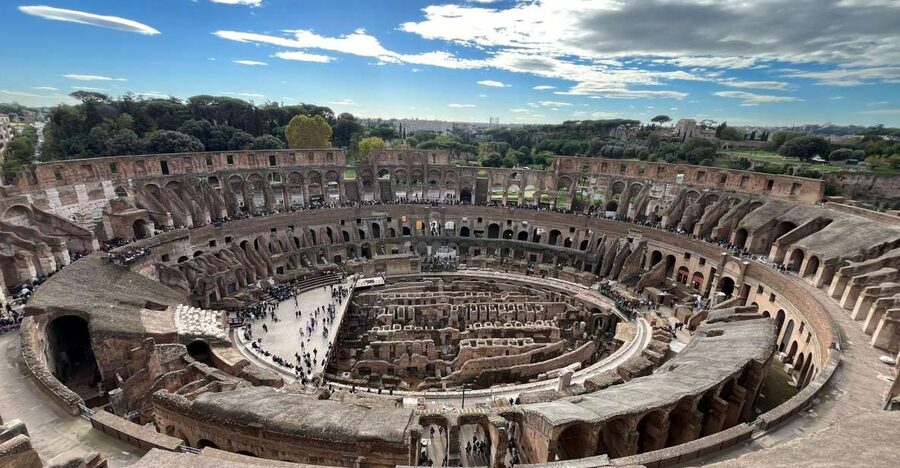
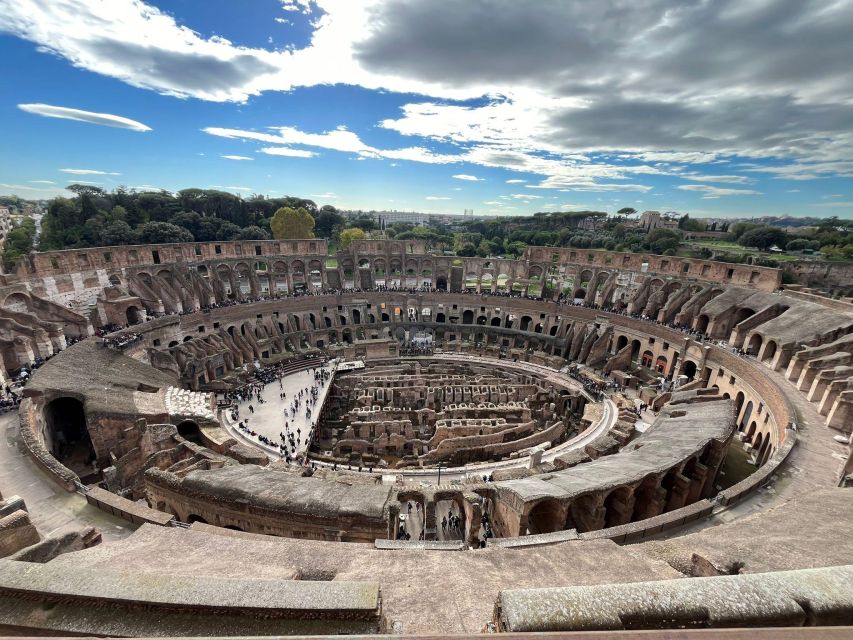
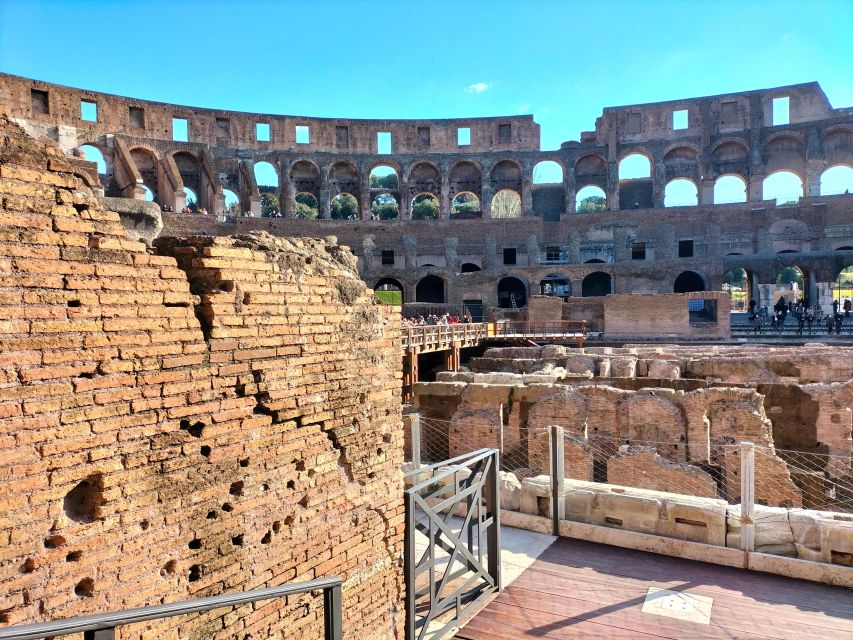
The Colosseum is the emotional center of the tour. Even after seeing countless photographs, the first view inside is powerful. Your guide helps you read the building as more than a famous oval of stone.
The visit focuses on the first floor, where you can look across the arena and imagine the scale of the crowds. The commentary covers the building, its spectacles, and the people who used it. Several guides are praised for correcting popular myths about gladiator contests, a useful service since films often blur the line between history and invention.
This is where the guide adds real value. On your own, you can see the seating tiers and the exposed underground structures, but you may not know what you are looking at or why it mattered. A good explanation turns the building into a working institution, connected to politics, public entertainment, and imperial power.
The guides are also praised for keeping the tone light. David is repeatedly described as funny and direct, while Radu is praised for energy and the ability to make complex material easy to follow. That humor helps during pauses and queues, but the tone is still focused on the site.
The skip-the-ticket-line benefit is useful, especially at busy times. It does not mean you walk straight through every entrance. Everyone must pass a metal detector, and that security line can still be long. Large bags, luggage, sharp objects, weapons, drones, selfie sticks, glass items, sprays, alcohol, and drugs are not allowed.
Bring a passport or identity card. Wear shoes with good support. The stone surfaces and long periods on your feet make flimsy footwear a poor choice.
Walking through the Roman Forum
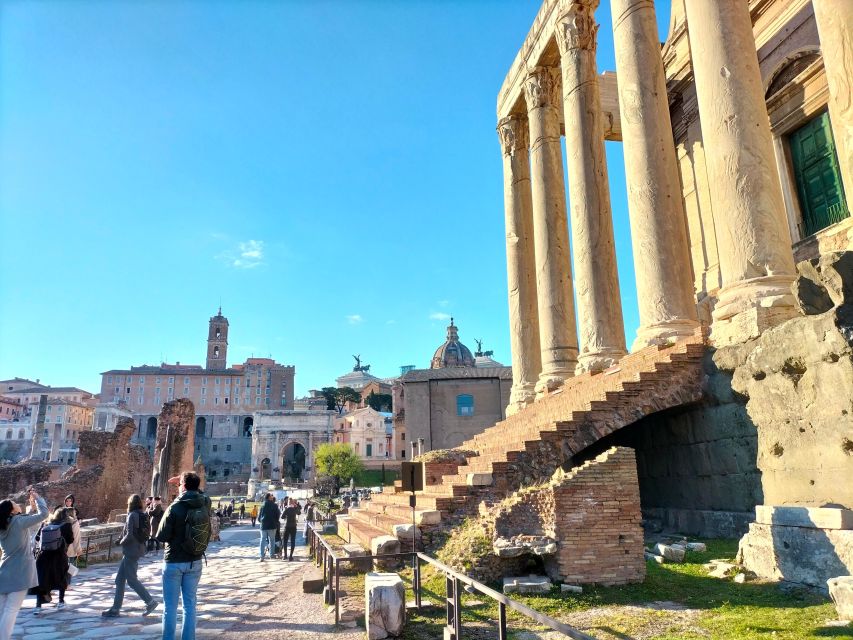
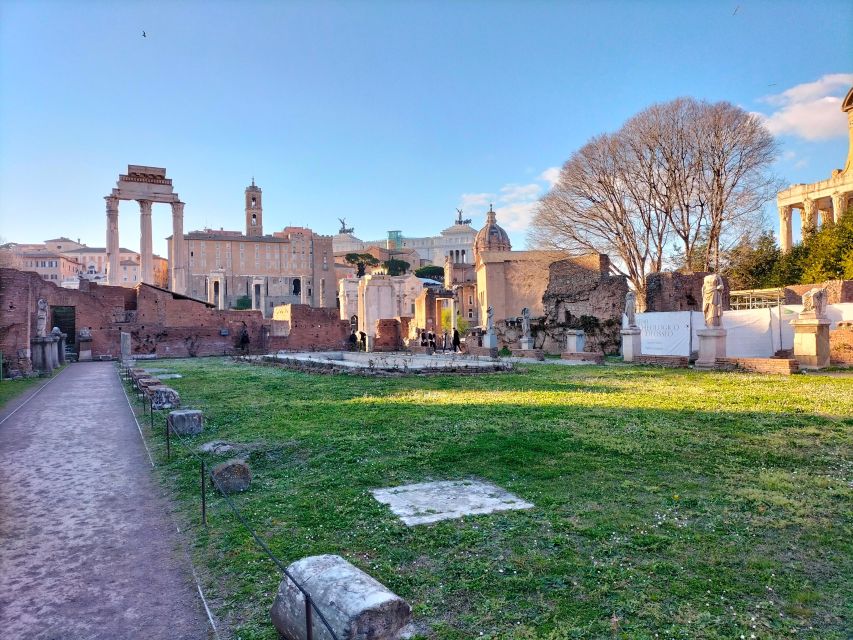
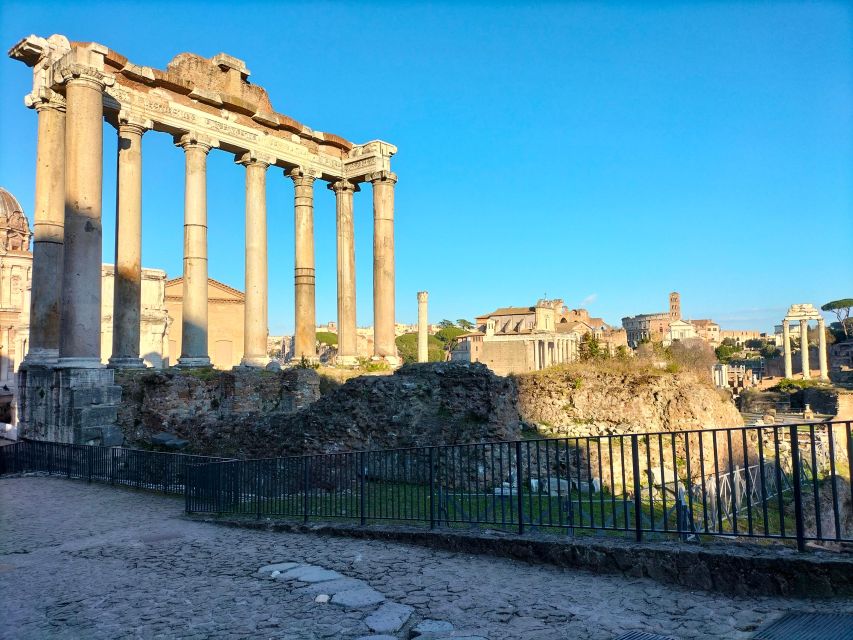
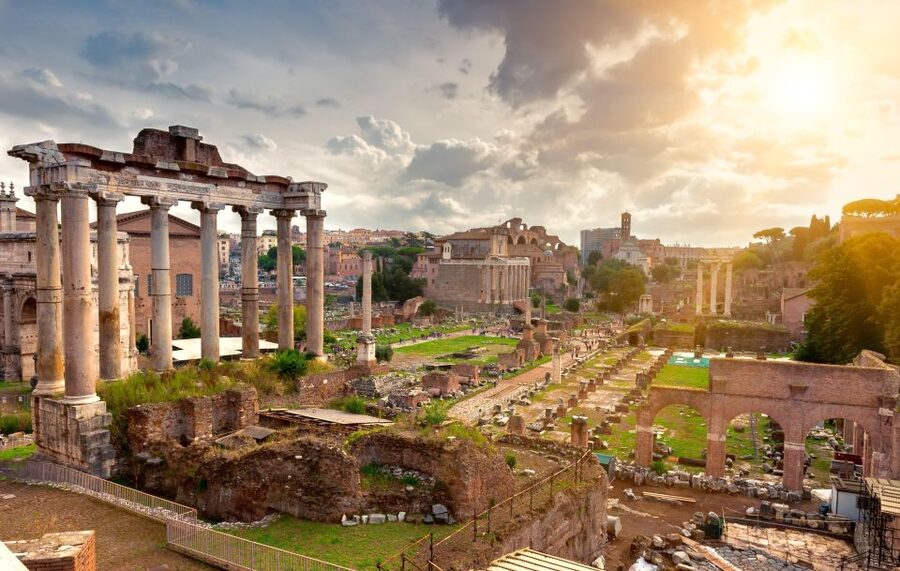
After the Colosseum, the route continues to the Roman Forum, once the center of Roman public life. Today it is a wide archaeological area filled with foundations and partial structures. Without a guide, it can be hard to tell which remains were temples, meeting places, civic buildings, or triumphal monuments.
The Forum section lasts about 45 minutes in the listed plan. That is enough for a strong introduction, though not enough to examine every ruin in detail. Your guide will point out important remains and explain how the Forum functioned as a place for law, politics, religion, public announcements, and ceremonies.
I particularly like this part because it gives scale to Roman history. The Colosseum shows one famous building. The Forum shows the machinery of the city around it. Here, the stories become less about gladiators and more about how decisions were made, how public life was organized, and how rulers presented themselves.
Expect uneven ground, open sun, and more walking. There is not always an obvious route through the ruins, so stay close enough to hear the guide and keep your headset working. Guides such as Frederica have been praised for using waiting time to explain other parts of Rome, which is useful if the group pauses at an entrance or bottleneck.
The Forum is also the place where a guide’s skill matters most. The ruins are visually impressive, but many are incomplete. A strong guide uses comparisons and old photographs to show what the structures may once have looked like. Arian, for example, is praised for showing before-and-after images of the Palatine Hill and Colosseum. That kind of visual aid can make the remains easier to understand.
Other walks around Rome:
- Rome: Trastevere & Campo de Fiori Street Food Walking Tour
★ 4.9 · 2,768 reviews - Rome: Paranormal Night Walking Tour & Secret Backstreets
★ 4.9 · 1,921 reviews - Rome by Night Walking Tour – Legends & Criminal Stories
★ 4.5 · 1,003 reviews - Rome: Guided City Center Evening Sightseeing Walking Tour
★ 4.4 · 953 reviews
Climbing Palatine Hill for the views
Palatine Hill is the final major stop in the usual order, though the itinerary can be reversed. This is where the tour becomes more uphill and physical.
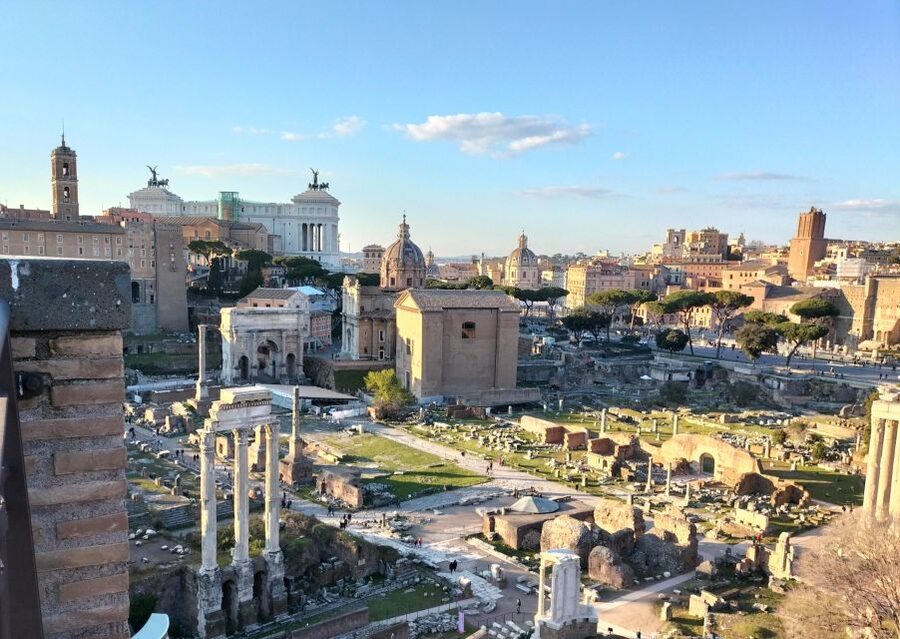
The hill is linked with Roman rulers and imperial residences. You walk among the remains of palaces and other structures while the guide explains how this high ground became associated with power. The setting gives you a different view of Rome than the Colosseum does. Instead of looking up at one building, you look across the Forum and the wider city.
The Palatine Hill Terrace is a highlight. It offers broad views over the ancient ruins and Rome beyond them. Bring your camera, but do not let the photo stop distract you from the guide’s explanation. The view helps you understand the relationship between the hill, the Forum, and the Colosseum.
This section is also why I would not book the tour in uncomfortable shoes. The walk includes slopes and uneven surfaces, and the full route requires stamina. The experience is not suitable for wheelchair users or people with mobility impairments, according to the activity information.
You usually get short periods to look around and take photos at key points. Sandra’s guide was praised for providing breaks and keeping the group organized and safe, which is exactly what you want in a large archaeological zone.
How much value do you get for $58?
At $58 per person, this is not the cheapest way to enter the ancient sites. You are paying for three things: admission to the Colosseum, Forum, and Palatine Hill; a guide for the full route; and headsets that let you hear the commentary.
The value depends on how you normally visit museums and monuments. If you are happy reading signs and piecing together ruins on your own, you may prefer a cheaper self-guided visit. But if this is your first time in Rome, the guide can save you from spending hours looking at remains without knowing what they represent.
The ticket-line advantage also has practical value. It does not remove the security queue, but it avoids the separate process of buying an entry ticket. At a busy site, that can make the price easier to accept.
I would also compare the length of the experience with the cost of other guided options. This is a relatively focused half-day outing, not a full-day tour with transportation or lunch. That keeps the price understandable, but it also means you should not expect every corner of the archaeological area to receive equal attention.
The guides make the difference
A tour like this rises or falls on the person holding the microphone. The strongest guide comments are unusually consistent about humor, clarity, and enthusiasm.
David is praised for dry wit, strong explanations, and an ability to keep people engaged. Radu is described as energetic, funny, and passionate, with a talent for making the ancient world easy to picture. Alessandra is praised for patience and careful explanations of art and monuments. Adrian, Raul, Ken, Eni, Arian, and Frederica are also singled out for answering questions and keeping the pace comfortable.
You cannot choose a particular guide when booking, so treat those names as examples of the level you might get, not a guarantee. One guide, Maria, was praised for her command of the subject, though her Italian accent was occasionally difficult for one visitor to understand. That is a fair reminder that guide style and clarity can vary.
The headsets help, but they do not fix every issue. Stay attentive, ask questions when there is a pause, and position yourself where you can see the guide’s gestures. The groups may include several languages and a range of ages, so the guide has to balance detail with pace.
What to bring and what to expect on the day
Wear comfortable walking shoes and bring your passport or identity card. Do not bring a large bag or luggage, and check the prohibited-items list before leaving your hotel.
Plan for sun, stone, slopes, and standing. The exact conditions vary by season, but the physical demands do not disappear. You will cover major ground in a limited time, and the Roman ruins are not arranged like a flat indoor museum.
Arrive early. The meeting point may be difficult to identify, the time can shift slightly, and the group needs to pass through security. The operator says you will be contacted if the meeting time changes.
The cancellation policy allows cancellation up to 24 hours ahead for a 50 percent refund. That is less flexible than a full-refund policy, so confirm your plans before booking.
Who should book this tour?
I would recommend it to first-time visitors who want the main ancient sights explained in one well-organized outing. Families can benefit from the humor and visual explanations, especially if children lose interest when faced with rows of ruins and Latin names.
It also suits anyone who prefers a human guide to a phone app. The best guides answer questions, correct common myths, and help you picture buildings that are now mostly fragments.
I would be more cautious if you have limited mobility, dislike group tours, or want a slow photographic visit. The route covers a lot of ground, and the guide must keep everyone together. The 2.5-hour format gives you a strong overview, but not the freedom to linger at every structure.
Should you book the Colosseum and Ancient Rome tour?
Book this tour if you want the Colosseum, Roman Forum, and Palatine Hill in one visit, with clear explanations and less ticket hassle. The strongest reason to choose it is the combination of sites and lively guiding. The strongest reason to skip it is the physical pace and the fact that security queues remain possible.
For $58, I see good value if you are visiting Rome for the first time and want the ancient center to make sense. Arrive early, wear serious walking shoes, carry only what the site permits, and leave a little time after the tour in case the route or queues run long.
FAQ
How long does the tour last?
The advertised duration is 2.5 hours. The listed time blocks add up to longer than that, so allow some extra time around the scheduled start and finish.
What sites are included?
The tour includes the Colosseum, Roman Forum, and Palatine Hill. Entry tickets for all three sites are included.
Is skip-the-line entry included?
Skip-the-ticket-line access is included, but you must still pass through the Colosseum’s metal detector security check. Busy days may bring a queue at security.
Which languages are available?
Live guides are available in English, Spanish, German, and French.
What should I bring?
Bring a passport or identity card and wear comfortable shoes. Large bags, luggage, weapons, sharp objects, drones, selfie sticks, alcohol, drugs, sprays, aerosols, and glass objects are not allowed.
Is the tour suitable for wheelchair users?
No. The tour is not suitable for wheelchair users or people with mobility impairments because of the walking, slopes, and uneven archaeological surfaces.
Just added in Rome
- Civitavecchia Private Transfer: From the Port to Rome Airport★ 5.0 · 309 reviews
- Civitavecchia Shore Excursion: Best of Rome Private Tour★ 5.0 · 247 reviews
- Civitavecchia Private Transfer from ship to FCO airport or Rome★ 5.0 · 245 reviews
- Food Tasty and History Tour in Civitavecchia★ 5.0 · 256 reviews
- Palatine Hill and Roman Forum Tour with Fast-Track Entrance★ 4.2 · 417 reviews
- Tivoli: Villa D’Este & Villa Adriana Pass & App Audioguide★ 4.4 · 364 reviews
- Tivoli: Villa D’Este Entry Ticket and App Audio Guide★ 4.3 · 191 reviews
- Vatican Museums & Sistine Chapel Skip-the-Line Guided Tour★ 4.6 · 254 reviews
Colosseum & Roman Forum Tours, compared.
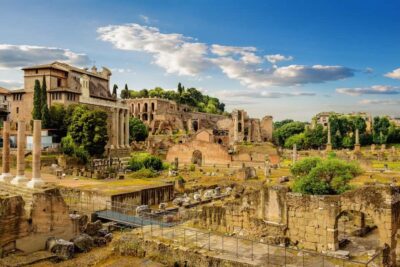
Colosseum, Roman Forum & Palatine Guided Tour
Read our review →
Colosseum & Forum with Audio Guide App -Optional Arena
Read our review →
Colosseum, Forum & Palatine Hill Tour & Optional Arena
Read our review →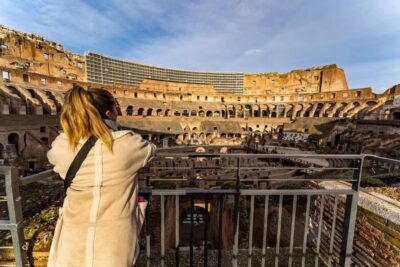
Colosseum, Roman Forum, Palatine with Multimedia Video
Read our review →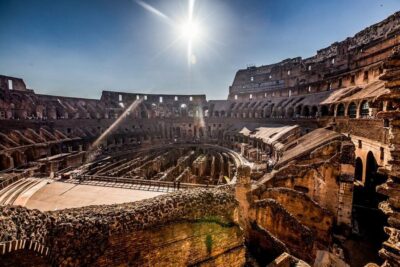
Colosseum: Underground and Ancient Rome Tour
Read our review →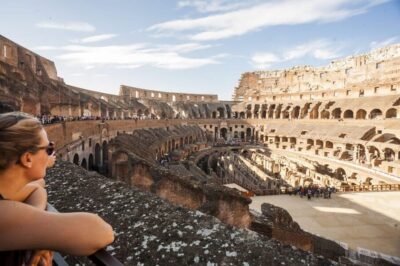
Colosseum, Forum, Palatine Hill Entry & Audioguide App
Read our review →Browse the lists this tour appears in