
Reviewed · WALKING TOURS
Rome: City Highlights Moonlight Walking Tour
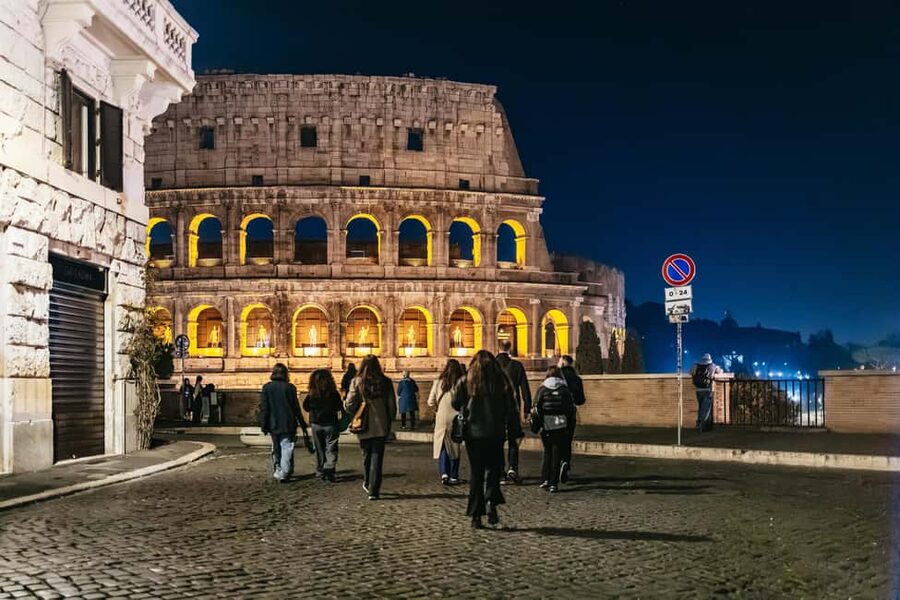
Rome is at its most atmospheric after sunset, when the stone facades glow, fountains catch the light, and the Colosseum appears almost theatrical. This tour links the city’s essential sights on foot, from Piazza Navona and the Pantheon to Trevi Fountain and the ancient forums.
I like the cooler pace and the chance to see Trevi Fountain away from the daytime crush. I also like the guides’ story-based approach. Guides including Sila, Alina, Csenge, Domenica, and Vladimir are often praised for making art and history easy to follow, with humor and useful orientation for the rest of your stay. The trade-off is simple: you see the monuments from outside, and two to two and a half hours on Roman pavement can feel long if your shoes are poor.
Key points to know before booking
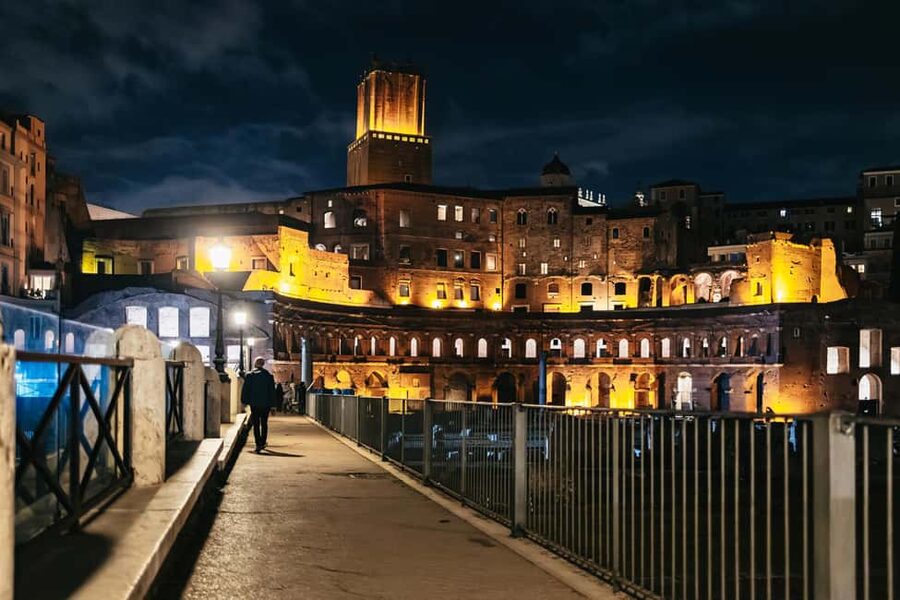
- Rome after dark: See major sights under streetlights and moonlight, when the historic center feels cooler and more relaxed.
- A useful first-night route: The walk connects many famous landmarks, making it a good way to get your bearings early in a Rome visit.
- Strong guide focus: Sila, Alina, Csenge, Domenica, Sarah, Anna, Pauline, and Vladimir are among the guides praised for clear explanations, humor, and energy.
- No attraction admissions: You walk past or view the monuments from outside, so tickets to enter the Pantheon, Colosseum, or other sites are not included.
- English or Spanish: The live tour is offered in both languages, with private groups available.
- Bring sensible shoes: The route uses city streets and includes several hours of standing, walking, and stopping.
Why Rome works so well after sunset
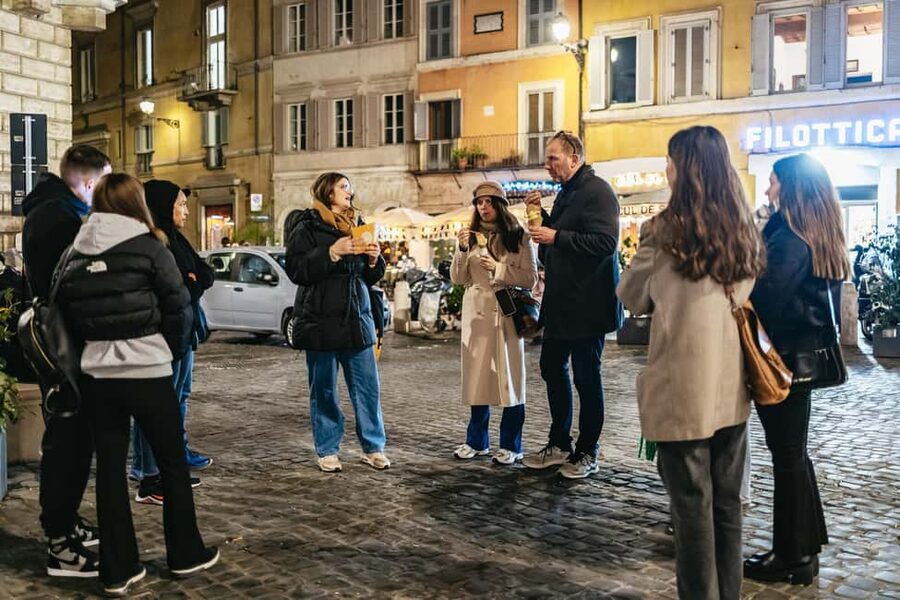
Rome’s historic center is made for an evening walk. You are not rushing between distant neighborhoods or sitting on a coach. Instead, you move through linked squares and streets where one landmark leads naturally to the next.
The night setting changes familiar sights. Bernini’s fountains look sharper under artificial light. The white Altar of the Fatherland seems even more imposing. The Colosseum, reached at the end, becomes a dramatic final view rather than just another stop on a crowded daytime schedule.
I see this tour as a city orientation with a strong atmosphere. You get a broad introduction to Rome’s ancient, Renaissance, Baroque, and modern layers without spending the evening inside a museum. The guide supplies the context, pointing out details you could easily miss on your own.
The price is $28 per person. That is fair value if you want a guided introduction and prefer to explore on foot rather than pay for several separate sightseeing tours. It is less useful if you mainly want interior visits, since admission fees are not included and the monuments are generally viewed from outside.
Other walks around Rome:
- Rome: Trastevere & Campo de Fiori Street Food Walking Tour
★ 4.9 · 2,768 reviews - Rome: Paranormal Night Walking Tour & Secret Backstreets
★ 4.9 · 1,921 reviews - Rome by Night Walking Tour – Legends & Criminal Stories
★ 4.5 · 1,003 reviews
Starting in the historic center
The exact meeting point depends on the option you book. The listed starting choices are Piazza d’Aracoeli and Piazza di Pasquino, while the route itself centers on Piazza Navona. Check your booking details carefully before setting out, since these are different squares and Rome’s lanes can make a short distance feel confusing.
Arrive with comfortable shoes and clothes. You will be outside for the full tour, and the route includes cobbled or uneven city streets. A small bottle of water is sensible, although food and drinks are not included.
The group walks at a leisurely pace, with frequent stops for explanations and photographs. That pace suits anyone who wants stories rather than a quick checklist. It also means the tour can run from two to two and a half hours, depending on the starting time and how the group moves.
Piazza Navona and the ancient stadium beneath it
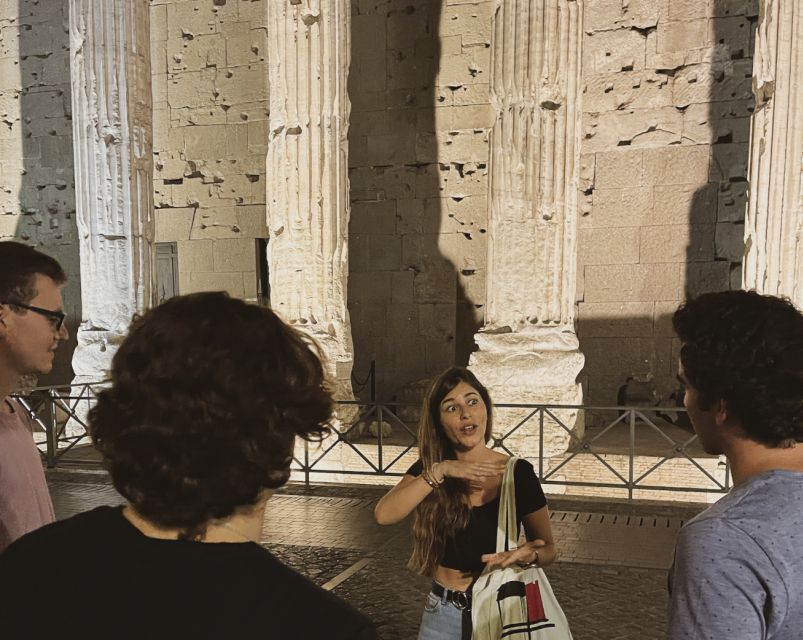
Piazza Navona is a strong place to begin because it combines ancient Rome with the city’s later artistic life. The square occupies the site of an ancient stadium where Romans watched athletic contests called agones.
Today, the center of the piazza is marked by Bernini’s Fountain of the Four Rivers. Your guide explains the fountain’s figures and symbolism while you take in the surrounding facades and evening activity. This is one of the tour’s more social stops, since the piazza remains lively after dark.
You get about 20 minutes of guided time here. That is enough for an introduction and a good look around, but not enough for a detailed study of every building or sculpture. If you want extended time in Piazza Navona, plan to return independently.
The Pantheon from the outside
The Pantheon is only about a five-minute walk from Piazza Navona, making this a natural next stop. The building is one of the best-preserved monuments from the Roman Empire, and its great unreinforced concrete dome remains one of its most remarkable features.
The tour passes by rather than taking you inside. That distinction matters. You can appreciate the massive entrance and hear why the dome is so important, but you will not see the interior, the oculus, or the tombs during this walk.
If entering the Pantheon is high on your list, set aside another visit. This tour gives you useful context and a nighttime exterior view, while a separate visit provides the full experience.
A few more things to do in Rome
- Rome: City Sightseeing Hop-on Hop-off Bus with Audioguide
★ 4.0 · 16,045 reviews - City Sightseeing Rome Hop-On Hop-Off Bus Tour
★ 3.5 · 5,446 reviews - Rome: Fettuccine Pasta Cooking Class in Rome’s City Center
★ 4.8 · 2,414 reviews - Vatican City: Vatican Museums & Sistine Chapel Entry Ticket
★ 4.3 · 2,185 reviews
Sant’Ignazio and Rome’s visual tricks
The Church of Sant’Ignazio di Loyola receives a longer guided stop, listed at about 30 minutes. This gives the guide room to discuss its artwork and architectural details rather than simply point and move on.
Several people who took the tour singled out the guides for explaining artworks, facades, and small features that might otherwise pass unnoticed. This is where that style of guiding can make a real difference. A good explanation turns a church facade or ceiling into part of Rome’s larger story.
The church also fits the nighttime route well. After the open space of Piazza Navona and the broad exterior of the Pantheon, you move into a more intimate part of the historic center. The walk feels less like a parade of famous names and more like a connected look at how Rome was built and decorated.
Galleria Sciarra and the winding backstreets
The route continues through smaller streets toward Galleria Sciarra. This section gives you a break from the major monuments and helps you notice Rome’s less obvious architectural details.
The listed stop allows about 20 minutes of guided attention. Your guide may use the gallery and nearby facades to explain decorative styles, city development, and the relationship between grand public spaces and quieter lanes.
This is also one reason to choose a walking tour instead of a hop-on, hop-off route. You move through the spaces between the headline sights, where Rome’s character is often easiest to feel. Keep your group in sight, though. Winding streets and evening crowds can make it easy to lose the guide.
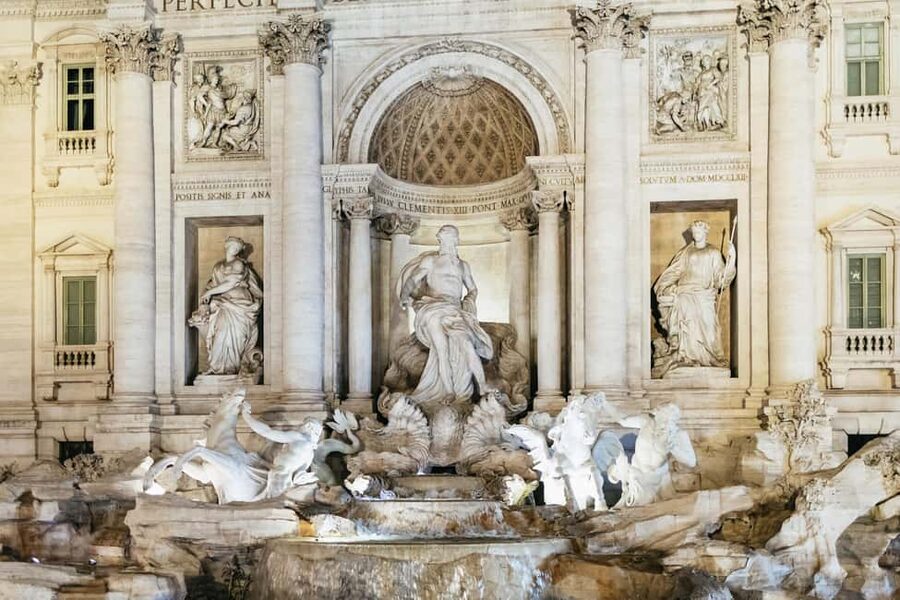
Trevi Fountain under the lights
Trevi Fountain is the emotional center of the tour for many people. You reach it at night, when the light gives the water and sculpted figures a different look from the bright daytime scene.
The guide explains the fountain’s symbols and gives you time for photographs. You can also toss a coin over your shoulder, the familiar tradition said to guarantee your return to Rome.
The timing is a major advantage. Trevi Fountain is rarely empty, but evening can feel more manageable than the busiest daytime periods. Do not expect solitude. This is still one of Rome’s most famous public spaces. The benefit is a cooler, more atmospheric visit with less pressure from the midday heat.
Plan your photos before arriving. Have your phone ready, but keep your attention on the explanation too. The fountain’s design rewards a closer look, and your guide can point out details you might otherwise reduce to a single wide photograph.
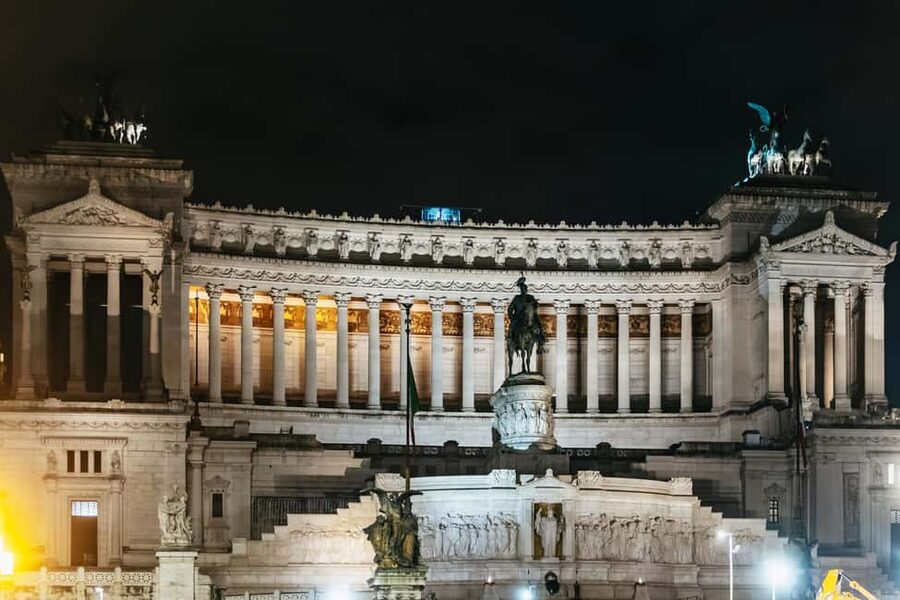
Piazza Venezia and the Altar of the Fatherland
From Trevi Fountain, the route heads through backstreets to Piazza Venezia. The square sits at a major historic junction, near the foot of Capitoline Hill and beside the Altar of the Fatherland.
This is a large, imposing setting. The white monument dominates the area, and your guide explains its place in modern Italian history as well as the significance of the surrounding streets.
The stop lasts about 20 minutes. You should have time to take in the scale of the square and listen to the main story, but the tour does not include entry to the monument. If you want rooftop or museum access, that requires a separate ticket and visit.
Piazza Venezia can also be busy and noisy, even at night. Stay close to the guide when crossing or moving through the area. The atmosphere is part of the experience, but it is not a quiet stop.
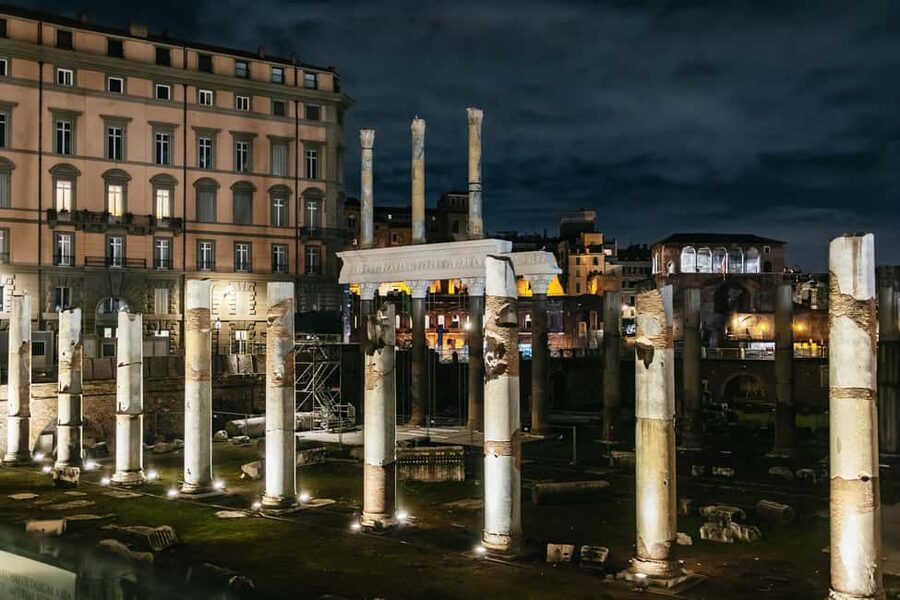
Trajan’s Column and the Imperial Forums
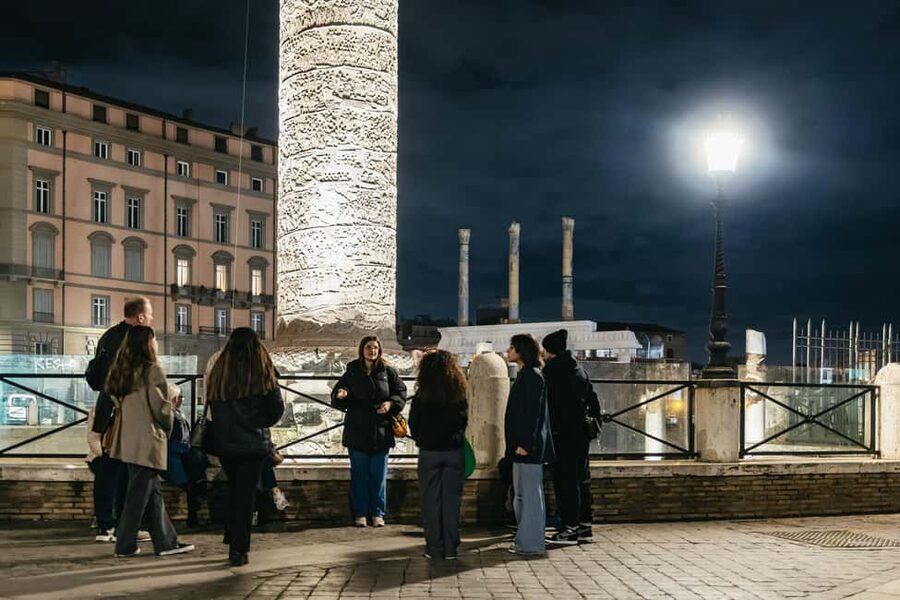
The tour then turns onto Via dei Fori Imperiali, the broad boulevard running through the ancient center of Rome. Along the way, you pass Trajan’s Column and the remains of the forums associated with Trajan, Augustus, and Nerva.
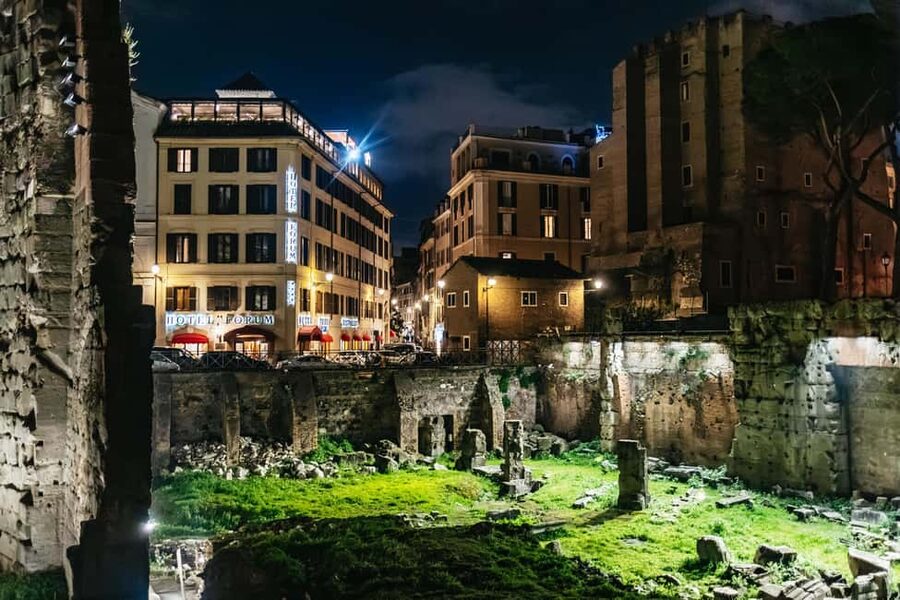
This stretch is especially valuable because the ruins are hard to read without help. At night, shadows and lighting can make the columns and broken walls striking, but they can also make the site feel abstract. The guide connects the remains to ancient Rome’s political and imperial life.
You pass Trajan’s Column rather than enter a museum or archaeological site. That keeps the walk moving and the price low, but you will not study the reliefs close up. If ancient Roman archaeology is your main interest, pair this tour with a daytime visit to the Colosseum and Forum area.
Via dei Fori Imperiali itself gives you a grand approach to the final stop. The road frames the ancient remains and leads toward the Colosseum, making the last part of the walk feel deliberate rather than incidental.
Ending beneath the Colosseum
The tour finishes at the Colosseum area, with listed drop-off points including Piazza del Colosseo and the Colosseum. The exact end point may vary, so confirm the details for your booking.
Seeing the Colosseum illuminated is a fitting finish. You do not enter, but the exterior view is powerful, especially after following the ancient forums toward it. The guide can tie together the earlier discussions of Roman public life, imperial ambition, and the city’s long afterlife.
This final stop also gives you an easy choice for the rest of your evening. You can continue taking photographs, find a nearby place to eat, or use the surrounding transport connections, depending on your plans. Since the activity ends in the Colosseum area rather than returning you by vehicle, plan your onward route in advance.
The guides make the difference
The strongest part of this experience is the human delivery. The tour depends on the guide turning a sequence of monuments into a story.
Sila is praised for connecting small details, including architectural features and even ordinary street objects, to Rome’s past. Alina is described as energetic, attentive, and generous with extra information. Csenge is noted for a friendly style and clear explanations, while Vladimir brings humor and a relaxed pace.
Domenica is praised for building a narrative instead of simply listing sights. Sarah and Anna are also described as lively and engaging. Pauline, sometimes listed as Paulina, is noted for explaining complex history in an easy-to-follow way.
Guide assignments can change, so you should not book expecting one particular person unless your reservation specifically confirms it. The broader pattern is clear: this tour works best when you want conversation, interpretation, and historical stories rather than an audio guide or a silent photo walk.
Private groups are available. That option may suit families or friends who want a more flexible rhythm, but the standard tour is the better value if you are comfortable sharing the walk with others.
Who will enjoy this walk most
I would choose this tour early in a Rome stay. It gives you a practical map of the historic center and helps you decide which places deserve a longer return visit.
It suits you especially well if:
- You have limited time and want several famous sights in one evening.
- You prefer walking to coach sightseeing.
- You enjoy history, art, architecture, and stories about how places connect.
- You want to avoid the heat of a daytime tour.
- You would rather see interiors separately and keep this activity focused on the city streets.
- You want a guided overview before exploring Rome on your own.
It may not suit you if you have limited mobility, dislike standing for long periods, or want admission to the Pantheon, Colosseum, and archaeological sites included. The supplied information does not describe accessibility arrangements, so ask the operator directly if that is important for you.
Practical value, timing, and what to bring
At $28, the tour offers a lot of ground for the money. You receive a live guide, a route through central Rome, and interpretation at major landmarks. You do not pay for food, drinks, or attraction entry, and those omissions keep the focus on walking and sightseeing.
The tour lasts two to two and a half hours. Starting times vary, so choose an evening slot that leaves enough room for dinner or another activity afterward. Rome’s late-night atmosphere is part of the appeal, but you should still check the end location before making plans.
Wear shoes that can handle several miles of city walking, even if the exact distance is not stated. Bring a phone or camera, and dress for the evening temperature. Comfortable clothing is specifically recommended.
Cancellation is flexible up to 24 hours before the activity for a full refund. You can also reserve now and pay later, which helps if your Rome schedule is still taking shape.
Should you book the Rome Moonlight Walking Tour?
Yes, if you want a lively introduction to Rome’s historic center and are happy to see the monuments from outside. The route is well chosen: Piazza Navona, the Pantheon, Sant’Ignazio, Galleria Sciarra, Trevi Fountain, Piazza Venezia, the Imperial Forums, and the Colosseum give you a broad view of Rome in one evening.
I would book it near the start of your stay, especially if you have only a few days. You will learn where the major sights are, hear useful context, and collect ideas for return visits.
Skip it if your main goal is entering the Colosseum or Pantheon, or if you want a small, quiet museum-style experience. For everyone else, the combination of nighttime views, a reasonable price, and guides who bring humor and detail to the walk makes this a practical first taste of Rome.
FAQ
How long does the Rome City Highlights Moonlight Walking Tour last?
The tour lasts about 2 to 2.5 hours. Starting times vary, so check availability when choosing your date.
What sights are included on the walking route?
The route includes Piazza Navona, the Pantheon, Sant’Ignazio di Loyola, Galleria Sciarra, Trevi Fountain, Piazza Venezia, Trajan’s Column, Via dei Fori Imperiali, and the Colosseum area.
Does the tour enter the Colosseum or Pantheon?
No. The tour is a walking sightseeing experience, and attraction entry is not included. The Pantheon and Colosseum are viewed from outside.
What languages are available?
Live guides are available in English and Spanish.
Where does the tour start and finish?
The starting point may be Piazza d’Aracoeli or Piazza di Pasquino, depending on the option booked. The tour ends at the meeting point or at listed locations in the Colosseum area. Confirm the exact details with your booking.
Can I cancel the tour or pay later?
You can cancel up to 24 hours in advance for a full refund. A reserve-now, pay-later option is also available.
Just added in Rome
- Civitavecchia Private Transfer: From the Port to Rome Airport★ 5.0 · 309 reviews
- Civitavecchia Shore Excursion: Best of Rome Private Tour★ 5.0 · 247 reviews
- Civitavecchia Private Transfer from ship to FCO airport or Rome★ 5.0 · 245 reviews
- Food Tasty and History Tour in Civitavecchia★ 5.0 · 256 reviews
- Palatine Hill and Roman Forum Tour with Fast-Track Entrance★ 4.2 · 417 reviews
- Tivoli: Villa D’Este & Villa Adriana Pass & App Audioguide★ 4.4 · 364 reviews
- Tivoli: Villa D’Este Entry Ticket and App Audio Guide★ 4.3 · 191 reviews
- Vatican Museums & Sistine Chapel Skip-the-Line Guided Tour★ 4.6 · 254 reviews
Walking Tours, compared.

Guided Walking Tour & Last Supper Visit with Ticket
Read our review →
Rialto Bridge & Offbeat Unusual Venice Walking Tour
Read our review →
Private 3 hrs Venice Tour: St Mark’s, Walking tour & Boat tour
Read our review →
Skip the line: Uffizi and Accademia Small Group Walking Tour
Read our review →Browse the lists this tour appears in