Reviewed · TOURS IN ROME
Rome: Catacomb of St. Callixtus and Appian Way Guided Tour
Rome’s ancient world feels different beneath the ground. At the Catacombs of St. Callixtus, you walk through narrow burial passages cut into soft tufa, then return to the open air along the old Appian Way and beneath enormous aqueduct arches. I like the change from crowded central Rome to quiet countryside, and I like that the three-hour outing combines Christian history, Roman engineering, and a little walking without making you arrange several separate visits. The main catch is that the catacombs involve stairs and enclosed passages, and you cannot take photographs underground.
This is a strong choice after busy days at the Colosseum and Vatican. Guides including Catia, Lara, Marije, Francesca, and others have been praised for lively explanations, good English, and helpful suggestions for the rest of your time in Rome. Still, the small minibus can limit your view during the drives, and the tour needs at least five participants to run.
Key points
- St. Callixtus underground: Walk through ancient Christian burial corridors, burial niches, sarcophagi, mosaics, and early religious art.
- The Crypt of the Popes: See the area associated with early Christian leaders and a replica of St. Cecilia’s tomb.
- Original Appian Way: Walk a section of Rome’s oldest major roads and picture Roman soldiers and pilgrims using the route.
- Cecilia Metella’s mausoleum: View the exterior of one of the best-known monuments along the Appian Way.
- Aqueduct park: Leave the city behind for broad views of ancient arches and a peaceful walking path.
- Useful transport: A minibus carries you between the catacombs, Appian Way, and aqueduct area, saving time and effort.
Why this outing is worth leaving central Rome
Most first-time visits to Rome concentrate on the historic center. That makes sense, but it can also make the city feel like one long line for monuments, followed by another crowded square. This tour gives you a different Rome, one of burial grounds, rural paths, old stone roads, and huge water channels.
I especially like the mix of subjects. The catacombs explain how early Christians buried their dead. The Appian Way shows the practical side of Roman power: roads built to move armies, officials, goods, and news. The aqueducts show how the city supplied water on a scale that still seems hard to grasp.
The three-hour format keeps the outing manageable. You are not committing a full day to sites far outside the center, yet you see places that are awkward to connect by public transportation. Transport is included from the meeting point at Via Cavour 224, near Cavour Metro station on Line B, with a return to the same general meeting point.
At $80 per person, I see this as a convenience purchase as much as a sightseeing ticket. The price includes transport, the three-hour guide, entry and booking fees for St. Callixtus, and headsets. You are paying to connect several scattered sites with a guide rather than spending time figuring out buses and entrances yourself.
A few more things to do in Rome
- Colosseum, Roman Forum & Palatine Guided Tour
★ 4.7 · 63,148 reviews - Vatican Museums, Sistine Chapel & St Peter’s Basilica Guided Tour
★ 4.5 · 39,149 reviews - Rome: Colosseum, Palatine Hill and Roman Forum Guided Tour
★ 4.8 · 32,814 reviews
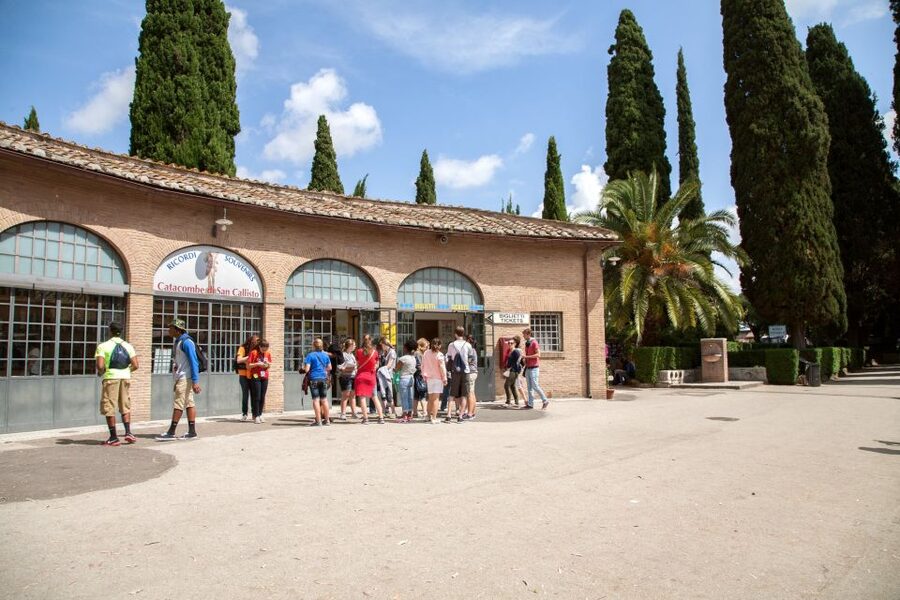
Entering the Catacombs of St. Callixtus
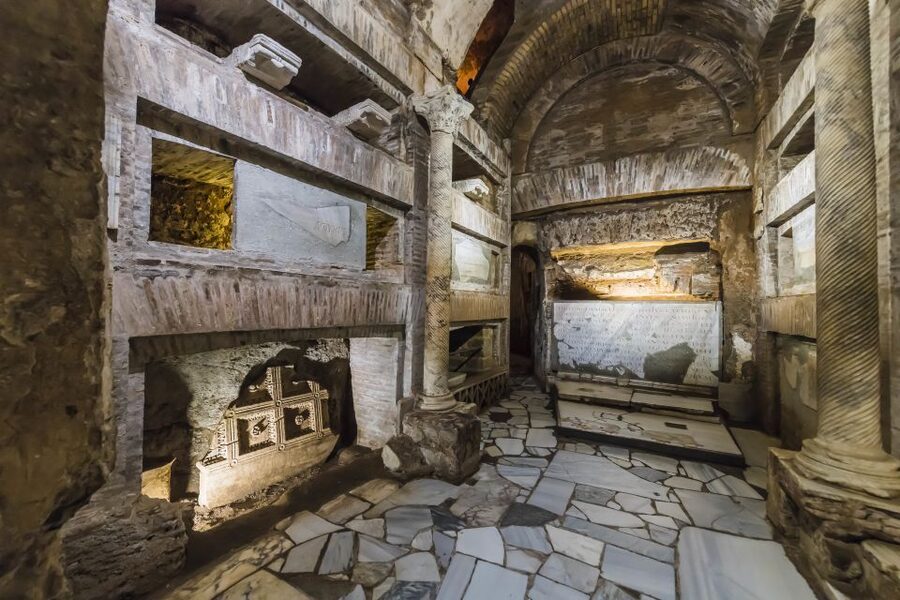
The catacombs are the heart of the outing. These underground complexes were cut into the soft tufa rock around Rome between the second and fifth centuries, when the growing Christian community needed burial space for large numbers of people. Many families could not afford a grand tomb, so these communal underground cemeteries offered a practical answer.
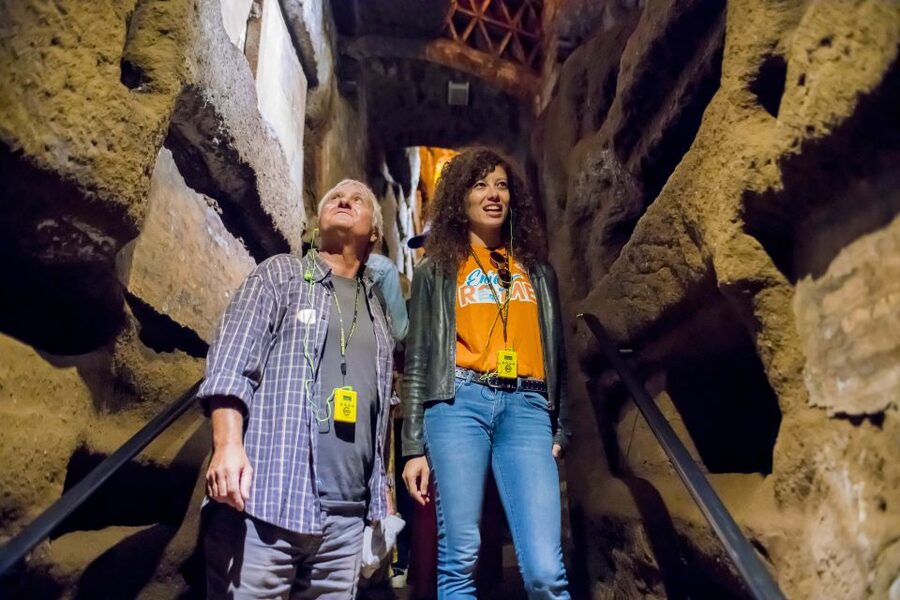
Inside, expect a sober rather than theatrical experience. You pass burial niches cut into the walls, along with sarcophagi, mosaics, inscriptions, and religious drawings. Some passages are narrow, and the surroundings are dim. The point is not spectacle. It is the chance to see how ordinary people and early Christian communities dealt with death.
The St. Callixtus complex includes the Crypt of the Popes, associated with several early Christian leaders. You may also see a replica of the tomb of St. Cecilia. The original burial setting and the early Christian artwork give this stop particular weight, especially if you have an interest in church history.
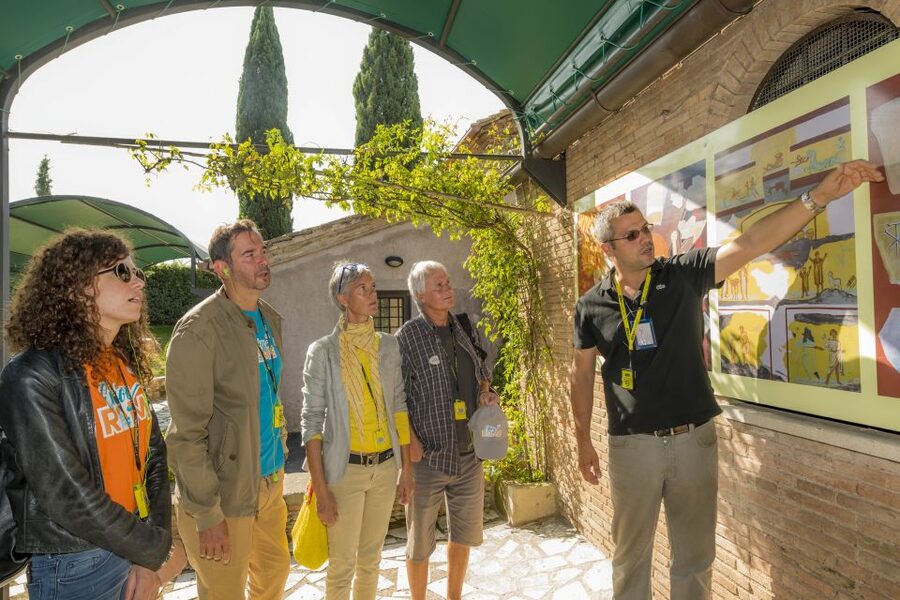
A catacomb guide from the site leads the underground portion, while your main tour guide handles the broader route and explanation. That arrangement matters because the catacombs have their own rules, access procedures, and historical details. Several guides who have led the full outing, including Catia and Lara, have been praised for making the history clear without losing the human side of the story.
Photography is not allowed inside. That can disappoint anyone hoping to collect underground images, but it also keeps the visit quiet and focused. Bring your attention rather than your camera. You will get more from noticing the scale of the passages, the repeated burial spaces, and the traces of early belief.
The catacombs are not suitable for anyone with severe claustrophobia. You should also be ready for stairs and uneven walking. A previous participant who used a cane found the visit manageable, but this is not a wheelchair-accessible activity, and comfort will vary from person to person.
Walking the ancient Appian Way
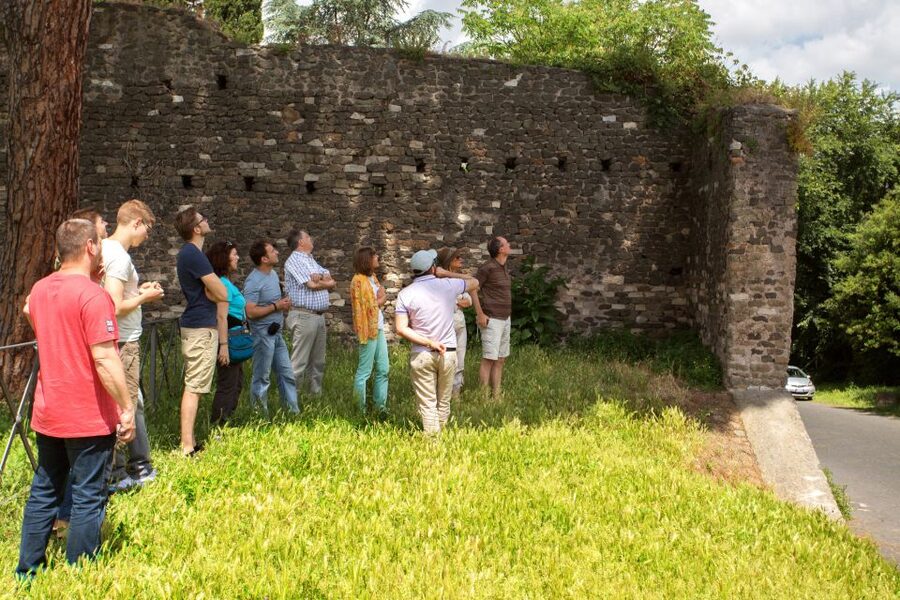
After the catacombs, the minibus takes you toward the Appian Way. This was one of ancient Rome’s major roads, and a short walk here gives you a useful sense of how the city once connected to the wider Roman world.
Do not expect a long hike. The route is a portion of the old road, and the walking pace has generally been described as manageable. That makes it a good fit if you want to see the countryside but have already spent several days walking across Rome.
The old stones give this stop its force. You are not simply looking at a road in a museum case. You are walking along an ancient route and hearing how it functioned. Guides have sometimes used the image of Roman soldiers marching in formation to help visitors picture the road in use.
Along the way, you view the exterior of the Mausoleum of Cecilia Metella. The large round tomb is one of the most recognizable monuments along the Appian Way. The tour does not promise an interior visit, so treat this as an exterior viewing and explanation rather than a full archaeological entry.
This portion can be weather-dependent in comfort. In rain or cold, the open road is less inviting, and one past group chose to remain on the bus while others walked. In hot weather, the catacombs provide a cool break, while the road and open areas can feel exposed. Wear sensible shoes and bring protection from the sun when needed.
Roman aqueducts in a quiet park
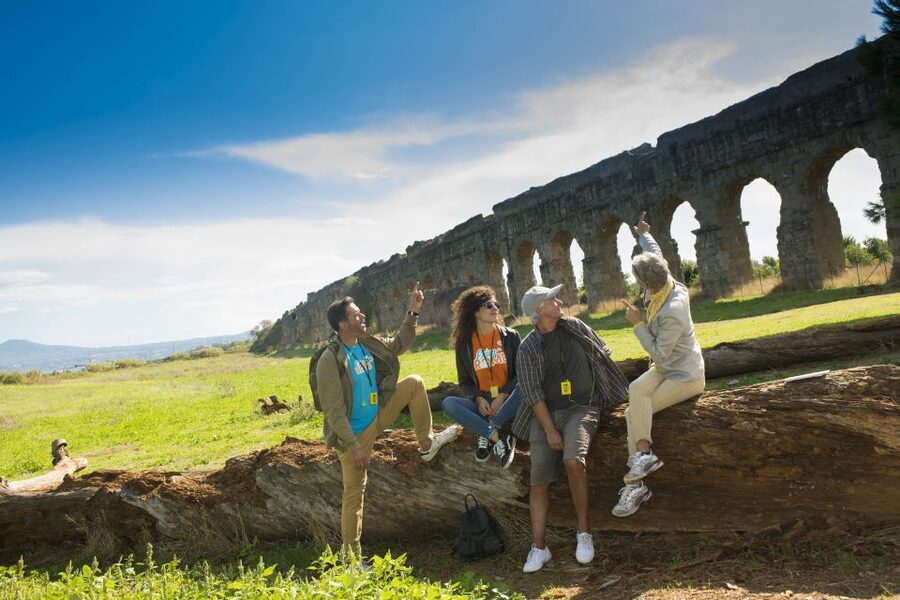
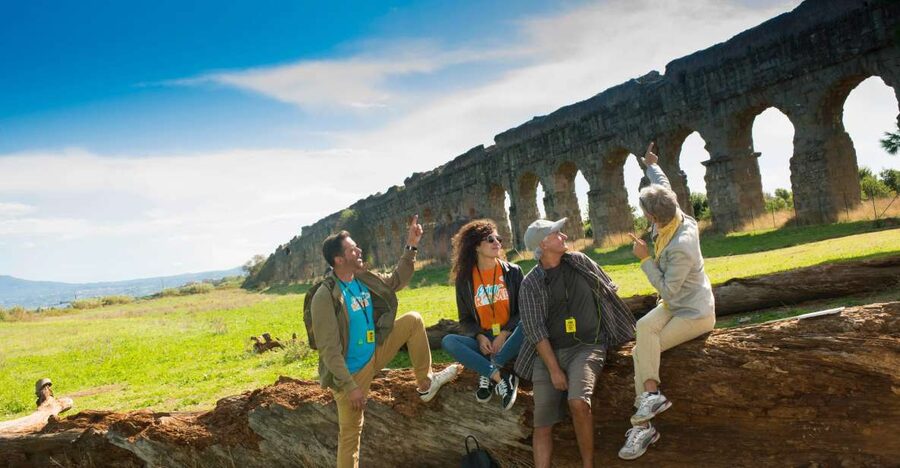
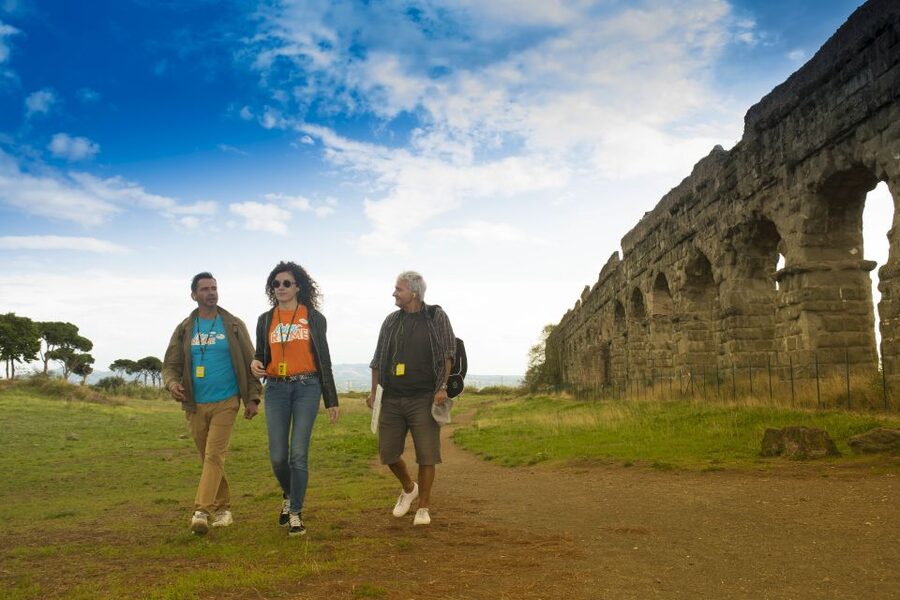
The aqueduct stop is often the visual highlight. The minibus takes you to the area around Parco degli Acquedotti, where you walk along a path and see the ancient arches stretching across open ground.
These aqueducts were built to carry water toward Rome. Their scale explains the achievement better than a paragraph in a guidebook can. The arches are not isolated ruins squeezed between modern buildings. Here, you can step back and see how the structure crosses the countryside.
I like this part because it slows the tour down. After the enclosed catacombs and the historical concentration of the Appian Way, the aqueduct park gives you room to walk, look, and take photographs. The contrast is one of the outing’s strengths: dark underground corridors, weathered road stones, and open views beneath towering arches.
The route is guided, so you are not left to guess which ruins you are seeing or why they mattered. Guides such as Lara, Marije, Francesca, and Catia have been praised for adding information during the drives as well as at the sites. That can make the transfer time useful instead of dead time.
Do keep expectations realistic. This is a short visit, not a full archaeological survey of every aqueduct in Rome. You get a walk and viewpoints rather than a long exploration of the park. For most people, that is enough to make the stop memorable without turning the morning into an exhausting march.
Same base, a different kind of day:
- Vatican: Museums & Sistine Chapel Entrance Ticket
★ 4.5 · 144,003 reviews - Vatican Museums & Sistine Chapel Tour with Optional Basilica
★ 4.3 · 67,413 reviews - Rome: Guided Tour of Colosseum, Roman Forum & Palatine Hill
★ 4.7 · 27,897 reviews - Rome: Colosseum & Forum with Audio Guide App -Optional Arena
★ 4.2 · 24,770 reviews
The guide makes the difference
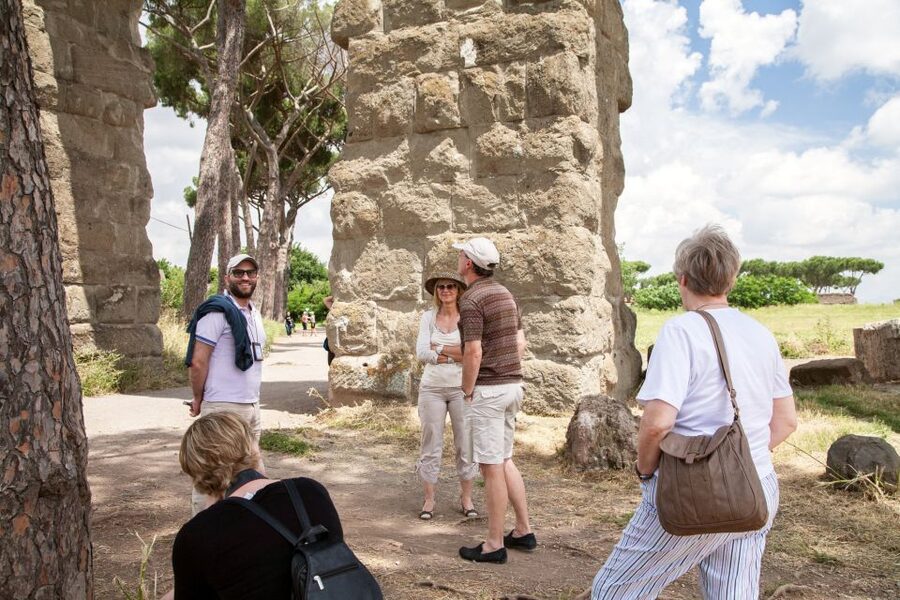
The route is straightforward, but the quality of the guide shapes the experience. Strong guides have included Catia, Lara, Marije, Francesca, Marije, and others whose names appear in different tour dates. Their shared strengths have been clear English, strong command of Roman history, and the ability to explain what you pass on the road.
Catia has been praised for being engaging and for helping families manage breaks. Lara has been described as an archaeologist and historian who could make the catacombs and aqueducts feel immediate. Marije was valued for combining serious historical detail with humor and practical restaurant advice. Francesca was praised for keeping the tour moving while adding information during the transfers.
You may not receive one particular guide, so I would not book solely on a guide’s name. The useful point is that the tour depends on live explanation. The headsets help you hear the guide while walking, and past groups have found the sound clear. They are especially helpful around the road and aqueducts, where people naturally spread out.
The driver also matters. The service uses small vans or minibuses, and drivers such as Mario have been praised for comfortable driving and handling Rome traffic. One practical weakness is visibility. A higher bus would give you a better view during transfers, and the windows on some smaller vans can make sightseeing from your seat difficult.
Transport, timing, and group feel
Meet at the bus stop at Via Cavour 224, near Cavour station, 25 minutes before departure. Hotel pickup is not included, so allow time to reach the meeting point, especially if you are staying outside the central area.
The tour lasts three hours and uses transport between the separate sites. That is the right setup for this route. Walking the entire distance would take far longer, and public transportation would make the schedule harder to manage.
Group size can vary. Some outings have been very small, including groups of six or seven, while others have had around 14 people. Small groups make it easier to hear the guide, ask questions, and move through the sites without feeling herded.
Traffic can affect departure or arrival. One past outing began 45 minutes late because of traffic but still ran for the full three hours. Rome traffic is a genuine factor, so avoid scheduling a tight lunch reservation immediately afterward.
The tour is offered in English. If English is not your first language, the headsets and clear guide delivery should help, but the catacomb section still involves specialized historical terms. Ask questions when needed. Good guides have generally welcomed them.
Who should book this tour
I would choose this tour if you have at least three days in Rome and want a break from the Colosseum, Vatican, and crowded central streets. It is also a good match for history fans, early Christian pilgrims, architecture enthusiasts, and anyone curious about Roman engineering.
Families can do well here if children can manage stairs, quiet explanations, and an enclosed setting. The tour is not built around entertainment, but a lively guide can keep young visitors interested. Breaks may be possible, though you should not expect a stroller-friendly route.
This is less suitable if you dislike underground spaces, cannot manage steps, or want a private and fully flexible visit. It is also not the best choice if you want extensive time at each location. The schedule connects several stops, so each one receives a focused visit rather than a long, independent exploration.
The tour works particularly well after several intense days in central Rome. The open Appian Way and aqueduct park provide a quieter change of pace, while the transport lets you rest between walks.
Is the $80 price fair?
For $80, the value comes from the combination of access, transport, and interpretation. Entry and booking fees are included, as are headsets and the guided catacomb visit. You also avoid arranging separate transportation to three places outside the historic core.
The price is less attractive if you only want to see one site or prefer exploring alone. The Appian Way and aqueduct park can be enjoyed at a slower pace on an independent visit, but you would need to plan the connections and research the sites yourself.
I consider the cost fair for a first visit, especially if your Rome schedule is full. The tour packs several distinct experiences into three hours without requiring a full day. You are paying for a practical route and a guide who connects the pieces.
Book with some flexibility. Cancellation is free up to 24 hours before departure, and you can reserve now and pay later. The minimum of five participants means a date can be rescheduled or canceled with a full refund if too few people book.
Should you book it?
Book this tour if you want Rome beyond the famous center, value a strong live guide, and can handle stairs and enclosed passages. The Catacombs of St. Callixtus provide the most unusual stop, while the Appian Way and aqueducts give you space, Roman engineering, and a welcome change of scenery.
Skip it if claustrophobia is a concern, you need wheelchair access, or you want photographs inside the catacombs. For everyone else, this is a well-planned three-hour outing that makes scattered ancient sites easy to reach and gives you a more varied picture of Rome.
FAQ
How long does the Catacomb of St. Callixtus and Appian Way tour last?
The tour lasts three hours, including travel by minibus and walking at the separate sites.
Where does the tour meet?
The meeting point is at the bus stop at Via Cavour 224. The nearest Metro station is Cavour on Line B. You should arrive 25 minutes before departure.
Is transportation included?
Yes. Transport from and back to the meeting point is included. Hotel pickup is not included.
Is the tour wheelchair accessible?
No. The tour is not wheelchair accessible and includes stairs and walking at the sites.
Can I take photographs inside the catacombs?
No. Photography is not permitted inside the Catacombs of St. Callixtus.
What should I wear?
You need suitable clothing for religious sites. Shorts, short skirts, sleeveless shirts, and uncovered shoulders are not allowed. Skirts and trousers should fall below the knee.
Can the tour be canceled if too few people book?
Yes. The tour requires at least five participants. If that minimum is not met, the outing may be rescheduled or canceled with a full refund.
Just added in Rome
- Civitavecchia Private Transfer: From the Port to Rome Airport★ 5.0 · 309 reviews
- Civitavecchia Shore Excursion: Best of Rome Private Tour★ 5.0 · 247 reviews
- Civitavecchia Private Transfer from ship to FCO airport or Rome★ 5.0 · 245 reviews
- Food Tasty and History Tour in Civitavecchia★ 5.0 · 256 reviews
- Palatine Hill and Roman Forum Tour with Fast-Track Entrance★ 4.2 · 417 reviews
- Tivoli: Villa D’Este & Villa Adriana Pass & App Audioguide★ 4.4 · 364 reviews
- Tivoli: Villa D’Este Entry Ticket and App Audio Guide★ 4.3 · 191 reviews
- Vatican Museums & Sistine Chapel Skip-the-Line Guided Tour★ 4.6 · 254 reviews
Tours in Rome, compared.
Vatican: Museums & Sistine Chapel Entrance Ticket
Read our review →
Vatican Museums & Sistine Chapel Tour with Optional Basilica
Read our review →
Colosseum, Roman Forum & Palatine Guided Tour
Read our review →
Vatican Museums, Sistine Chapel & St Peter’s Basilica Guided Tour
Read our review →
Colosseum & Forum with Audio Guide App -Optional Arena
Read our review →
Pantheon Fast-Track Ticket and Official Audio Guide
Read our review →
City Sightseeing Hop-on Hop-off Bus with Audioguide
Read our review →