Reviewed · TOURS IN FLORENCE
Florence: Palazzo Vecchio Entrance Ticket & Audioguide
Palazzo Vecchio is Florence’s civic heart, but inside it feels like a fortress, government office, Medici palace, and art museum rolled into one. I like the way the Salone dei Cinquecento makes the city’s political power visible, and I like having an audio or video guide to explain the paintings, rooms, and symbols above your head. The main drawback is that the guide can be confusing, especially when room numbers or letters do not match what you see.
I also like the choice to add Arnolfo’s Tower, since the climb gives you a fine view of Florence and the Duomo. You should allow enough time for the palace itself, though. Some visitors finish faster than expected, while others wish they had slowed down to study the ceilings, carvings, and Medici rooms.
Key points to know before you go
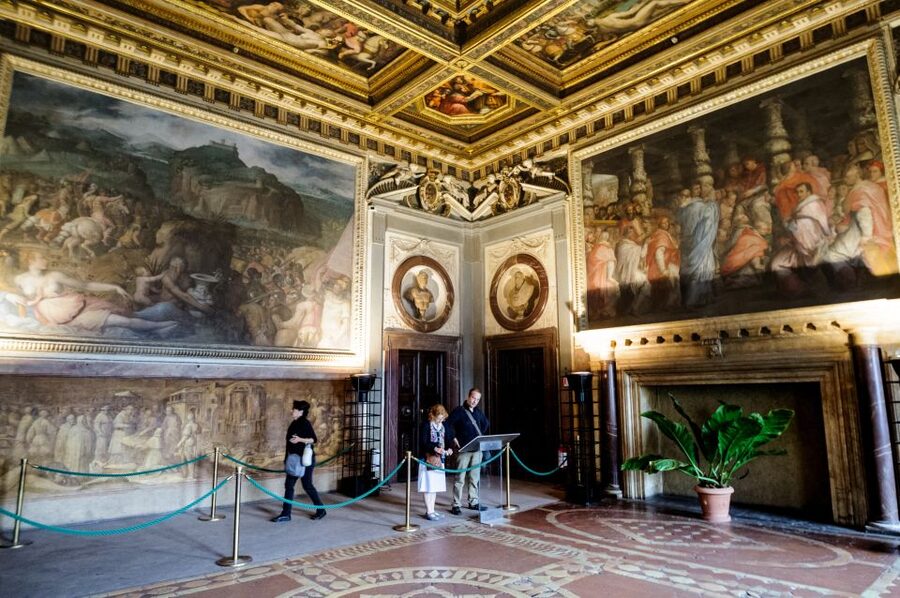
- Vasari’s Salone dei Cinquecento: See Florence’s enormous council hall, filled with paintings, carved details, and political theatre.
- Two guide choices: Select a standard audio guide or a 7-inch tablet with video, high-definition images, and 3D recreations.
- Tower views: Add Arnolfo’s Tower for a climb and broad views over Florence, the Duomo, and the Tuscan hills.
- Easy ticket collection: Enter from Piazza della Signoria, then go to the InfoPoint counter in the courtyard rather than waiting at the regular ticket line.
- A self-guided visit: You set the pace, but the guide’s numbering system and map may take time to understand.
- A weather warning: Tower access can be suspended in rain, and children aged 6 and under cannot climb it.
Why Palazzo Vecchio matters in Florence
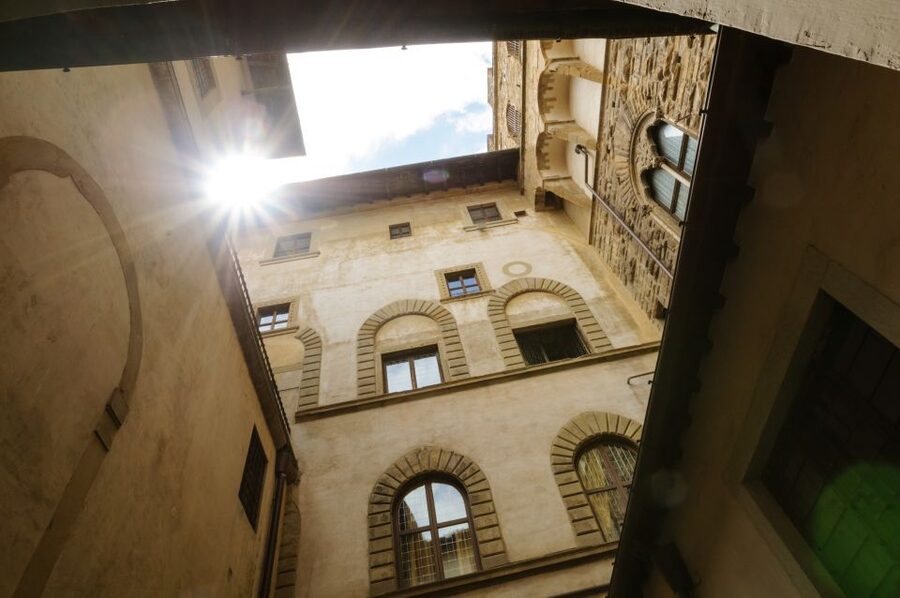
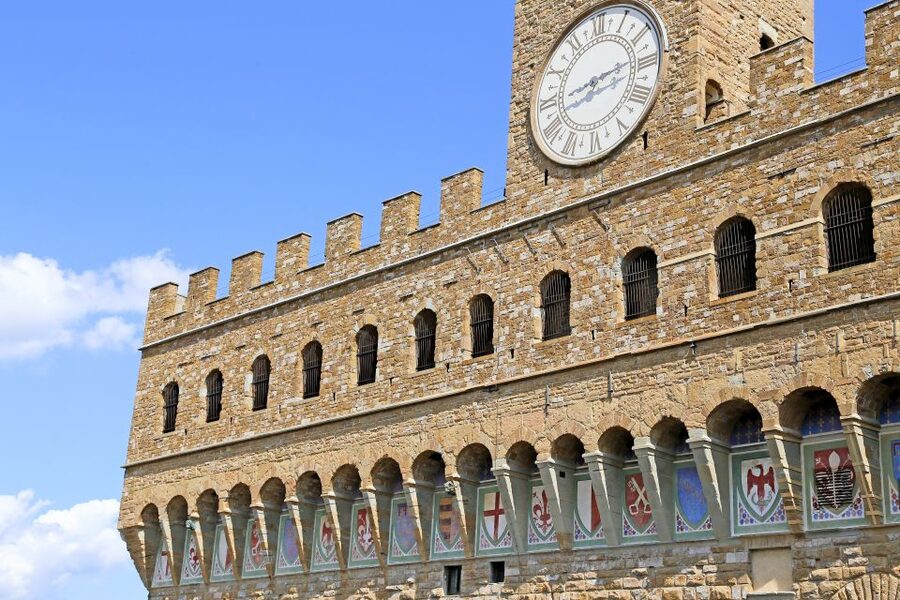
Palazzo Vecchio began in 1299 as the seat of Florence’s medieval government. Its thick, severe exterior reflects a city that wanted its political center to look strong and secure.
Later, the Medici family turned the building into a palace. That change is the key to understanding the visit. You are not simply walking through an old town hall. You are moving through rooms shaped by political ambition, family power, art, and ceremony.
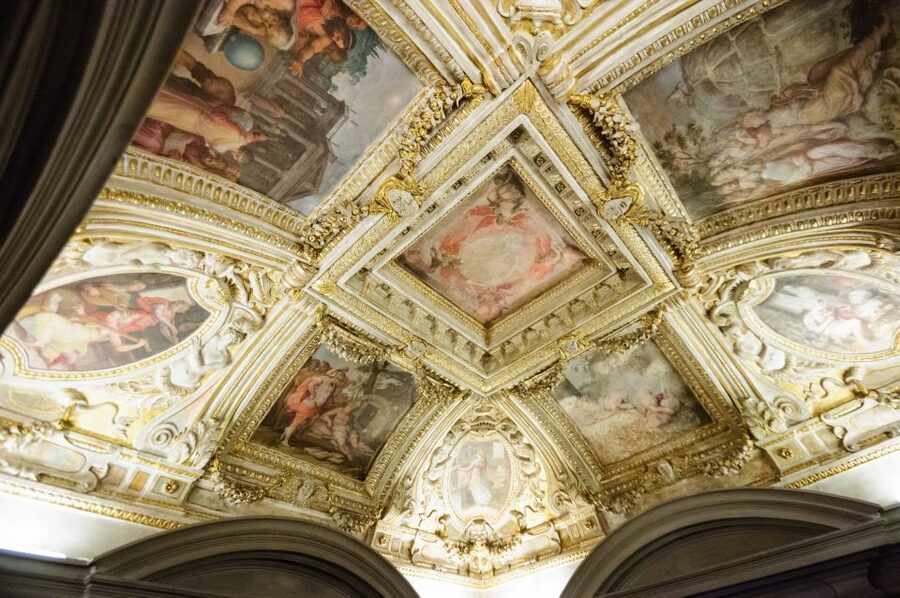
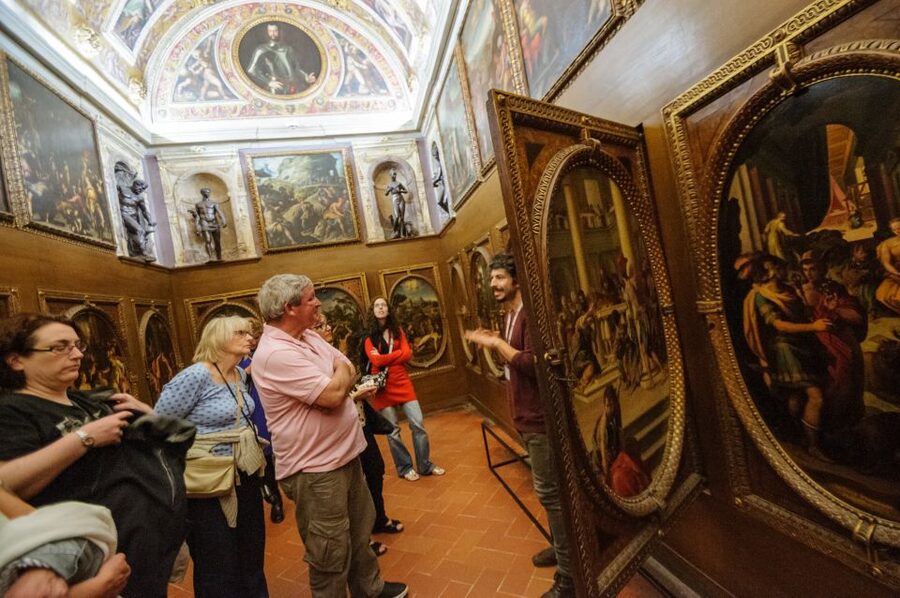
I find the building most rewarding when you look up. Painted ceilings, carved beams, wall decoration, and sculptural details compete for attention. Some works are easy to miss if you focus only on the large paintings at eye level.
The palace also helps explain Florence beyond its famous churches and galleries. Here, art serves government. A grand hall is not just beautiful. It tells you who ruled, who was expected to obey, and how public space could be used to display authority.
A few more things to do in Florence
- Florence: Skip-The-Line Uffizi Gallery Timed Entry Ticket
★ 4.5 · 27,832 reviews - Florence: Timed Entrance Ticket to Michelangelo’s David
★ 4.6 · 16,983 reviews - Florence: Michelangelo’s David Skip-the-Line Entry Ticket
★ 4.5 · 12,764 reviews
Entering from Piazza della Signoria
The entrance is on Piazza della Signoria, one of Florence’s most important public squares. Once inside the courtyard, go to the ticket office and head directly to the InfoPoint counter to use the skip-the-ticket-line arrangement.
The process is generally straightforward, but the entrance can be confusing if you do not know where to go. The useful detail is this: the meeting point is not a separate street office. You enter Palazzo Vecchio first, then find the InfoPoint inside the courtyard.
Bring a passport or other valid identification. If you choose the multimedia tablet, you must leave a valid ID at the ticket office while you use the device. This is easy enough, but it is worth knowing before you arrive.
Your ticket is valid for the selected time. Access to some rooms can change if an event is taking place, and the Hall of 500 is closed on September 16, 22, 23, 24, and 25. If your Florence visit falls on one of those dates, check your plans before paying for this particular entry.
The courtyard and the first rooms
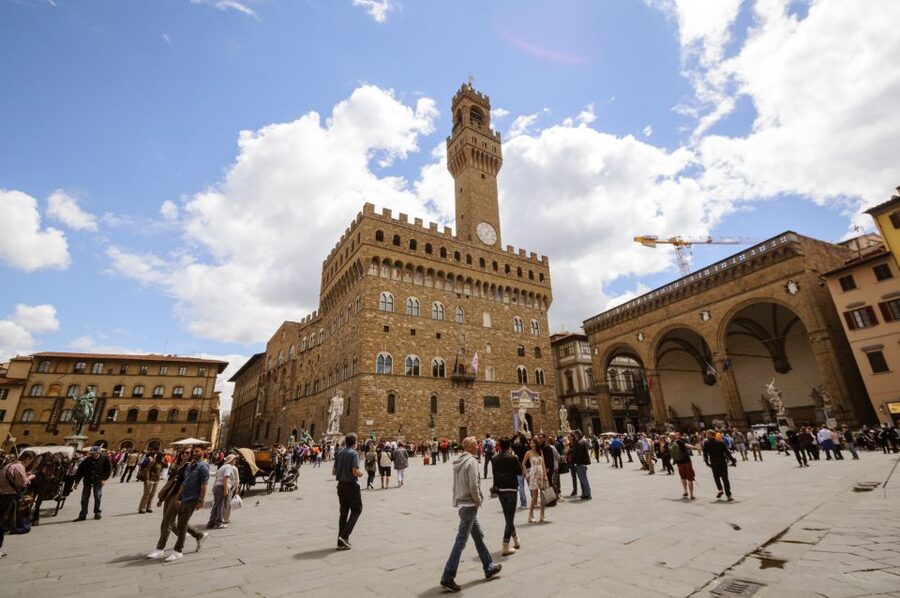
The courtyard prepares you for the rest of the building. It gives you a quick sense of the palace’s blend of government and display before you reach the main museum rooms.
From there, you enter a series of decorated spaces connected with Florence’s rulers and public life. The visit is self-guided, so you can pause when a ceiling catches your eye or move on when a room feels less important to you.
I recommend looking at the architecture before reaching for the guide. Notice the floor, the wall decoration, the scale of the rooms, and the carved ceiling details. Then use the narration to connect those details with the people and events behind them.
The experience works best when you do not treat the audio as a checklist. The palace can feel crowded with information, and the guide may give you more material than you want in every room. Choose the sections that interest you most, then keep moving.
The Salone dei Cinquecento and Vasari’s grand design
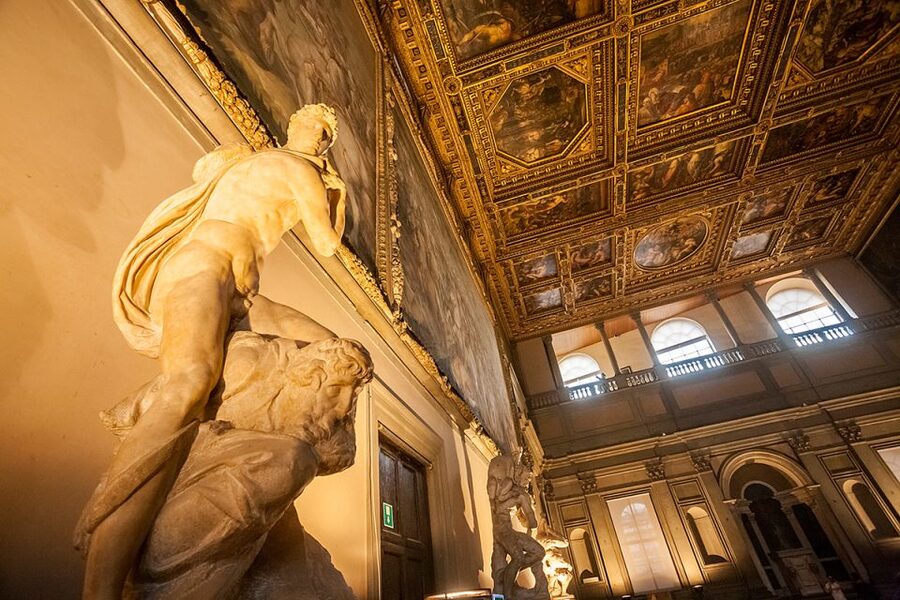
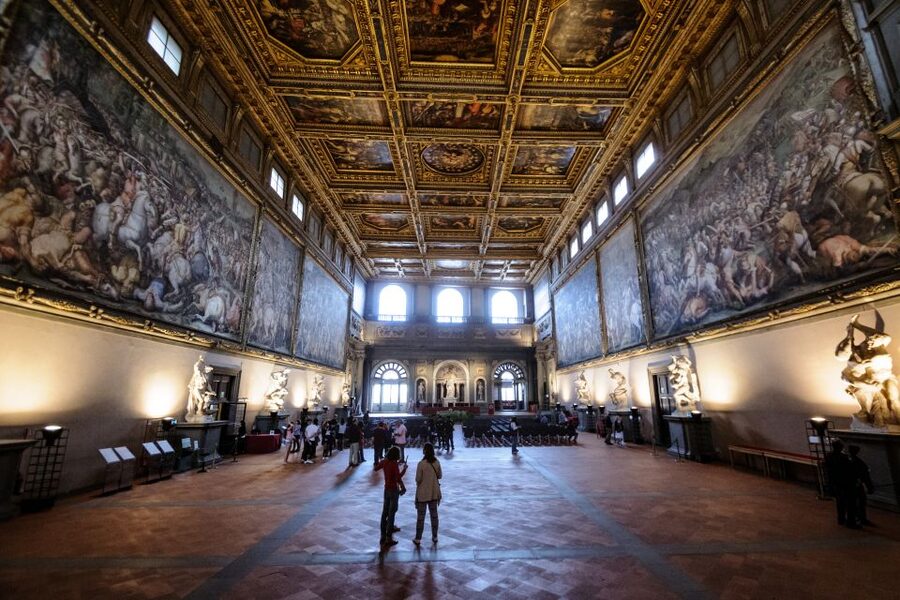
The Salone dei Cinquecento is the visual center of the palace. Built for Florence’s governing council, it is huge, formal, and designed to make political power feel physical.
Giorgio Vasari’s works dominate the room. The scale can be hard to absorb at first, so give yourself time to stand back and look across the walls and ceiling. The paintings are not placed in a quiet gallery setting. They are part of an architectural program meant to impress anyone entering the hall.
This is where the audio or video guide earns its keep. Without context, you may see a grand room filled with paintings and ornament. With an explanation, you begin to understand how art, civic pride, and Medici control fit together.
The guide is not perfect. Several people have found the numbers or letters difficult to match with the rooms. Labels may not always be obvious, and the map on the tablet can take a moment to interpret. I suggest checking your position before starting each track rather than blindly following the sequence.
The Hall of 500 can also be closed for an event, so access is not guaranteed on every visit. That matters because it is the room many people most want to see.
Same base, a different kind of day:
- Tuscany Day Trip from Florence: Siena, San Gimignano, Pisa and Lunch at a Winery
★ 5.0 · 21,634 reviews - The Best tour in Florence: Renaissance & Medici Tales – guided by a STORYTELLER
★ 5.0 · 12,316 reviews - Florence: Leonardo Interactive Museum Entry Ticket
★ 4.5 · 11,763 reviews - The Best Tour in Florence: Renaissance and Medici Tales
★ 5.0 · 10,810 reviews
The audio guide or the 7-inch multimedia tablet
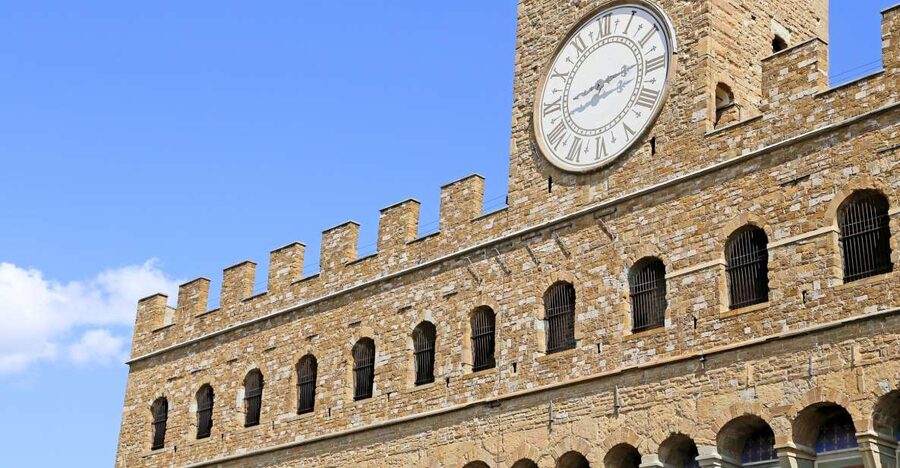
You can choose between a standard audio guide and a multimedia guide on a 7-inch tablet. The tablet adds photographs, high-definition images, audio-video narration, and 3D recreations. It can help you picture how certain rooms looked during the Medici period.
The standard audio guide is the simpler choice. It lets you keep your attention on the building rather than on a screen. Audio options are listed in Spanish, English, French, German, Russian, Italian, Chinese, and Portuguese, though the initial description also lists a smaller five-language selection. Confirm your preferred language when booking.
I would choose the tablet if you like visual explanations and want extra help connecting art with its original setting. I would choose the audio guide if you prefer to look around without holding a device.
The biggest weakness is navigation. Room numbers can be hard to find, and letters on the screen may not match obvious signs in the palace. Take a few minutes to understand the map at the beginning. If you have earphones, bring them, though disposable earphones may be provided if needed.
The guide is also the same for children and adults. Families should not expect a special children’s version.
Arnolfo’s Tower: the optional climb
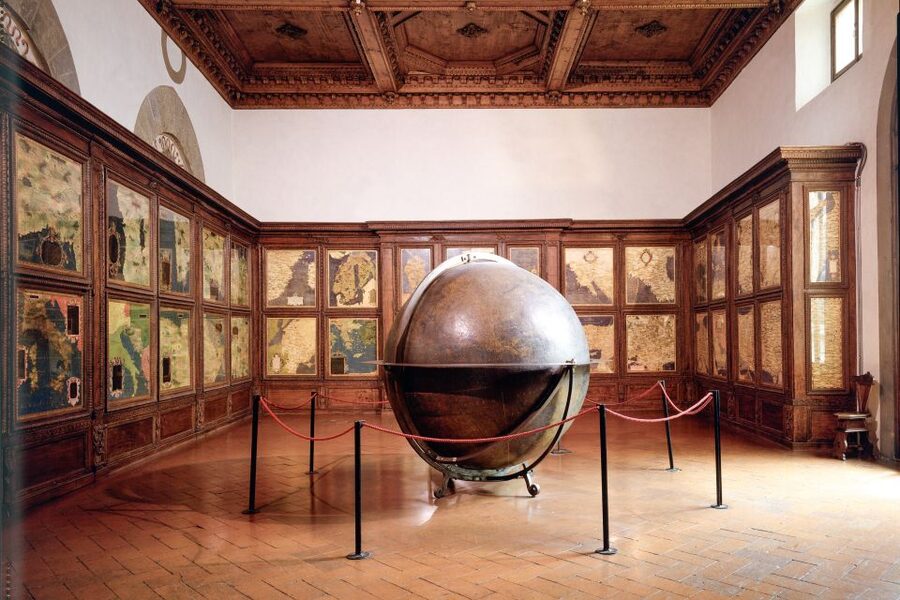
Adding Arnolfo’s Tower changes the visit from a palace tour into a palace-and-viewpoint outing. The tower rises above the city and offers views toward Florence, the Duomo, and the Tuscan hills.
You visit the tower first, then enter the museum one hour later. Plan around that gap rather than treating the tower as a quick extra at the end. The climb includes many steps. Personal accounts put the total at more than 200 and as many as 418, depending on the route and point counted, so you should expect a serious stair climb rather than a casual lookout.
The climb is manageable for some people in about ten minutes, while others find it hard. The view is the reward. From above, Florence’s streets and major landmarks make more sense, and the Duomo becomes part of a broader city panorama rather than a building seen from street level.
Tower access is not allowed for children from 0 to 6 years old. Children aged 7 to 17 must be with an adult. Rain can suspend access to the tower, although the battlements may still be open.
If you are deciding between the basic ticket and the tower option, I would add the tower if you enjoy climbs and want a city view. Skip it if stairs are a concern, if you have limited time, or if bad weather is likely.
How much time should you allow?
The ticket is valid for one day, but the selected entry time matters. The tower option requires extra planning because the tower is visited first and the museum follows one hour later.
The palace itself can be a short visit if you move room to room and listen only to selected tracks. That is not necessarily a flaw, but it can make the $37 price feel high if you arrive expecting a full-day museum.
I would allow at least two hours for a relaxed palace visit, with additional time for the tower, the climb, and the one-hour schedule between sections. The exact pace depends on how much of the guide you hear and how long you spend looking at the decoration.
Do not rush the rooms simply because the route seems compact. Some of the best details are overhead, and visitors often miss them by focusing only on the main artworks.
Is the $37 price good value?
At $37 per person, this is not Florence’s cheapest museum entry. The value depends on what you want from the visit.
The ticket includes skip-the-ticket-line admission and either the audio guide or multimedia tablet. If you want clear access at a chosen time and plan to use the guide, the price is reasonable for a major civic palace in central Florence. The optional tower adds another strong reason to consider the package.
The value is weaker if you only want to walk through quickly. Some people find the museum shorter than expected, especially when they do not listen to much of the guide. You are paying for the building, the art, the scheduled entry, and the explanation, not simply for the number of rooms.
Booking in advance can also save time during busy periods. In quieter weeks, you may find little or no regular line, so the skip-the-line feature matters less. The booking includes free cancellation up to 24 hours before the selected time and a reserve-now, pay-later option, which gives you some flexibility.
Who will enjoy this visit most?
I recommend Palazzo Vecchio to anyone interested in Florence’s political history, Renaissance art, or the Medici family. It is especially useful if you have already seen Florence’s churches and want a different side of the city.
The tower option suits people who enjoy stairs and want a high viewpoint without leaving the city center. It also works well for a first Florence visit because the view helps you orient yourself.
The experience is less suitable if you dislike self-guided museums, find tablet maps frustrating, or want a live guide to lead every step. A live guide can add conversation and quick explanations, while this ticket leaves you to manage the pace and route.
The palace is wheelchair accessible, but the tower is a separate consideration. The supplied information confirms accessibility for the activity as a whole, while the tower has its own age and weather rules.
Practical advice for a smoother visit
Arrive with your ID ready, especially if you selected the multimedia tablet. After entering from Piazza della Signoria, go straight to the InfoPoint counter rather than joining a general ticket queue.
Start by understanding the map and guide numbering. If a track does not seem to match the room, do not waste ten minutes trying to force it. Look for the next clear marker or ask staff for help.
Wear comfortable shoes for the tower and keep your pace steady. The palace can also feel hot inside during warm weather, so a summer visit may be less comfortable than expected.
Look up often. The floors and ceilings deserve as much attention as the famous wall paintings. If the Hall of 500 is open, give it more than a quick glance. It is the room that best explains why this palace mattered.
The ticket allows one day of use, but this is not an open-ended pass to every Florence monument. The included access is Palazzo Vecchio, plus Arnolfo’s Tower if that option is selected. Do not rely on a general claim that the ticket covers other monuments.
Should you book Palazzo Vecchio?
I would book this experience if you want an easy, self-guided introduction to Florence’s civic power and the Medici period. The palace is visually strong, the Salone dei Cinquecento is memorable, and the tower gives you a worthwhile view if you can handle the stairs.
Choose the audio guide for simplicity or the tablet for images and 3D material. Add the tower when the weather looks reliable and your group is comfortable with a substantial climb.
I would skip the booking if you only have a few minutes, dislike recorded narration, or are mainly searching for a large art collection. For everyone else, Palazzo Vecchio fills an important gap in a Florence itinerary: it shows how art was used not only for worship, but also for government, family power, and public display.
FAQ
Where is the entrance to Palazzo Vecchio?
The entrance is on Piazza della Signoria. After entering the courtyard, go to the ticket office and use the InfoPoint counter.
What does the ticket include?
It includes Palazzo Vecchio admission and either a 7-inch multimedia tablet or an audio guide, depending on the option selected. Arnolfo’s Tower is included only when that option is chosen.
Is a live guide included?
No. This is a self-guided visit using an audio guide or multimedia guide.
Which languages are available for the guide?
The listed language options are Spanish, English, French, German, Russian, Italian, Chinese, and Portuguese. The activity description also mentions a five-language audio option, so confirm the available choice when booking.
Do I need identification?
Yes. Bring a passport or ID card. You must leave valid identification at the ticket office to collect the multimedia guide.
Can children visit Arnolfo’s Tower?
Children aged 0 to 6 cannot access the tower. Those aged 7 to 17 must be accompanied by an adult.
Can rain affect the tower visit?
Yes. Arnolfo’s Tower access may be suspended in rainy weather. The battlements may still be accessible.
How long is the ticket valid?
The ticket is valid for one day, but you must use the selected entry time. If you choose the tower, you visit it first and enter the museum one hour later.
Is Palazzo Vecchio wheelchair accessible?
The activity is listed as wheelchair accessible. Arnolfo’s Tower has separate access rules, including age limits and possible weather restrictions.
Just added in Florence
- Wine Tasting Experience in Ponte Vecchio: Best Tuscany selection!★ 5.0 · 197 reviews
- Walking Food Tour of Florence with Tastings and Wine★ 5.0 · 518 reviews
- Wine Experience In Chianti Hills from Florence★ 4.5 · 195 reviews
- Florence Sunset Food Tour with Wine & Dine at a Tuscan farmhouse★ 5.0 · 194 reviews
- Uffizi and Accademia Small Group Guided Tour★ 4.5 · 449 reviews
- Val d’Orcia Brunello Wine Tour with Montalcino and Montepulciano★ 4.5 · 359 reviews
- Uffizi Gallery Timed Entry Admission Tickets★ 4.0 · 392 reviews
- Uffizi Gallery Small Group Tour with Guide★ 4.5 · 879 reviews
Tours in Florence, compared.
Skip-The-Line Uffizi Gallery Timed Entry Ticket
Read our review →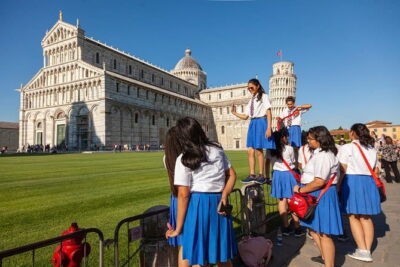
Tuscany Day Trip from Florence: Siena, San Gimignano, Pisa and Lunch at a Winery
Read our review →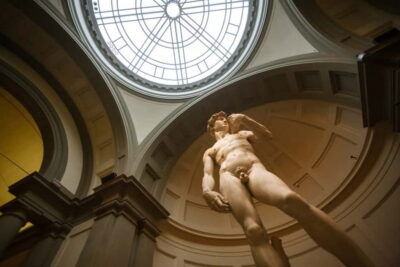
Timed Entrance Ticket to Michelangelo’s David
Read our review →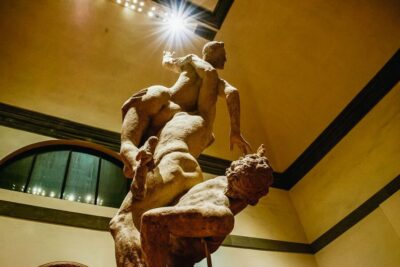
Michelangelo’s David Skip-the-Line Entry Ticket
Read our review →

The Best Tour in Florence: Renaissance and Medici Tales
Read our review →