Reviewed · TOURS IN ROME
Taste of Testaccio: Special 15 Year Anniversary Edition
Rome’s Testaccio neighborhood gives you something central Rome often cannot: a look at how people eat when they are not racing between famous monuments. This 15-year anniversary food walk mixes market bites, old family food shops, three classic pastas, and a 2,000-year-old pyramid into one very full afternoon.
I like the small group size, capped at 12, and the way the food comes with useful context. Guides such as Luca, Katherine, Francesca, Giuseppe, and Valter have been praised for making the walk conversational rather than a lecture. I also like the range of stops, from Salumeria Volpetti and Testaccio Market to Flavio al Velavevodetto and historic Giolitti.
The main consideration is the price, $131.81 per person. That is a serious food-tour tab, though the amount of food can replace a meal and the sightseeing is folded in. Come hungry, wear comfortable shoes, and tell the company about dietary needs before you arrive.
Key points to know before booking
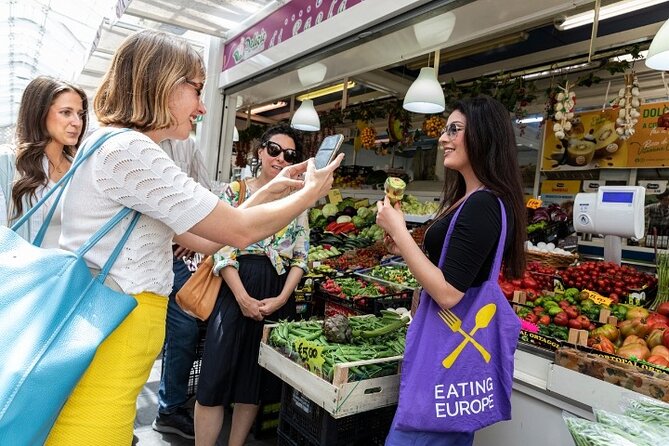
- Testaccio Market is the heart of the tour: Make bruschetta with market tomatoes, taste buffalo mozzarella, and see where local cooks shop.
- The pasta course is substantial: Try carbonara, amatriciana, and cacio e pepe with local wine at Flavio al Velavevodetto.
- You get more than food: The route includes the Pyramid of Cestius, the Protestant Cemetery, Monte Testaccio, and the old slaughterhouse district.
- The group stays manageable: A maximum of 12 people makes it easier to hear the guide and interact with vendors.
- Save room for gelato: The final stop at Giolitti offers a lesson in spotting real gelato, not just a sweet finish.
- Plan for a long tasting session: The walk lasts about three and a half hours and includes enough food to stand in for lunch.
Why Testaccio makes such a good food neighborhood
Testaccio sits south of Rome’s most visited sights, but it is not far from the center. That small shift matters. Instead of spending the whole outing in streets lined with souvenir shops, you move through a neighborhood shaped by markets, food trades, working families, and Roman cooking.
The area’s food identity is tied to the former slaughterhouse and to quinto quarto, the Roman tradition of using the less prized cuts of an animal. You do not need to be an adventurous eater to enjoy this part of the story. It helps explain why Testaccio developed a cooking style that is hearty, practical, and closely connected to everyday life.
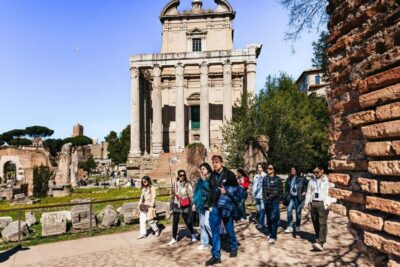
The tour also brings in two odd bits of Roman history. The Pyramid of Cestius is an authentic Egyptian-style pyramid built about 2,000 years ago, and Monte Testaccio is a man-made hill formed from millions of broken ancient olive-oil jars. These sights are not random interruptions. They show how Rome absorbed foreign fashions and how much food moved through the ancient city.
That blend is the real appeal. You are not simply stopping at restaurants. You are seeing how the neighborhood’s past connects to what is placed on your plate.
Other days out people book in Rome:
- Vatican: Museums & Sistine Chapel Entrance Ticket
★ 4.5 · 144,003 reviews - Vatican Museums & Sistine Chapel Tour with Optional Basilica
★ 4.3 · 67,413 reviews - Colosseum, Roman Forum & Palatine Guided Tour
★ 4.7 · 63,148 reviews
Starting with Volpetti’s meats, cheeses, and prosecco
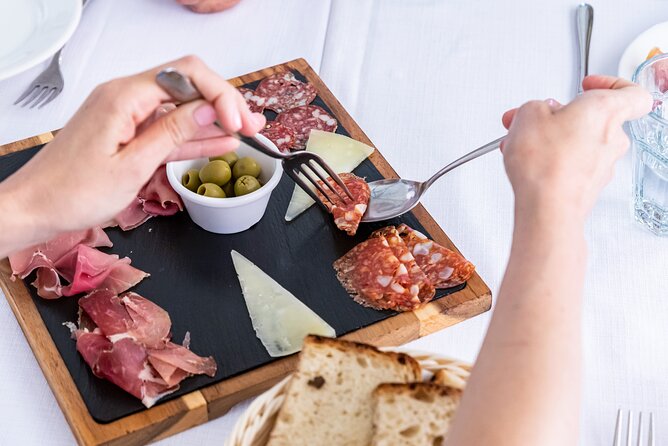
The walk begins at Salumeria Volpetti, where the opening tasting sets a generous tone. You can expect cured meats, artisanal cheeses, olive oil, balsamic vinegar, and a celebratory glass of prosecco.
Volpetti carries about 150 cheeses, so this is more than a quick sample from a deli counter. Your guide can help explain what you are tasting and how the ingredients fit into Italian eating habits. It is also a useful first stop because the food comes in small portions, giving you time to settle into the pace before the heavier dishes later.
The olive oil and balsamic tasting is a nice detail. These are pantry staples in Italy, but quality varies widely. Tasting them side by side gives you a better sense of why simple Roman food depends so much on good ingredients.
This stop can feel like a full appetizer course, especially when paired with the prosecco. If you have a small appetite, pace yourself here. The tour keeps feeding you.
The Pyramid of Cestius and the Protestant Cemetery
After the first food stop, the route heads toward the Pyramid of Cestius. This compact monument feels almost out of place beside modern Rome, which is exactly why it catches your attention.
You spend about 15 minutes seeing the pyramid and hearing about its place in the city. It is not a long archaeological visit, and you should not expect an interior tour. Instead, it is a short, memorable stop that adds an unusual Roman landmark to a food-focused walk.
The route also points out the Protestant Cemetery, where poet John Keats is buried. The cemetery adds a quieter note to the outing and gives the guide room to discuss a side of Rome that many first-time visitors miss.
This section involves walking outdoors, so weather matters. One outing took place on a day near 100 degrees, and the group still enjoyed the tour, but heat can make a three-and-a-half-hour food walk feel longer. Bring water, especially in summer, and do not count on the tasting stops to replace hydration.
Making bruschetta at Testaccio Market
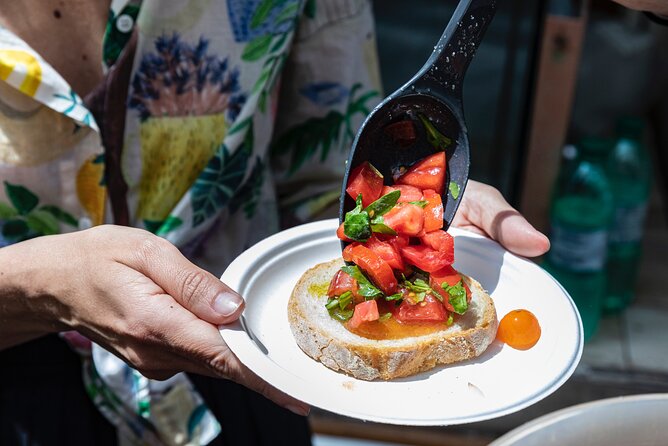
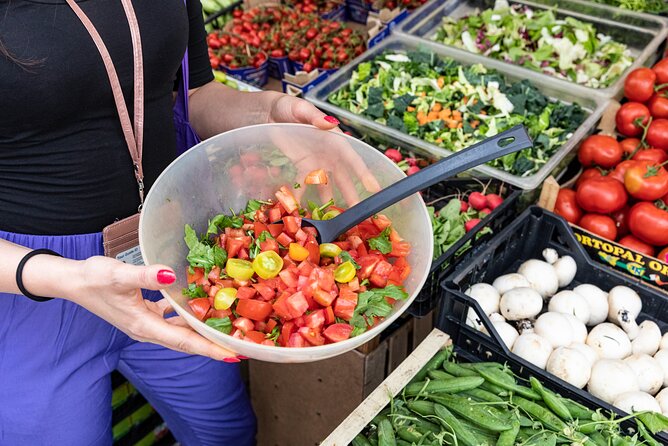
Testaccio Market is the tour’s most hands-on section. Rather than simply walking through the stalls, you get fresh ingredients from local vendors and make your own bruschetta.
Expect ripe tomatoes, fresh bread, garlic, and other market ingredients brought together for you. One of the pleasures here is that your guide can introduce you to the vendors and show how a very basic dish depends on good produce. The preparation is simple, but that is the point. Roman food often asks for little more than bread, tomatoes, oil, and careful seasoning.
You also sample buffalo mozzarella and caprese salad. The mozzarella gives you a chance to compare fresh dairy with the more familiar packaged versions found outside Italy. The caprese is another straightforward dish that works best when the ingredients do the heavy lifting.
The market stop lasts about 45 minutes, making it one of the longer sections of the tour. If you like food markets, this is the part where you may wish for even more time. You can look around, meet vendors, and get a feel for the neighborhood’s daily shopping habits, but the schedule still has to move on.
The market is also one of the better places to ask questions about Italian ingredients. Guides such as Valentina, Giuseppe, and Fabio have been praised for explaining both the food and the surrounding Roman culture in a friendly way.
Same base, a different kind of day:
- Vatican Museums, Sistine Chapel & St Peter’s Basilica Guided Tour
★ 4.5 · 39,149 reviews - Rome: Colosseum, Palatine Hill and Roman Forum Guided Tour
★ 4.8 · 32,814 reviews - Rome: Guided Tour of Colosseum, Roman Forum & Palatine Hill
★ 4.7 · 27,897 reviews - Rome: Colosseum & Forum with Audio Guide App -Optional Arena
★ 4.2 · 24,770 reviews
Supplì, trapizzino, and Rome’s street-food habits
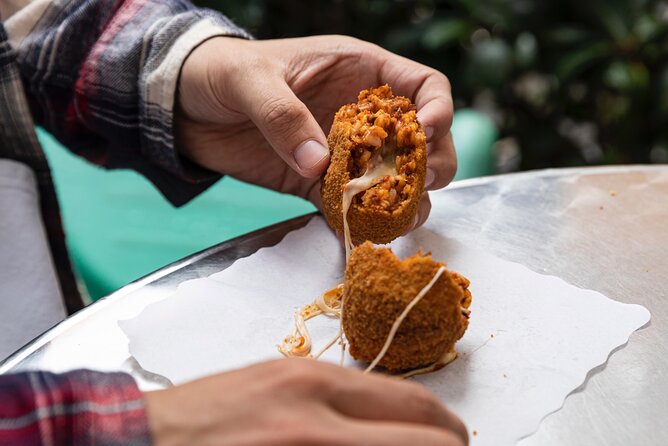
The next bites shift from fresh market food to Roman street food. You try supplì, a fried rice ball with a crisp exterior and soft filling. It is Rome’s answer to the broader Italian family of stuffed and fried snacks, but the Roman version has its own place in local eating.
You also visit Trappizino for a trapizzino, a pocket of pizza-like bread filled with saucy food. The listed sample uses hunter-style chicken. It is filling, messy in the best way, and easy to understand as a grab-and-go Roman meal.
These stops are important because they show that Roman food is not only pasta served in a sit-down restaurant. It also includes quick foods designed for a walk, a snack, or a casual lunch.
The sample menu includes a local beer with the supplì. Other parts of the tour include wine, prosecco, and espresso, but extra drinks are not included. If you want more than the listed pairings, budget for that separately.
The former slaughterhouse and Monte Testaccio
As you walk, the guide explains the old slaughterhouse complex and its role in Testaccio. The site helped shape the neighborhood’s food culture, especially the cooking tradition known as quinto quarto.
You may not spend a long time touring the complex itself, but the stop gives meaning to the dishes you are eating. It also helps explain why Testaccio has a stronger connection to food trades than many central Roman neighborhoods.
Monte Testaccio is another quick but memorable sight. This artificial hill was built from fragments of millions of ancient Roman olive-oil amphorae. It is a remarkable reminder of the scale of food storage and trade in the Roman Empire.
I like these short history stops because they keep the tour from becoming a string of tastings. You get a reason for Testaccio’s identity, not just a list of places to eat. Still, anyone seeking lengthy archaeological visits should choose a dedicated history tour instead. Here, the monuments support the food story.
Three Roman pastas at Flavio al Velavevodetto
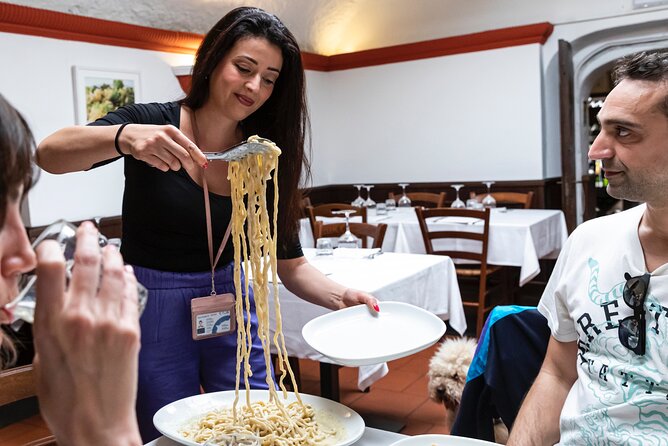
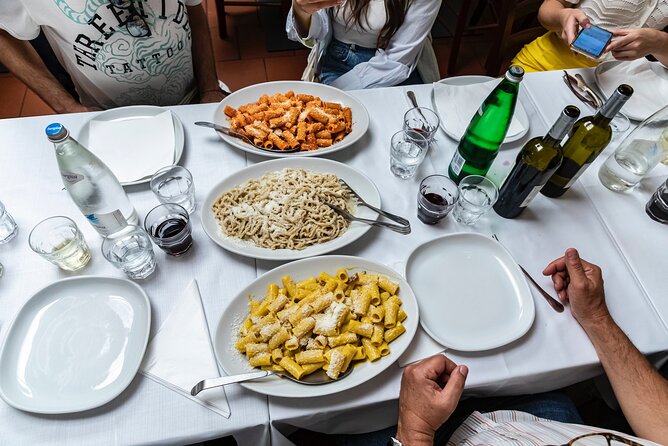
The restaurant meal is the tour’s main event. At Flavio al Velavevodetto, you taste three iconic Roman pastas: carbonara, amatriciana, and cacio e pepe.
Each dish depends on a small number of ingredients, but each has a different character. Carbonara is creamy without relying on cream, amatriciana brings tomato and a savory pork flavor, and cacio e pepe centers on cheese and black pepper. Tasting them close together makes the differences easier to understand.
This is also where the guide’s food knowledge matters most. Roman pasta names are familiar around the world, but preparation varies greatly. A good guide can explain what gives each sauce its identity and help you notice the texture of the pasta, the balance of salt, and the role of the cheese.
The restaurant stop lasts about 30 minutes, which is not a leisurely multi-course dinner. It is a focused tasting of three dishes, generally paired with local wine. Portions are reported to be generous across the tour, so you should not arrive after a large lunch.
One practical point: the menu can vary. The company describes the tastings as a selection that may change with the day or season. You can expect the three Roman pasta styles as a central feature, but individual ingredients and stops may shift.
Finishing with real gelato at Giolitti
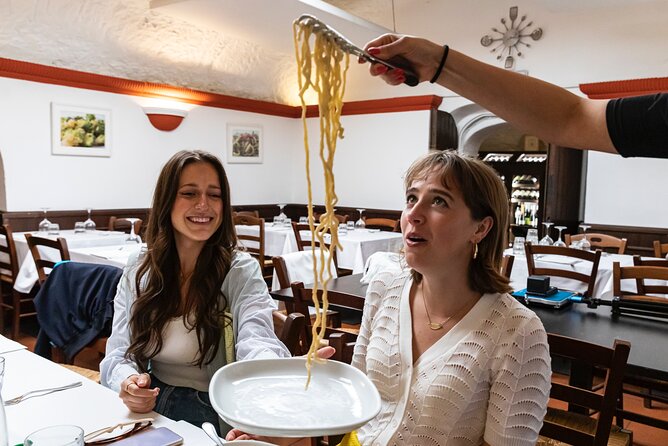
The final food stop is Giolitti Caffe and Gelateria, a historic gelateria that has been making artisan gelato for more than 100 years. It is a fitting end because gelato gives you a lighter finish after the savory food, even if you have already eaten quite a lot.
The guide also explains how to spot real gelato. Look for practical clues rather than assuming every colorful mound is high quality. The point is to help you make better choices later in Rome, not simply to hand you one final dessert.
The gelato stop lasts about 25 minutes. Several guides have urged participants to save room for it, and that is sensible advice. If you fill up at Volpetti or the market, you may enjoy the last taste less.
The end point is on Via Amerigo Vespucci, only a couple of blocks from the starting point. That makes the route easy to understand and leaves you in Testaccio, where you can continue exploring if you still have energy.
How much food do you actually get?
You should treat this as a meal, not as a few dainty samples. The listed menu includes:
- Cured meats, cheeses, olive oil, balsamic vinegar, and prosecco
- Espresso and a typical Italian pastry
- Tomato bruschetta
- Buffalo mozzarella and caprese salad
- Supplì and local beer
- Trapizzino filled with hunter-style chicken
- Carbonara, amatriciana, and cacio e pepe
- Artisan gelato
That is a lot over three and a half hours. The food arrives in stages, with walking between stops, so it does not feel like one long sitting. Still, you should eat lightly beforehand.
Vegetarian and gluten-free needs can be discussed at booking, and the company says it will try to accommodate them. Severe or life-threatening allergies are not suitable for this experience because the company cannot accept responsibility for food allergies or intolerances. Children under four can join free, but food is not included for children three and under. Paid food tickets apply from age four.
Price, group size, and guide style
At $131.81 per person, this is not a budget snack walk. The value depends on how you use it. You receive a full meal’s worth of food, several drink pairings, a local English-speaking guide, market access, restaurant tastings, and neighborhood history.
I would compare the price with what you might spend on a good Roman lunch, several snacks, gelato, and a separate neighborhood walk. The tour will not suit someone who wants the cheapest possible way to eat pasta, but it makes sense if you value a planned route and explanations along the way.
The group maximum is 12, which is a strong point. Small groups make it easier to hear in the market, ask questions, and speak with the guide. The best outings seem to depend heavily on the guide’s personality. Luca, Katherine, Francesca, Giuseppe, Amin, Valter, Valeria, Gabriele, Giorgia, and others have all led highly praised walks, with repeated approval for friendly, relaxed teaching.
One practical warning is worth noting. A previous booking problem involved a guest who waited at the meeting point and later disputed whether the guide had arrived. To avoid confusion, check the start time, arrive early at Piazza Testaccio 39, and keep communication with the operator clear if your plans change.
Free cancellation is available up to 24 hours before the start time. If the minimum of two participants is not met, the company offers a new date, another experience, or a full refund.
Who should book this Testaccio food walk?
I would choose this tour if you want to understand Roman food while eating plenty of it. It suits first-time visitors who have already seen the major sights, repeat visitors looking for a less familiar neighborhood, and people who enjoy markets more than formal sightseeing.
It is also a good choice for families with older children who can manage the walking and appreciate a meal broken into several stops. Solo participants should feel comfortable joining, since the group format and guide-led introductions make the outing social.
I would think twice if you have severe food allergies, want a fully fixed menu, dislike cheese or pork-heavy dishes, or prefer a quiet restaurant meal. You should also reconsider on an extremely hot day if you do not handle outdoor walking well.
Should you book it?
Yes, if you want a substantial food experience with a real sense of place. The strongest parts are the Testaccio Market, the three pasta tasting, and the guide’s connection between food, local vendors, and Roman history.
The price is high, but the quantity and variety help justify it. Book well ahead, since the tour is often reserved about 62 days in advance. Arrive hungry, tell the company about dietary needs, and save room for the gelato. If your idea of seeing Rome includes eating where the neighborhood eats, this is a smart way to spend half a day.
FAQ
Where does the Taste of Testaccio tour begin?
The tour begins at Piazza Testaccio, 39, 00153 Rome, Italy.
Where does the tour end?
The tour ends at Via Amerigo Vespucci, 35, 00153 Rome, Italy, a couple of blocks from the starting point.
How long does the tour last?
The experience lasts approximately three hours and 30 minutes.
What foods are included?
The tastings can include cured meats, artisanal cheeses, olive oil, balsamic vinegar, bruschetta, buffalo mozzarella, caprese salad, supplì, trapizzino, carbonara, amatriciana, cacio e pepe, pastry, espresso, and gelato.
Are drinks included?
Some drinks are included with the tastings, such as prosecco, local wine, and local beer. Extra drinks are not included.
Is the tour offered in English?
Yes. The tour includes a local English-speaking guide.
How many people can join the tour?
The maximum group size is 12 people.
Can children join?
Yes. Children under four can join without a ticket, but food is not included for children aged three and under. Paid tickets with food are available for children aged four and up.
Can dietary requirements be accommodated?
Vegetarian, gluten-free, and other dietary needs can be noted at booking or sent to the company by email. The experience is not suitable for severe or life-threatening food allergies, and the company does not accept responsibility for allergies or intolerances.
Just added in Rome
- Civitavecchia Private Transfer: From the Port to Rome Airport★ 5.0 · 309 reviews
- Civitavecchia Shore Excursion: Best of Rome Private Tour★ 5.0 · 247 reviews
- Civitavecchia Private Transfer from ship to FCO airport or Rome★ 5.0 · 245 reviews
- Food Tasty and History Tour in Civitavecchia★ 5.0 · 256 reviews
- Palatine Hill and Roman Forum Tour with Fast-Track Entrance★ 4.2 · 417 reviews
- Tivoli: Villa D’Este & Villa Adriana Pass & App Audioguide★ 4.4 · 364 reviews
- Tivoli: Villa D’Este Entry Ticket and App Audio Guide★ 4.3 · 191 reviews
- Vatican Museums & Sistine Chapel Skip-the-Line Guided Tour★ 4.6 · 254 reviews
Tours in Rome, compared.
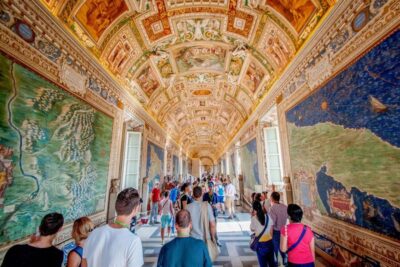
Vatican: Museums & Sistine Chapel Entrance Ticket
Read our review →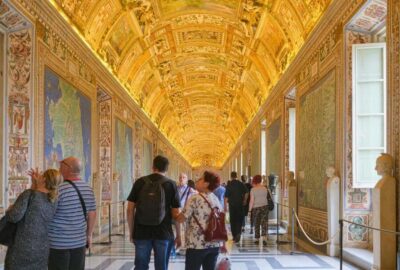
Vatican Museums & Sistine Chapel Tour with Optional Basilica
Read our review →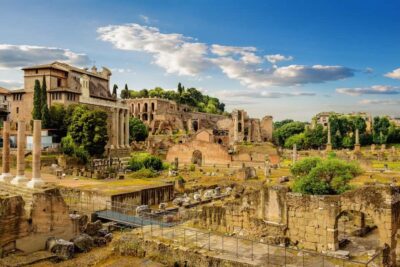
Colosseum, Roman Forum & Palatine Guided Tour
Read our review →
Vatican Museums, Sistine Chapel & St Peter’s Basilica Guided Tour
Read our review →
Colosseum & Forum with Audio Guide App -Optional Arena
Read our review →
Pantheon Fast-Track Ticket and Official Audio Guide
Read our review →
City Sightseeing Hop-on Hop-off Bus with Audioguide
Read our review →