
Reviewed · MUSEUMS
Leonardo3 The World of Leonardo: Tickets for the Interactive Exhibition
Leonardo3 turns Leonardo da Vinci’s sketches into working ideas you can see and handle. You’ll find reconstructed machines, digital copies of his artwork, and a carefully presented restoration of The Last Supper. I especially like the physical models and the interactive screens, which make Leonardo’s inventions easier to understand than a page of technical drawings. The central Milan location beside the Galleria is another strong point.
The exhibition is fairly small, so you can visit without sacrificing half a day. Give yourself at least an hour, and closer to two if you read the material or use the audio guide. The main drawback is space: it can feel crowded, and several displays have limited English text. Also check the date on your ticket carefully, since the supplied booking information lists an expiration date of November 13, 2024 alongside opening dates in 2025.
Key points to know before you go
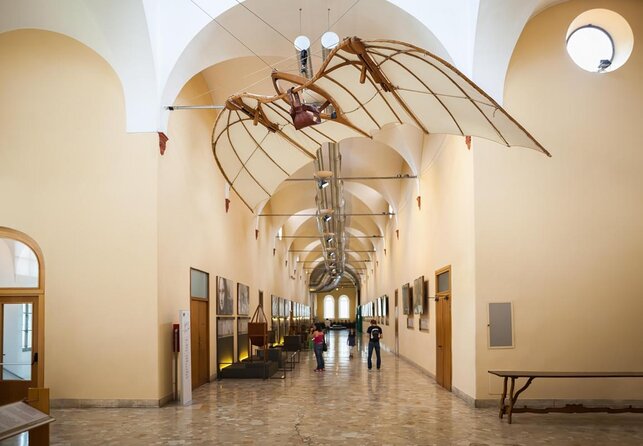
- Leonardo’s inventions take center stage: See physical reconstructions of machines based on his notebooks, rather than only paintings and written explanations.
- The Last Supper is digitally restored: The display helps you study the fresco’s details and condition, but it does not replace seeing the original at the refectory of Santa Maria delle Grazie.
- Interactive screens add real value: You can explore drawings, mechanisms, and artistic details at your own pace.
- Plan for 1 to 2 hours: The venue is compact, but careful reading and the optional audio guide can stretch the visit.
- The location is very convenient: Find it near the Duomo and Galleria, close to public transportation.
- Bring patience for a busy visit: The small rooms can fill up, and photography may be restricted.
Leonardo’s machines become easier to understand
Leonardo is often introduced as the painter of the Mona Lisa and The Last Supper. Leonardo3 gives much more attention to the engineer, anatomist, musician, and inventor.
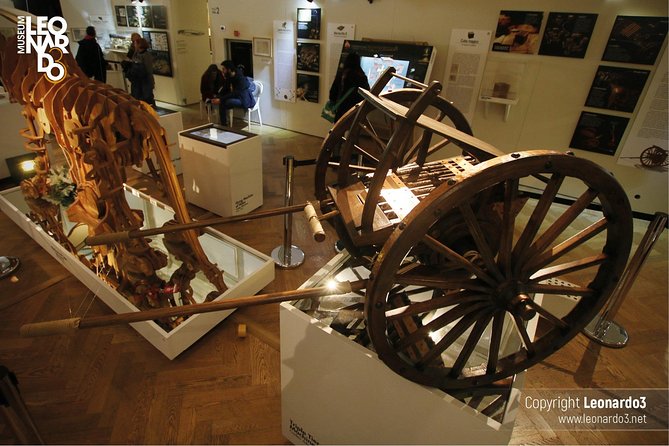
That wider view is the exhibition’s main strength. Leonardo left many ideas in notebooks rather than finished machines. His drawings can be hard to read on a page, especially when several gears, levers, pulleys, or wings overlap. Here, reconstructed models show how those ideas may have worked.
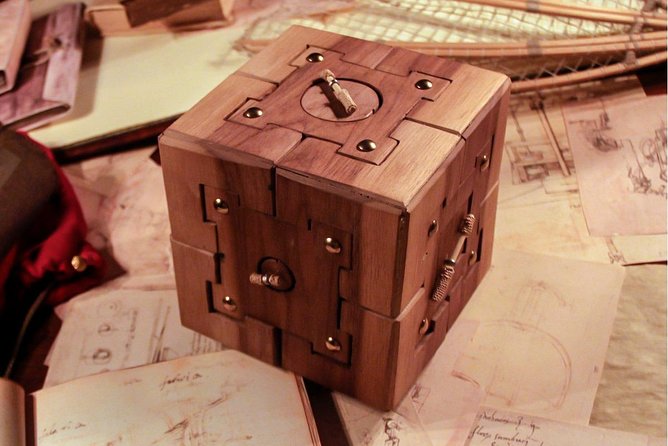
You’ll see machines based on Leonardo’s studies, with displays that explain the parts and purpose. Some models are designed for close viewing, while interactive elements let you examine the mechanism or learn more about the original drawing. The experience is especially useful if you enjoy understanding how something works, not simply looking at a famous name.
I like this approach because it turns Leonardo from a distant historical figure into a working problem-solver. His sketches show repeated changes, experiments, and questions. The models help you see that process.
Some exhibits focus on ideas that feel far ahead of their time. The point is not that every machine was built and used in Leonardo’s lifetime. Instead, you are seeing modern reconstructions based on his surviving designs. That distinction matters, and the best way to approach the displays is as an exploration of his thinking.
Other museums and galleries in Milan:
- Milan: Science and Technology Leonardo da Vinci Museum Entry
★ 4.5 · 7,169 reviews - Official San Siro Stadium and Museum Guided Tour
★ 4.4 · 3,573 reviews - Milan: Leonardo3 The World of Leonardo Museum Entry Ticket
★ 4.4 · 3,241 reviews
Digital restorations bring the artwork closer
The exhibition also uses digital technology to examine Leonardo’s paintings and written work. Digital restorations of major works let you look closely at details that can be difficult to see in the originals.
The Last Supper receives particular attention. A digital restoration presents the fresco with renewed clarity and helps explain its appearance, technique, and condition. You can study the composition and the figures without the time pressure that often comes with a short viewing slot at the actual refectory.
This is a good reason to visit Leonardo3 before seeing The Last Supper, if your schedule allows. The exhibition gives you background that can make the original more meaningful. You’ll have a better sense of Leonardo’s choices, the scale of the work, and the problems created by his experimental painting method.
Still, keep the comparison clear. Leonardo3 offers a digital restoration and interpretation. It is not the original fresco. If you have a reserved visit to Santa Maria delle Grazie, treat this exhibition as preparation rather than a replacement.
The digital displays also make the Codex Atlanticus and Leonardo’s writing easier to approach. One of the more interesting details is the attention given to his unusual mirror writing. Seeing the script enlarged and explained gives you a better idea of how his notes functioned as private working pages rather than polished publications.
Interactive displays reward curious visitors
This is not a museum where you simply walk past framed objects. Several displays invite you to press, examine, or manipulate information on a screen.
The interactive format works best when you take your time. You can move from a machine to the original sketch, then use the digital material to see how the reconstruction was interpreted. That sequence connects the surviving evidence with the modern model.
For adults, the format adds useful detail without requiring specialist knowledge. For older children, it can make the visit more approachable than a traditional art museum. Younger children may lose interest, especially if they are not drawn to machines or historical drawings.
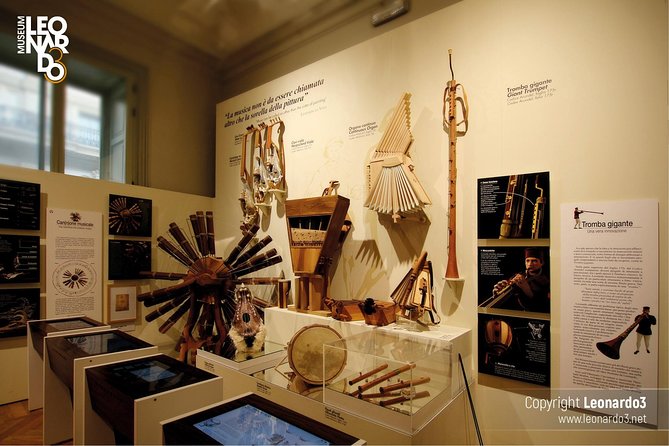
The exhibition also includes material connected with Leonardo’s musical interests. One account describes musicians playing some of the reconstructed instruments, though you should not assume a performance will take place during every visit. Even without that, the instruments add another reminder that Leonardo worked across art, science, engineering, and music.
I would choose the audio guide if you want the fullest explanation. It can be purchased in Chinese, English, French, German, Italian, Portuguese, Russian, and Spanish. The written English beside some displays may be brief, so the guide is useful when you want more context.
A compact museum beside the Duomo
Location is one of Leonardo3’s practical advantages. The exhibition is in the city center, near the Duomo and beside the Galleria. If you are walking through the Galleria from the Duomo toward the next small piazza, look for it just after the city information storefront on the left.
The entrance can be easy to miss if you are moving quickly through this busy part of Milan. Allow a few extra minutes to locate it, especially if you have timed plans afterward.
Because the exhibition is close to major sights, it fits neatly into a day of sightseeing. You can visit before or after the cathedral, the Galleria, or other central Milan stops. There is no transportation included, but that is rarely a serious problem given the location and nearby public transit.
A locker is available, which is helpful if you are carrying shopping bags or a small backpack. Souvenirs can be purchased inside, though they are not part of admission.
The rooms are compact rather than grand. That has an advantage: you can focus on the machines and drawings without walking long distances. The tradeoff is that busy periods may feel tight, particularly around the most popular interactive stations.
Temperature may also affect your visit. One past account described the exhibition as very hot on a summer day and noted that there was no air conditioning. Conditions can vary, but if Milan is experiencing extreme heat, you may prefer to visit earlier in the day.
A few more things to do in Milan
- Milan: Cathedral and Duomo’s Terraces Entrance Ticket
★ 4.6 · 61,054 reviews - Milan Cathedral: Duomo Terraces Ticket (No Church Access)
★ 4.6 · 6,111 reviews - Milan: Guided Walking Tour & Last Supper Visit with Ticket
★ 4.7 · 5,409 reviews - Milan: Duomo Rooftop and Cathedral Guided Tour with Tickets
★ 4.8 · 2,678 reviews
How much time should you allow?
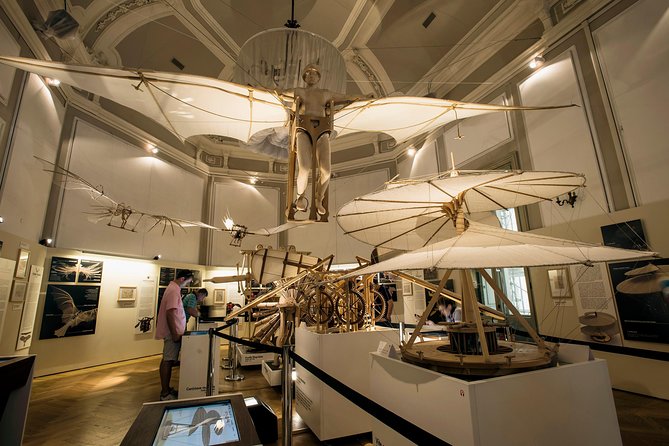
The official estimate is 1 to 2 hours. That is sensible.
An hour works if you move steadily, focus on the main machines, and make a short stop at the digital Last Supper. Two hours is better if you read the explanations, use the audio guide, and spend time with the interactive screens.
I would not plan an entire morning around Leonardo3 unless you are a serious Leonardo enthusiast. The exhibition is small, and one account described it as packed with displays despite its limited size. That means the quality of your visit depends more on your interest and pace than on the number of rooms.
Try visiting early in your day if you want more breathing room. Opening hours are listed as 9:30 AM to 8:00 PM on most days during the stated dates, with a special Tuesday opening time of 2:00 PM to 8:00 PM on December 16, 2025. Since the supplied information contains dates that do not fully match, confirm the current opening hours and ticket validity before setting out.
Flexible hours are useful in Milan. You can fit this visit around a cathedral reservation, lunch, or an appointment to see The Last Supper. Instant confirmation and skip-the-line access are also listed as benefits, though you should still have your ticket ready on your phone or printed copy.
Is the $19.22 admission good value?
At about $19.22 per person, Leonardo3 is not the cheapest short museum visit in Milan. Its value depends on what you want from the experience.
If you are mainly looking for original Renaissance paintings, this may not be your best choice. Much of the material consists of reconstructions, digital restorations, models, and explanatory displays. The attraction is interpretation and hands-on learning, not a large collection of original masterpieces.
For anyone interested in Leonardo’s inventions, the price is easier to justify. You are paying for the chance to see his ideas translated into physical form, along with digital material that explains difficult drawings. The central location also saves time and makes the visit easy to add to a sightseeing day.
The audio guide costs extra, so include that in your budget if you want detailed explanations. The basic admission includes entry but not transportation, souvenirs, or the guide.
There is one pricing point worth checking. One past account suggested that people could enter by paying the regular admission directly, at a lower price than the booked option. That may depend on the date, ticket type, or current policy, so compare the direct price with the online price before purchasing. The online option can still be useful if instant confirmation and skip-the-line access matter to you.
Free cancellation is available when you cancel at least 24 hours before the experience begins. Changes or cancellations made inside that period are not accepted for a refund.
Who will enjoy Leonardo3 most?
I would recommend this to adults who want a broader picture of Leonardo, beyond the familiar paintings. It is also a good choice for anyone who likes engineering, invention, technical drawing, or museum displays that explain how things function.
Art lovers planning to see The Last Supper can use it as preparation. The digital restoration offers helpful context, but it should not be treated as the original artwork.
Families may find the interactive parts appealing, especially with older children. Keep expectations realistic for younger children. The exhibition is educational, and some displays require reading or patience. Children must be accompanied by an adult.
This is also useful for a mixed-interest group. One person can focus on the art, another on the machines, and another on the digital technology. Since the visit is self-paced, you do not need to move through every display together.
The private activity wording means only your group participates, but this is still an exhibition visit rather than a traditional guided walking tour. No guide name is provided, and the audio guide is an optional purchase.
Small drawbacks worth knowing
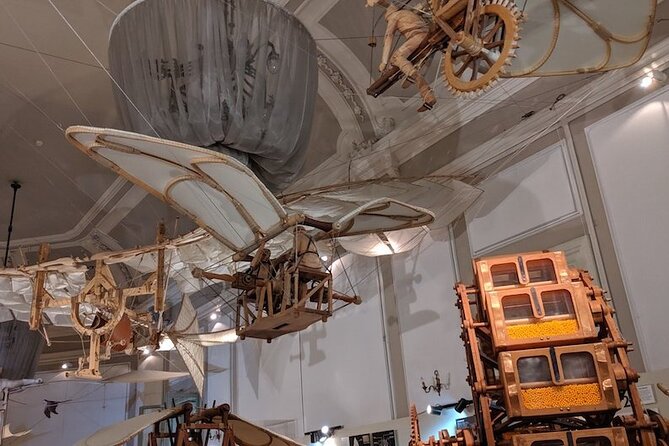
The biggest issue is scale. If you expect a large museum with several floors and a major original-art collection, Leonardo3 may feel smaller than expected. Two hours is usually enough.
The English explanations may be sparse beside some displays. The audio guide is the better choice if you want a fuller account in English or another supported language.
Photography may also be restricted. Several displays are visually striking, but you may not be allowed to photograph them, so plan to enjoy the models in person rather than building a camera record of the visit.
Crowding is another consideration. The exhibition’s compact rooms and popular interactive stations can make it harder to linger during busy periods. An early visit may give you a more comfortable pace.
Finally, do not confuse the digital Last Supper with access to the original fresco. Leonardo3 can help you understand the painting, but seeing the actual work requires a separate reservation and admission arrangement.
Should you book Leonardo3 in Milan?
Book it if you want to see Leonardo as an inventor and experimenter, not only as a painter. The reconstructed machines, interactive displays, Codex material, and digital restorations make difficult ideas easier to grasp. Its position near the Duomo makes it a practical addition to a central Milan day.
Skip it if your schedule is already crowded with original-art museums or if you only want to see authentic Renaissance objects. The exhibition is compact and relies heavily on modern reconstructions and screens.
For most curious visitors, I would allow about 90 minutes, add the audio guide if you want more explanation, and visit before The Last Supper if both are on your schedule. Before paying, check the current direct admission price and confirm the ticket date, since the supplied information includes conflicting validity and opening dates.
FAQ
How long does the Leonardo3 exhibition take?
Allow about 1 to 2 hours. One hour is enough for a quicker visit, while two hours allows time for the interactive displays, explanations, and optional audio guide.
Where is Leonardo3 located?
It is in central Milan near the Duomo and the Galleria. If you walk through the Galleria from the Duomo toward the next small piazza, the entrance is just after the city information storefront on the left.
Is the audio guide included?
No. Admission includes the exhibition ticket only. An audio guide can be purchased separately in Chinese, English, French, German, Italian, Portuguese, Russian, and Spanish.
Is The Last Supper included?
You can see a digital restoration and learn about the fresco at Leonardo3. The ticket does not provide admission to the original Last Supper painting at Santa Maria delle Grazie.
Is skip-the-line access included?
The ticket information states that skip-the-line access is included, along with instant confirmation.
Can children visit Leonardo3?
Yes. Children must be accompanied by an adult. Younger children may lose interest quickly, while older children may enjoy the interactive machines and displays.
Can I cancel for a refund?
Yes, if you cancel at least 24 hours before the experience start time. Cancellations or changes made less than 24 hours before the start time are not refundable.
Just added in Milan
- Highlights and hidden gems of Milan Bike Tour★ 5.0 · 491 reviews
- Milan Gourmet Tour: A Premium Tasting Experience by Do Eat Better★ 5.0 · 241 reviews
- Private Milan Food Walking Tour of Brera★ 5.0 · 217 reviews
- Da Vinci’s Last Supper and Santa Maria delle Grazie Church Tour★ 4.5 · 218 reviews
- Learn to Cook Italian Recipes with an Italian Chef★ 5.0 · 283 reviews
- La Scala Theatre and Museum guided experience★ 4.5 · 664 reviews
- La Scala Theatre and Museum Tour in Milan With Private Guide★ 3.5 · 384 reviews
- Milan Last Supper and S. Maria delle Grazie Skip the Line Tour★ 5.0 · 1,031 reviews
Museums, compared.
Vatican: Museums & Sistine Chapel Entrance Ticket
Read our review →
Vatican Museums & Sistine Chapel Tour with Optional Basilica
Read our review →
Vatican Museums, Sistine Chapel & St Peter’s Basilica Guided Tour
Read our review →
Skip-The-Line Uffizi Gallery Timed Entry Ticket
Read our review →
Vatican Museums & Sistine Chapel Skip-the-Line Entry Ticket
Read our review →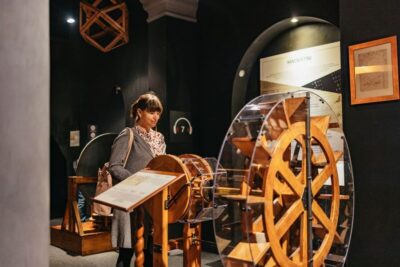
Browse the lists this tour appears in