
Reviewed · HISTORICAL TOURS
2 Hours Private Historical Tour in Genoa
Genoa’s old center is a maze of narrow lanes, steep streets, grand palaces, and sudden little squares. This private rickshaw tour lets you cover a surprising amount without spending two hours wrestling with a map or climbing every hill. Guides such as Eleonora, Giulia, Yusuf, Sophie, and Beatrice have been especially praised for making the city’s story easy to follow.
I like the small private format, since your guide can stop for photos and adjust the pace for your group. I also like the practical route, which links the medieval core with Via Garibaldi, Piazza De Ferrari, and the waterfront. The main caution is the vehicle: mechanical trouble has occasionally caused delays, and a rickshaw is not the best choice if you want long visits inside monuments.
Key points to know before booking
- A compact route through old Genoa: See Sarzano, the medieval lanes, Via Garibaldi, San Lorenzo, De Ferrari, and the Old Port in about two hours.
- A good cruise-stop choice: The meeting point is at the Galata Museo del Mare, with the driver waiting in the square by the terminal exit.
- Private for up to two people: The listed price is $114.93 per group, not per person.
- Easy on your legs: The vehicle reaches narrow streets and lets you look around while the local guide handles the route.
- Strong guide reports: Eleonora, Giulia, Yusuf, Sophie, Beatrice, and others are praised for warmth, local knowledge, and clear explanations.
- Allow for weather and vehicle limits: The tour needs good weather, and a few mechanical problems have led to delays or shortened outings.
Why a rickshaw makes sense in Genoa
Genoa is not a city that reveals itself neatly from one main avenue. Its old center is made of tight lanes, small stairways, churches tucked into the urban fabric, and grand buildings that appear around corners. You can walk it, but in two hours you will either cover less ground or spend much of your time checking directions.
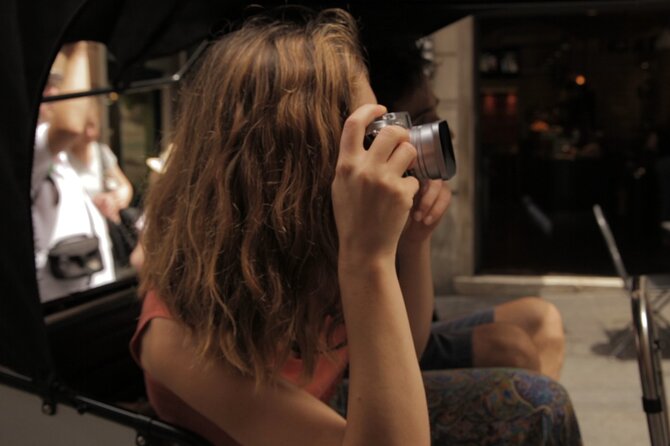
The rickshaw gives you a moving seat and a driver who knows the route. You can watch the streets rather than study your phone. Several guides also stop often for photographs, which matters in a city where the best detail may be a church doorway, an old tower, or a narrow lane rather than a famous monument.
This is not a full museum tour. Most stops are outside, and the listed time at each place is short. I would treat it as an introduction that helps you decide where to return on foot later.
The private setup is a real advantage. At $114.93 for up to two people, the cost works out to about $57.47 each if two people share it. That is not the cheapest way to see Genoa, but it is reasonable for a private two-hour service with transport and a local guide, especially if you are visiting from a cruise ship and have limited time.
Other history to see in Genoa:
- Genoa: 2-Hour Guided Walking Tour of the Historical Center
★ 4.2 · 605 reviews - Genoa Food, Wine Tasting & History Walking Tour
★ 5.0 · 212 reviews - Genoa: Historic Guided Tour of Christopher Columbus’ House
★ 4.4 · 186 reviews
Starting at Galata and reaching Sarzano
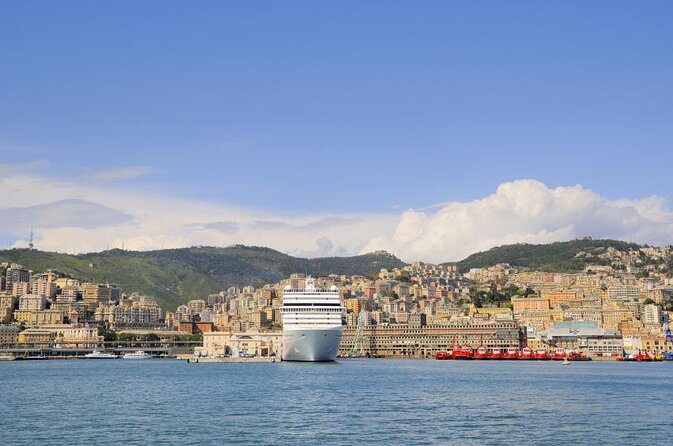
The tour begins at the Galata Museo del Mare, at Calata Ansaldo De Mari 1. If you arrive by ship, look for the driver in the square in front of the terminal exit. This detail is useful because the port area can feel spread out, and you do not want to begin your short outing by searching along the waterfront.
The first proper stop is Piazza Sarzano, a useful introduction to Genoa’s oldest core. The area is tied to the original nucleus of Ianua, the ancient name associated with the city. You can look toward the bell tower of Sant’Agostino and a small temple, with colorful Via Ravecca behind them.
You get about 15 minutes here. That is enough to hear the basic story and take photographs, but not enough for a detailed visit to every feature. I like this opening because it places you in the old city quickly, away from the port’s broad modern spaces.
A short stop at the Church of Santi Cosma e Damiano follows. The visit lasts about five minutes, so think of it as a glimpse rather than a church tour. The attraction here is the setting within the medieval center, where the street itself is part of the experience.
Via Garibaldi and Genoa’s grand palaces
Via Garibaldi is one of the route’s major highlights. This broad historic street cuts through the old center and is lined with imposing palaces and gardens. It was once called Strada Maggiore, later Strada Nuova, and for a time Via Aurea, or Golden Street. In 1882 it received its current name in honor of Giuseppe Garibaldi.
You have around 15 minutes here. Your guide can point out the architectural style and explain how this grand street fits into Genoa’s past as a powerful maritime and trading city. The contrast is part of the fun: a few minutes earlier you may have been in a cramped medieval lane, and now you are looking at palaces built to impress.
If you want to enter palace museums, you will need to return later. The tour’s timing gives you an outside overview, not a long interior visit. That is a fair trade for seeing more of the city in a short period.
The route then reaches La Casa di Colombo, the so-called Columbus House near Porta Soprana. The building is probably an 18th-century reconstruction of the medieval home where Christopher Columbus spent part of his youth. Written sources place him there between 1455 and 1470.
The house has two floors. His father, Domenico Columbus, is said to have used the ground floor as a wool-weaving and trading workshop, while the family lived above. The original building was likely destroyed in the French bombardment of Genoa in 1684.
You get about 10 minutes here. The stop is valuable because it adds a personal scale to Genoa’s story. Instead of only seeing palaces and public buildings, you get a small home linked to one of the city’s most famous names. Again, plan on an exterior look unless your guide confirms that an interior visit is included.
Piazza Banchi and the heart of San Lorenzo
Piazza Banchi sits near one of Genoa’s key docks and once served as the city’s grain market. By the 12th century, it was associated with the money changers’ stalls under the porticoes, which explains the name Banchi.
The stop lasts about 15 minutes. This is a good place to connect Genoa’s streets with its commercial past. The port was not just a scenic waterfront. It shaped the city’s wealth, work, politics, and buildings, and Piazza Banchi shows how trade reached right into the urban center.
From here, the route moves toward San Lorenzo Cathedral. The cathedral is Genoa’s most important church, and its walls carry art, stories, and legends. The surrounding San Lorenzo district became the center of the growing city after the cathedral moved and new defensive walls were built.
The cathedral’s forecourt had an important public role in medieval Genoa. In a city with few open squares, the parvis of San Lorenzo became a place for social and political life. Your stop lasts about 15 minutes, enough for an explanation and photographs.
I would pay close attention here even if you are not planning to enter. The setting tells you how Genoa functioned as a medieval city. Streets, church, walls, and public life were closely packed together.
A few more things to do in Genoa
- From Milan: Como & Bellagio with Private Lake Como Cruise
★ 4.6 · 9,788 reviews - Murano & Burano Islands Guided Small-Group Tour by Private Boat
★ 4.5 · 7,580 reviews - Rome by Golf Cart Private Tour: Beyond the Landmarks
★ 5.0 · 4,361 reviews - From Venice: Murano & Burano Guided Tour by Private Boat
★ 4.7 · 4,170 reviews
Giardini Luzzati and Piazza De Ferrari
Giardini Luzzati offers another look at the medieval center. The planned stop is about 10 minutes, and the appeal is less about one grand monument than about seeing how small public spaces fit among the old lanes.
The tour then reaches Piazza Raffaele De Ferrari, Genoa’s main square. This is where the scale changes again. The center holds a large bronze fountain made in 1936 by architect Cesare Crosa di Vergagni. Around it are the Teatro Carlo Felice, the Accademia Ligustica di Belle Arti, Palazzo Ducale, the Liguria regional offices, and Palazzo della Nuova Borsa.
The square is named for Raffaele De Ferrari, Duke of Galliera, who gave a major donation in 1875 toward expansion of Genoa’s port. That connection is worth remembering: even the city’s central civic spaces are tied to shipping, money, and public investment.
You have about 10 minutes here. It is enough to take in the buildings and fountain, but a serious look at the theater, academy, or Palazzo Ducale would require another visit. I see this stop as a useful orientation point. If you later explore Genoa on foot, Piazza De Ferrari gives you an easy landmark for finding your way between the old center and the wider city.
Palazzo San Giorgio and the Old Port
Palazzo San Giorgio is one of the medieval palaces along the route. The stop is brief, about 10 minutes, but it helps connect the city’s political and commercial power with the harbor nearby.
The final major stop is Genoa’s Old Port, with about 15 minutes to look around. The waterfront has been reshaped by Genoese architect Renzo Piano into a public area with open views, cultural attractions, and places to pause beside the harbor.
This is a pleasant ending because it brings the route back toward the port while showing how Genoa has reused its waterfront. You see the city’s older maritime identity alongside a more modern public space. If you have extra time after the tour, the Old Port is also a practical place to continue exploring, though the tour itself ends back at the starting point.
The route covers a lot, but the timing is brisk. Ten or 15 minutes at a stop is enough for an explanation and a few photographs. It is not enough to linger over every church or palace. I recommend noting the places you want to revisit before you leave the vehicle.
Guides, language, and the feel of the outing
The advertised language is English. The guide is both driver and local host, so the quality of the experience depends heavily on who leads your ride. Eleonora is praised for local knowledge and for making contact to arrange the meeting point. Giulia is valued for having grown up in Genoa, while Yusuf is repeatedly described as warm, entertaining, and well informed.
Sophie, Beatrice, Gavino, Lucia, and other guides have also received strong praise for clear explanations and friendly service. One guide even offered a restaurant recommendation and dropped the couple at their hotel, though that should not be treated as a standard part of the tour.
The best guides do more than name buildings. They explain how the port, walls, churches, merchants, and public squares fit together. That makes a difference in Genoa, where a short street can hold several centuries of change.
A few people have found the vehicle a little rickety, and one outing involved several vehicle changes after mechanical failures. Another had a flat tire that caused a long interruption. These appear to be exceptions rather than the normal pattern, but they are worth keeping in mind when your port schedule is tight.
The vehicle has also been described as an electric rickshaw or electric bicycle in different outings. You should expect a cycle-style vehicle, not a car. It reaches narrow streets and saves your legs, but it can be affected by hills, rain, and mechanical problems. Other people will notice you as you pass, so if you prefer to blend into the crowd, walking may feel more natural.
Who gets the best value from this tour
I would choose this experience if you have only a few hours in Genoa, want a clear first look at the historic center, or find steep streets tiring. It is particularly useful at the start of a visit, since you can mark places for a later walk. One couple wished they had taken it before spending time exploring on their own, rather than after lunch.
It also suits anyone who wants a private outing without joining a large group. The price covers up to two people, so couples receive the best value. Solo visitors pay the same group rate, unless booking terms change.
I would be more cautious if you want long interior visits, a slow photography walk, or a guaranteed schedule with no mechanical risk. The tour moves from place to place, and the short stops favor breadth over depth.
The activity requires good weather. Service animals are allowed, and most people can take part, with public transportation nearby. Free cancellation is available up to 24 hours before the start time. Changes or cancellations made later are not accepted for a refund, and a weather cancellation brings either another date or a full refund.
Should you book the Genoa historical tour?
Book it if you want to get your bearings quickly, avoid carrying a map through Genoa’s maze, and see both the medieval center and the Old Port in one compact outing. The local guides are the strongest part, especially when you get someone such as Eleonora, Giulia, Yusuf, Sophie, or Beatrice.
Skip it if you want a museum-focused visit or prefer to explore every lane at walking pace. For a couple on a cruise stop, though, the $114.93 group price buys a useful overview and saves your limited time. Schedule it early in your day, leave room for weather, and use the stops as a list of places to explore more slowly afterward.
FAQ
How long does the tour last?
The tour lasts approximately two hours.
How much does the tour cost?
The listed price is $114.93 per group for up to two people.
Where does the tour begin?
It begins at the Galata Museo del Mare, Calata Ansaldo De Mari 1, in Genoa.
Where do I meet the driver?
The driver meets you in the square in front of the terminal exit.
Where does the tour end?
The activity ends back at the starting point.
What language is offered?
The tour is offered in English.
Is this a private tour?
Yes. Only your group participates, with a maximum of two people at the listed group price.
Can I cancel for a refund?
You can cancel at least 24 hours before the start time for a full refund. Later cancellations and changes are not accepted for a refund. If poor weather cancels the tour, you can choose another date or receive a full refund.
Just added in Genoa
- Homemade Pasta and Pesto Class with a Local Chef in Genoa★ 5.0 · 305 reviews
- Genoa Food, Wine Tasting & History Walking Tour★ 5.0 · 212 reviews
- City Sightseeing Genoa Hop-On Hop-Off Bus Tour★ 3.0 · 259 reviews
- Genoese cooking lesson in the with lunch in the terrace★ 5.0 · 189 reviews
- Taste Genoa: A Full Meal Walking Food Tour by Do Eat Better★ 5.0 · 509 reviews
- Genoa: Impossible Museum Entry Ticket★ 4.2 · 226 reviews
- Levanto: Pesto-Making Class★ 4.8 · 196 reviews
- Guided Tour of Rolli Palaces UNESCO Site, Genoa★ 4.4 · 539 reviews
Historical Tours, compared.
St. Mark Basilica Ticket, Audioguide+History Gallery
Read our review →
Venice’s Best: Basilica, Doge’s Palace, Gondola & History Gallery
Read our review →
Historic Milan Tour with Skip-the-Line Last Supper Ticket
Read our review →
Ancient History and Colosseum Underground Tour
Read our review →
Forbidden History Walking Tour & Pub Crawl with Drinks
Read our review →Browse the lists this tour appears in