

Reviewed · WALKING TOURS
Rome: Jewish Ghetto Walking Tour
Rome’s Jewish Ghetto is where ancient ruins, Jewish memory, and everyday Roman life meet on a compact walk. You’ll see the Theater of Marcellus, older than the Colosseum, then trace the long story of Rome’s Jewish community through the Portico d’Ottavia, the Great Synagogue, and Tiber Island.
I like the way this tour connects famous monuments with less obvious details, and I like the small-group feel that lets guides such as Angela, James, Tom, and Daniel answer questions and adjust the pace. The main consideration is that this is a walking tour with outdoor stops in all weather, and you generally view the Great Synagogue from outside rather than touring its interior.
Key points to know before you book
- Ancient Rome comes first: Begin at Trajan’s Column and move through the Theater of Marcellus before focusing on Jewish Rome.
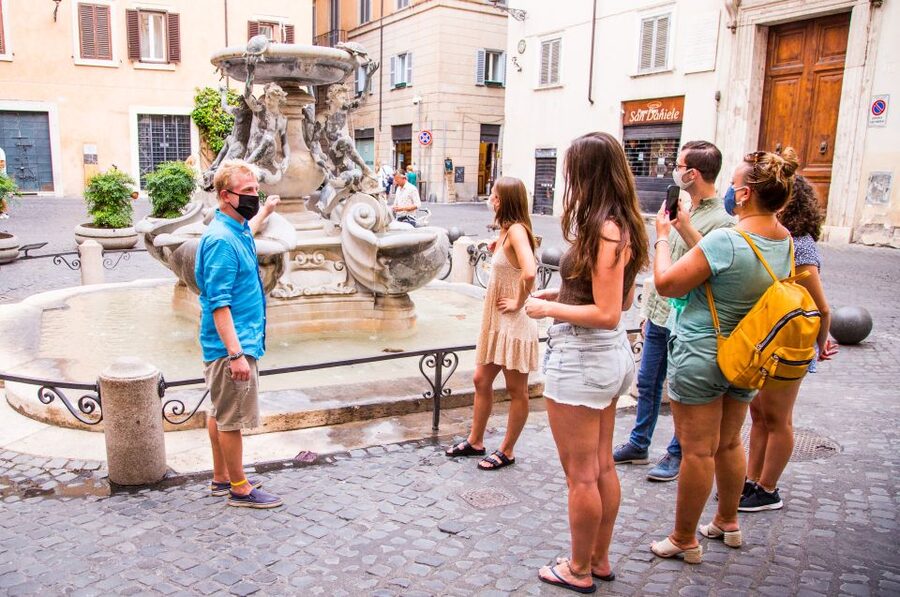
- The Turtle Fountain adds a human story: Piazza Mattei brings art, romance, and local legend into the walk.
- Kosher gelato is included: You receive homemade kosher gelato or coffee during the tour.
- The route ends on Tiber Island: Hear about the island’s ancient temple, its church, and its hospital during World War II.
- Guides shape the experience: Angela, James, Tom, Daniel, James, Maria, and others are praised for clear storytelling and thoughtful answers.
- Plan for weather and walking: Bring comfortable shoes, water, sun protection, and clothing suitable for changing conditions.
Why the Jewish Ghetto makes such a good walking tour

Rome can feel like a giant outdoor museum, with one monument piled on top of another. The Jewish Ghetto gives you a more focused route through that complexity. In about 2.5 hours, you move from imperial Rome to Renaissance fountains, from the forced confinement of Rome’s Jewish community to the area’s survival and renewal today.
The name Ghetto refers to the walled district where Rome’s Jewish residents were required to live for centuries. The area’s past is not presented as a single story. Your guide places Jewish life beside Roman politics, ancient religion, Christian institutions, war, and modern remembrance.
That broader setting matters. You are not simply looking at old stones. You are learning how the same small section of Rome changed purpose over 2,000 years. The ancient structures remain part of the city, while memorial markers and the Great Synagogue keep more recent events in view.
The tour is conducted in English, and the guide is the main reason to book it. The strongest guide reports describe clear explanations, good pacing, and a knack for turning dates into stories. James is repeatedly praised for making history easy to follow. Angela is noted for energy, warmth, and a strong grasp of Jewish history in Rome. Tom is described as especially good at putting three thousand years of Roman history into context. Daniel is praised for adapting the pace and answering questions.
Guides vary by departure, so you cannot count on one particular person. Still, the pattern is clear: this experience depends less on a scripted route than on the person leading it. Small groups can become especially rewarding. On some dates, a booking of two or four people has operated almost like a private tour.
Other walks around Rome:
- Rome: Trastevere & Campo de Fiori Street Food Walking Tour
★ 4.9 · 2,768 reviews - Rome: Paranormal Night Walking Tour & Secret Backstreets
★ 4.9 · 1,921 reviews - Rome by Night Walking Tour – Legends & Criminal Stories
★ 4.5 · 1,003 reviews
Meeting Trajan’s Column and entering ancient Rome
The meeting point is at Foro Traiano 84, near Trajan’s Column. Look for the orange Roman Vacations sign. This is a central location, but Rome’s monuments can be crowded and confusing, so arrive early rather than cutting it close. Late arrivals cannot be accommodated, and missed tours are not refunded.
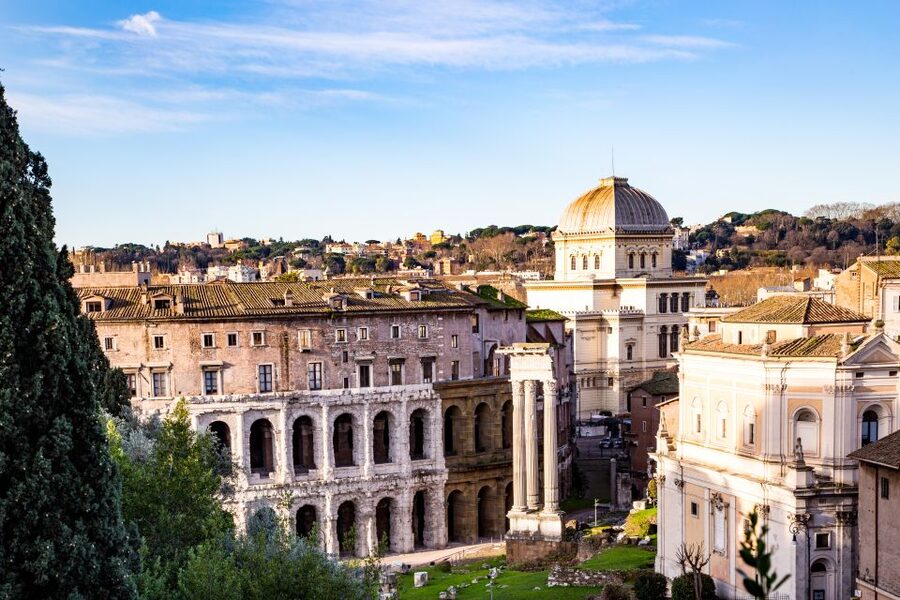
The first stop is the Theater of Marcellus, with about 20 minutes for explanation. It is one of the most striking reminders that ancient Rome was not confined to the Colosseum and Roman Forum. The theater predates the Colosseum, and its surviving arches show how Roman buildings could be reused long after their original purpose faded.
This opening section gives you useful background before the tour turns toward the Jewish Ghetto. You hear about Rome as an evolving city, not just a collection of ruins. That context helps you understand why later communities built homes, religious buildings, and public spaces among ancient Roman remains.
The stop is guided rather than a formal theater visit. You should expect to view and discuss the structure from the route, not spend time inside a museum or performance space. If you want a tour devoted only to ancient Rome, this will feel brief. If you want a clear bridge between imperial history and the Jewish neighborhood, the 20-minute stop works well.
Piazza Mattei and the Turtle Fountain
The route continues to Piazza Mattei, home of the Fontana delle Tartarughe, or Turtle Fountain. You spend about 20 minutes here, enough time to study the fountain and hear the story tied to its creation.
The fountain is a fine pause in the walk because it shifts the mood. Ancient theater gives way to a more intimate square, with sculpture, water, and a story of unrequited love. Your guide explains the tale rather than leaving you to admire the fountain as a pretty object with no context.
This is one of the tour’s more memorable stops for people who enjoy the human side of history. Rome’s monuments often come with political or religious explanations. Here, the guide brings in emotion, ambition, and romance.
The square also gives your group a natural place to pause. Rome can be hot, and the route includes several outdoor stops. Use these breaks to drink water and listen without rushing. The tour includes kosher gelato or coffee at a gelateria, though additional food and drinks are not included.
The Jewish Ghetto and the Portico d’Ottavia
From Piazza Mattei, the tour moves into the Jewish Ghetto itself. This is the heart of the experience, and the guide explains how Rome’s Jewish community lived under restrictions, how the district was enclosed, and how residents endured changing political and religious pressures.
You will pass the last remaining section of the wall that confined the community for centuries. It is a modest physical remnant, but it carries more weight once you understand what it represented. A good guide helps you connect the wall to daily life, not just dates and decrees.
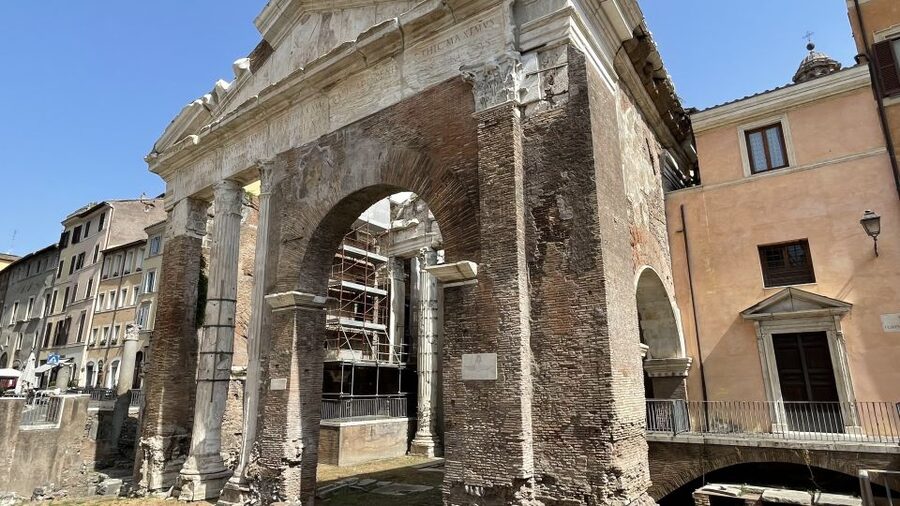
The Portico d’Ottavia receives about 15 minutes of guided attention. These ancient remains are especially powerful because they are not isolated from modern Rome. The structures are part of the neighborhood, set among streets and buildings still used today.
Your guide also discusses the relationship between the ancient Roman site and the Jewish community that lived beside it. This is where the tour’s approach pays off: the past is layered rather than separated into neat museum rooms.
The Ghetto section is serious. You will hear about persecution, confinement, and the destruction suffered by Jewish communities. The subject requires attention and respect, but the guides are also described as warm, conversational, and willing to answer questions. The best experience is not a lecture delivered at you. It is a thoughtful walk in which you can ask how the past connects with the city you see now.
Same base, a different kind of day:
- Vatican: Museums & Sistine Chapel Entrance Ticket
★ 4.5 · 144,003 reviews - Vatican Museums & Sistine Chapel Tour with Optional Basilica
★ 4.3 · 67,413 reviews - Colosseum, Roman Forum & Palatine Guided Tour
★ 4.7 · 63,148 reviews - Vatican Museums, Sistine Chapel & St Peter’s Basilica Guided Tour
★ 4.5 · 39,149 reviews
Kosher gelato and the Great Synagogue
A stop at a gelateria provides kosher gelato or coffee. It is included in the price, and it gives the group a pleasant break during a demanding history walk. The gelato is not the reason to book, but it is a useful touch because it ties the refreshment to the neighborhood’s Jewish identity rather than adding a generic snack.
Next, you pass the Great Synagogue of Rome. The synagogue is one of the major landmarks of modern Jewish Rome, and the guide explains its place in the community and the city. The exterior is part of the planned route, but an interior visit is not listed as included.
That distinction matters. Several people have wished for time inside the synagogue, so you should not book this tour expecting a synagogue admission. If entering the building is important to you, check separately for visiting arrangements and opening conditions before your visit. The tour itself gives you historical context and an exterior view.
You may also encounter memorial markers connected with the Jewish community and the events of the twentieth century. After the tour, you will have a better sense of what those markers mean when you notice them elsewhere in Rome. That is a real benefit of a guided walk: the city becomes easier to read on your own.
If you are planning for Friday, pay attention to the time. A departure on Friday afternoon, shortly before the Sabbath, may be less convenient for the neighborhood and for your schedule. This is a practical point, especially if visiting the synagogue area is central to your plans.
Crossing to Tiber Island
The last part of the route takes you across the oldest functioning bridge in Rome to Tiber Island. The island is a strong ending because it brings together ancient belief, Christian history, medicine, and wartime courage.
Your guide tells the story of Asclepius, the ancient god associated with healing, and explains how the temple site is now connected with a church. You also hear about the hospital on the island and its role in saving people during World War II.
This final section helps keep the tour from becoming only a story of suffering. The neighborhood’s past includes exclusion and violence, but it also includes care, survival, faith, and practical help. The route ends with those ideas still in view.
The island also gives the walk a clear sense of completion. You begin near Trajan’s Column, pass through ancient theater and Jewish streets, and finish across the river. It is a compact route, but the subject matter covers a very large span of time.
What the $65 price gets you
At $65 per person, the tour is not the cheapest way to see the Jewish Ghetto. You can walk the streets independently and view many of the monuments without paying an admission fee. The value comes from the guide’s interpretation, the carefully linked route, the kosher gelato or coffee, and the chance to ask questions as you go.
I think the price is reasonable if you want context rather than a checklist. The Theater of Marcellus, Turtle Fountain, Portico d’Ottavia, Great Synagogue, and Tiber Island are easy to pass without understanding how they relate. The guide turns separate sights into one story.
The cost is less convincing if you prefer to explore at your own pace, spend long periods taking photographs, or enter the Great Synagogue. The tour has a fixed route and a fixed duration, and the included refreshment is modest. You are paying mainly for the person leading the walk.
A 4.7 rating from 274 reviews suggests a consistently strong experience, but the individual guide still matters. The most praised qualities are clear storytelling, broad command of Roman and Jewish history, patience with questions, and an ability to adjust the walking pace. If your group is small, you may get an especially personal experience.
Walking conditions, weather, and practical planning
Wear comfortable shoes. The route lasts 2.5 hours and includes several outdoor stops, so this is not the place for stiff footwear or a rushed schedule before dinner.
Bring a reusable water bottle, sunscreen, a sun hat, and weather-appropriate clothing. An umbrella is also recommended. Tours continue in all weather, so do not assume rain will cancel the walk.
If you have limited walking speed, tell the guide at the start. One guide is specifically praised for keeping a comfortable pace for a participant with difficulty walking, and other descriptions note that guides pause in shady areas and adapt to the group. There is no promise of a fully accessible route, so ask the provider if you have specific mobility needs.
Bring something to cover bare shoulders if you may enter a church. The route includes religious sites and discussion of them, and modest clothing is the safer choice.
Free cancellation is available up to 24 hours in advance, and you can reserve now and pay later. Those options help if your Rome plans are still shifting, but they do not protect you from arriving late. Leave extra time to find the orange sign near Trajan’s Column.
Who will enjoy this tour most

I would choose this tour if you want to understand Rome beyond its biggest ticketed attractions. It suits first-time visitors who need historical connections, repeat visitors who want a less familiar neighborhood, and anyone interested in Jewish life in Rome across the centuries.
It also works well for families with older children and teenagers. One guide was especially successful at presenting history as a story, which kept teenagers interested. The subject is serious, but the route includes fountains, ruins, gelato, a river crossing, and plenty of visual variety.
You do not need to be Jewish to get value from the walk. The tour explains the Jewish community’s experience within the wider story of Rome and Italy, so it suits anyone interested in religious history, urban change, ancient Rome, or the survival of communities under pressure.
I would think twice if you want a museum-style tour with indoor seating, a long visit inside the Great Synagogue, or a slow photography walk. This is an interpretive walking tour, and its strength is the guide’s spoken explanation.
Should you book the Jewish Ghetto Walking Tour?
Book it if you want a compact, serious, and human look at one of Rome’s oldest neighborhoods. The route is well chosen, the final stop on Tiber Island adds a strong closing chapter, and the guides are consistently praised for making a huge span of history understandable.
Before booking, accept three limits: you will walk outdoors in all weather, the Great Synagogue is not listed as an interior visit, and late arrival means missing the tour. If those points work for you, $65 is fair for the historical context, live questions, small-group possibility, and included kosher gelato or coffee.
FAQ
How long is the Rome Jewish Ghetto walking tour?
The tour lasts 2.5 hours.
What language is the tour conducted in?
The live tour guide speaks English.
Where does the tour meet?
The meeting point is at Foro Traiano 84, near Trajan’s Column. Look for an orange Roman Vacations sign.
What sights are included on the route?
The route includes the Theater of Marcellus, Turtle Fountain in Piazza Mattei, the Jewish Ghetto, the Portico d’Ottavia, the Great Synagogue area, and Tiber Island.
Is food included?
Kosher gelato or coffee is included. Extra food and drinks are not included.
Does the tour go inside the Great Synagogue?
An interior visit is not listed as part of the tour. You pass the Great Synagogue and learn about its importance.
What should I bring?
Bring comfortable shoes, a sun hat, sunscreen, a reusable water bottle, an umbrella, and clothing suitable for the weather. Bring a cover for bare shoulders inside churches.
Does the tour run in bad weather?
Yes. The tour proceeds in all weather conditions.
Can I cancel for a refund?
You can cancel up to 24 hours in advance for a full refund. You can also reserve now and pay later. Late arrivals and missed tours are not refunded.
Just added in Rome
- Civitavecchia Private Transfer: From the Port to Rome Airport★ 5.0 · 309 reviews
- Civitavecchia Shore Excursion: Best of Rome Private Tour★ 5.0 · 247 reviews
- Civitavecchia Private Transfer from ship to FCO airport or Rome★ 5.0 · 245 reviews
- Food Tasty and History Tour in Civitavecchia★ 5.0 · 256 reviews
- Palatine Hill and Roman Forum Tour with Fast-Track Entrance★ 4.2 · 417 reviews
- Tivoli: Villa D’Este & Villa Adriana Pass & App Audioguide★ 4.4 · 364 reviews
- Tivoli: Villa D’Este Entry Ticket and App Audio Guide★ 4.3 · 191 reviews
- Vatican Museums & Sistine Chapel Skip-the-Line Guided Tour★ 4.6 · 254 reviews
Walking Tours, compared.

Guided Walking Tour & Last Supper Visit with Ticket
Read our review →
Rialto Bridge & Offbeat Unusual Venice Walking Tour
Read our review →

Private 3 hrs Venice Tour: St Mark’s, Walking tour & Boat tour
Read our review →
Skip the line: Uffizi and Accademia Small Group Walking Tour
Read our review →Browse the lists this tour appears in