
Reviewed · MUSEUMS
Leonardo Da Vinci Museum Entrance Ticket
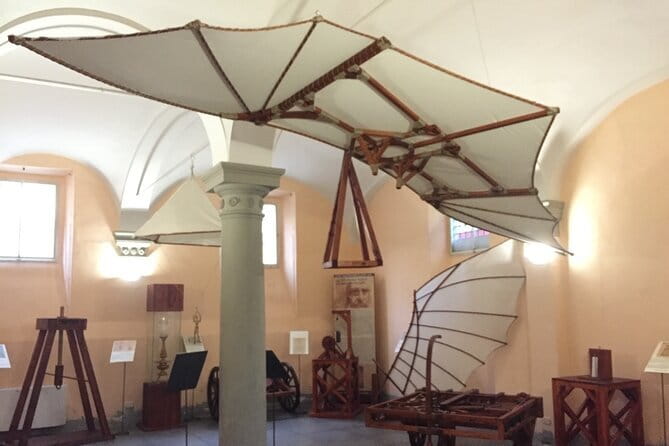
Leonardo’s genius gets a practical workout at this small Florence museum. Instead of staring at paintings, you’ll examine more than 50 models based on his sketches, including flying machines, military devices, civil engineering designs, and anatomical studies. Many are built to move, so you can see how his ideas worked rather than simply read about them.
I like the museum’s hands-on approach and its compact size. You can see the main collection in about an hour, making it easy to fit between major Florence sights. The low price is another plus, especially for families. The catch is simple: this is a museum of replicas and working models, not a gallery of Leonardo’s original paintings or manuscripts.
Key points to know before you go
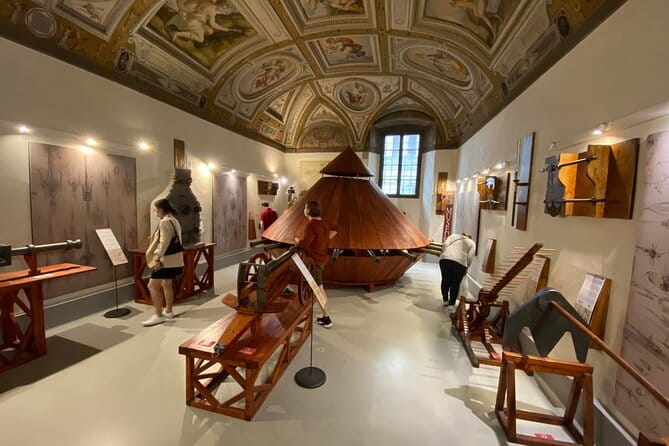
- More than 50 working models: The machines cover civil engineering, flight, warfare, and anatomy.
- Four themed rooms: The layout gives you a clear path through Leonardo’s different fields of study.
- Good for families: Selected displays invite children and adults to test ideas with their hands.
- A short, flexible visit: Plan on about one hour, or up to 90 minutes if you read everything carefully.
- Central Florence location: The museum is at the Galleria Michelangelo, on one of the city center’s best-known streets.
- Check the city carefully: This ticket is for Florence, not Leonardo museums in Rome, Milan, or Venice.
Leonardo’s machines in a former artists’ meeting place
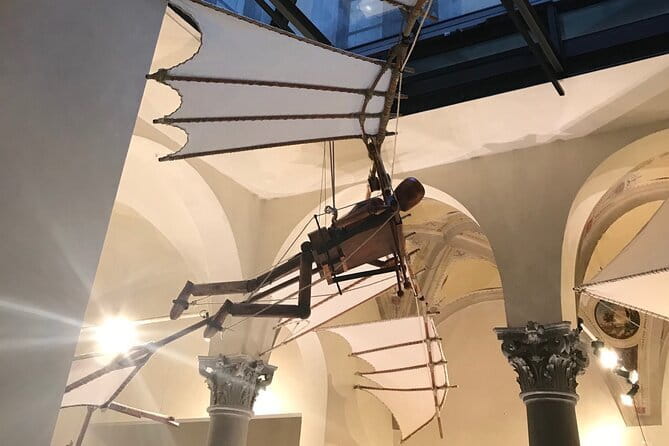
The museum occupies the Galleria Michelangelo, a historic gallery where the Macchiaioli, a group of nineteenth-century Italian painters, once met. That setting gives the visit a little more character than a plain modern exhibition hall, though the main attraction is clearly the machine collection.
The museum is in central Florence and close to public transportation. Its location makes it useful as a short stop while you explore the city’s main sights. You will not need to set aside half a day, which matters in Florence, where the Uffizi, Accademia, churches, markets, and streets can quickly fill your schedule.
The entrance ticket is listed at $12.55 per person. For that price, I see this as a reasonable short attraction, particularly if you enjoy science, engineering, or hands-on exhibits. It is less convincing if you expect original Leonardo art, detailed academic interpretation, or a major museum complex.
The museum is open daily from 10 a.m. to 6 p.m. The ticket offers flexible time slots throughout the day, and some booking instructions describe entry at any time during opening hours. Because the exact voucher instructions can vary, check your confirmation before setting your schedule.
Other museums and galleries in Florence:
- Florence: Skip-The-Line Uffizi Gallery Timed Entry Ticket
★ 4.5 · 27,832 reviews - Florence: Leonardo Interactive Museum Entry Ticket
★ 4.5 · 11,763 reviews - Florence Accademia Gallery Tour with Entrance Ticket Included
★ 4.5 · 6,148 reviews
Four rooms that show four sides of Leonardo
The collection is arranged in four rooms. This is a helpful design choice because Leonardo worked across so many fields that a less organized display could feel scattered.
The first room focuses on civil machines. Here you see designs linked to construction, transport, water, and mechanical problem-solving. These displays help explain why Leonardo was more than a painter. He studied how materials moved, how force could be transferred, and how machines could make difficult work easier.
The second room is devoted to flying machines. Leonardo never produced a modern airplane, but his observations of birds and his attempts to understand lift reveal his habit of studying nature before designing a machine. The models make those ideas easier to grasp than a page of sketches alone.
The third room contains war machines. This section may interest visitors who want to see Leonardo’s work in military design, but it also gives the museum a harder edge. His notebooks included ideas for weapons, fortifications, and devices meant for defense or attack. You can see how his imagination served both practical engineering and military needs.
The fourth room presents the newer collection of anatomical models. Leonardo’s anatomy studies came from the same close observation that shaped his art and engineering. These models broaden the visit beyond gears and weapons, showing how his curiosity moved from machines to the human body.
The arrangement also helps families. Children can move from one type of invention to another without facing a long wall of text. Adults who want more detail can take their time with the descriptions and compare the models with Leonardo’s original ideas.
Working replicas make the visit more active
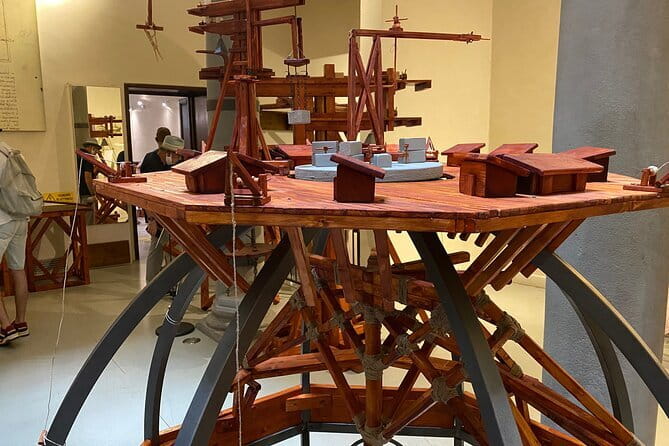
The strongest part of this museum is the chance to see many models in working form. You are not only looking at a shape behind glass. Selected machines can be operated or tested, allowing you to understand the basic motion behind the design.
Some displays are hands-on, while others are for looking only. The difference matters. If you are visiting with young children, explain that not every exhibit can be touched. The museum includes a children’s area in the basement, and hands-on activities are concentrated in certain parts of the visit rather than spread through every room.
The working models are replicas, not Leonardo’s original objects. That is unavoidable for most of his inventions, since many were never built during his lifetime. Still, the distinction should be clear before you arrive. If you want original Renaissance artifacts, this is not the right stop.
I find the models most useful when you already know a little about Leonardo’s sketches. A quick look at his life and work before you visit can make the machines more meaningful. Without that context, some devices may look like clever wooden mechanisms without much explanation of the problem they were meant to solve.
The museum also shows a documentary about Leonardo’s life and work on large-screen monitors. Use it as an introduction or a pause between rooms. It gives the visit a human thread and helps connect the separate subjects, from painting and anatomy to architecture and military design.
What the museum does not include

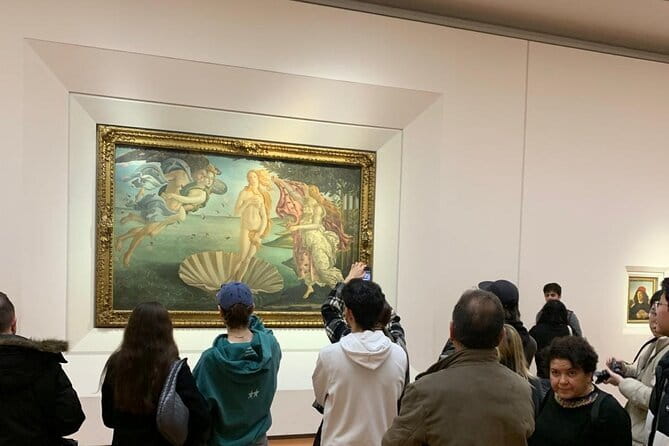
The museum’s main subject is Leonardo’s inventive mind, not his art. You should not expect to see the Mona Lisa, original paintings, or a major collection of Renaissance works. That point is worth stressing because Leonardo’s name naturally brings his paintings to mind.
The displays focus on models inspired by his designs. Some visitors find that approach fascinating because it turns drawings into objects you can study and operate. Others find the replicas too basic or want more historical depth and stronger storytelling.
I would describe the museum as educational and visual rather than scholarly. It works best when you want to understand the range of Leonardo’s ideas in a short visit. It works less well if you are looking for original documents, rare objects, or a detailed account of Renaissance Florence.
The museum is also compact. That is an advantage when you have a full day of sightseeing, but it means you should not expect hours of galleries. Most people can see it in one to one and a half hours, depending on how closely they read the explanations and use the interactive displays.
A few more things to do in Florence
- Florence: Timed Entrance Ticket to Michelangelo’s David
★ 4.6 · 16,983 reviews - Florence: Michelangelo’s David Skip-the-Line Entry Ticket
★ 4.5 · 12,764 reviews - Florence: Cathedral & Brunelleschi’s Dome Ticket & Audio App
★ 4.4 · 6,973 reviews - Florence: Michelangelo’s David Priority Ticket & Audio App
★ 4.4 · 6,812 reviews
Why families often get the most from it
Children usually have an easier time connecting with a moving machine than with a long label beside a painting. The building areas and selected interactive exhibits give younger visitors something active to do, while the four-room layout keeps the visit manageable.
Adults can enjoy the same displays by thinking about the engineering problems behind them. How does a mechanism transfer power? How might a flying device have been tested? What did Leonardo understand about the body, and what did he only imagine? The museum does not answer every question in depth, but it gives you a visual starting point.
The children’s area is in the basement, and not every machine is interactive. That makes this a better family stop for children who can handle a museum with both touchable and untouchable exhibits. If your child needs constant activity, the visit may feel uneven.
The museum can also work well for mixed-age groups. One person can focus on anatomy, another on military inventions, and children can spend time with the hands-on sections. Since the visit is short, you are not committing the family to a long indoor stretch.
A sensible one-hour plan
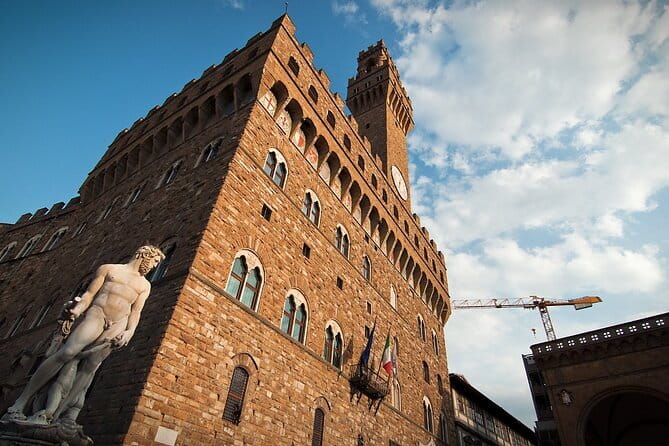
Give yourself about 60 minutes for a brisk visit. Start with the civil machines, then continue through the flying and war rooms before finishing with anatomy. This order follows the museum’s layout and gives you a steady change of subject.
Allow closer to 90 minutes if you want to read the explanations, watch the documentary, try the working models, and spend time in the children’s area. On a hot Florence afternoon, the museum can also provide a cool indoor break.
A practical visit might look like this:
- Spend 10 to 15 minutes getting oriented with the documentary and introductory material.
- Give the civil machines 15 to 20 minutes, especially if engineering interests you.
- Allow another 15 to 20 minutes for the flying and war machines.
- Finish with anatomy, the children’s area, the bookshop, and any displays you want to revisit.
The timetable is only a guide. The museum is self-guided, so you can move at your own pace. There is no listed tour guide or scheduled lecture to follow.
Food, books, and the historic setting
The gallery has an agreement with Caffé Michelangiolo, a restaurant inside the exhibition area. Food and drinks are not included with the ticket, so treat the café as an optional add-on rather than part of the admission.
The bookshop sells publications and souvenirs related to Leonardo. It is useful if you want a book to explain the inventions in more detail after your visit. It also offers gadgets, including items aimed at children. Prices are described as generally reasonable, though some souvenirs are mass-produced.
Look up occasionally at the building itself. Painted ceilings and the older gallery setting add atmosphere and remind you that this is not only a room full of mechanical replicas. The historic surroundings are not the main reason to buy the ticket, but they help the stop feel connected to Florence.
Price, booking, and the wrong-city warning
At $12.55, this is among the more affordable paid attractions in central Florence. The value depends on your expectations. I think the price works well for a focused one-hour visit, especially when you want something educational and family-friendly without committing to a large museum.
Pre-booking can save time and help you choose a convenient time during the 10 a.m. to 6 p.m. opening window. The activity has a maximum group size of 20, though the visit itself is self-guided rather than a guided group tour.
Take special care when booking. Leonardo museums in several Italian cities use similar names, and a ticket for Florence will not get you into a museum in Rome, Milan, or Venice. Confirm that the destination says Florence and that the address matches the Museo Leonardo Da Vinci at the Galleria Michelangelo.
The ticket includes admission only. Hotel pickup and drop-off, food, and drinks are not included. Confirmation is provided at booking, and the attraction is near public transportation.
Free cancellation is available if you cancel at least 24 hours before the scheduled start time. Cancellations or changes made within 24 hours are not accepted for a refund, and the cut-off uses local time.
Who should book this Florence museum
I would recommend it most strongly to families, curious children, science fans, and adults who want to see Leonardo’s inventions rather than only hear about his paintings. It is also a good choice when you need a short indoor activity near central Florence.
You may want to skip it if your main goal is original art, rare Renaissance objects, or a major historical collection. The models are the point, and some displays are simple replicas. Your enjoyment will depend on how much you like taking an idea apart and seeing how it might work.
The museum also suits a flexible schedule. You can visit in roughly an hour, then continue to another sight. It does not require the mental or time commitment of Florence’s largest museums.
Should you book the Leonardo da Vinci Museum?
Book it if you want a reasonably priced, compact visit built around working models, interactive displays, and Leonardo’s wide-ranging interests. Families will likely get the most from the hands-on areas, while adults with a strong interest in engineering or science can appreciate the inventive range.
Skip it if you expect Leonardo’s original art or a detailed scholarly treatment of his life. Before paying, double-check that you are booking Florence and not another Italian city. With the right expectations, this is a useful one-hour stop that turns Leonardo’s drawings into machines you can actually understand.
FAQ
Where is the Leonardo da Vinci Museum located?
The museum is at the Galleria Michelangelo on a well-known street in central Florence, Italy. It is near public transportation.
How much does admission cost?
The listed price is $12.55 per person.
How long does the visit take?
Plan on about one hour to one and a half hours, depending on how closely you examine the models, read the information, and use the interactive displays.
What does the admission ticket include?
The ticket includes admission to the Leonardo da Vinci Museum.
What is not included?
Food, drinks, and hotel pickup and drop-off are not included.
What are the museum’s opening hours?
The museum is open Monday through Sunday from 10 a.m. to 6 p.m.
What can I see inside the museum?
More than 50 models are arranged in four rooms covering civil machines, flying machines, war machines, and anatomical models. Many of the models are working machines.
Is the museum suitable for children?
Yes. The museum has hands-on displays, building areas, and a children’s room in the basement. Not every exhibit can be touched, so the experience includes both interactive and observation-only sections.
Can I cancel for a refund?
Yes. You can receive a full refund if you cancel at least 24 hours before the experience start time. Changes or cancellations made less than 24 hours before the start time are not accepted.
Just added in Florence
- Wine Tasting Experience in Ponte Vecchio: Best Tuscany selection!★ 5.0 · 197 reviews
- Walking Food Tour of Florence with Tastings and Wine★ 5.0 · 518 reviews
- Wine Experience In Chianti Hills from Florence★ 4.5 · 195 reviews
- Florence Sunset Food Tour with Wine & Dine at a Tuscan farmhouse★ 5.0 · 194 reviews
- Uffizi and Accademia Small Group Guided Tour★ 4.5 · 449 reviews
- Val d’Orcia Brunello Wine Tour with Montalcino and Montepulciano★ 4.5 · 359 reviews
- Uffizi Gallery Timed Entry Admission Tickets★ 4.0 · 392 reviews
- Uffizi Gallery Small Group Tour with Guide★ 4.5 · 879 reviews
Museums, compared.

Vatican: Museums & Sistine Chapel Entrance Ticket
Read our review →
Vatican Museums & Sistine Chapel Tour with Optional Basilica
Read our review →
Vatican Museums, Sistine Chapel & St Peter’s Basilica Guided Tour
Read our review →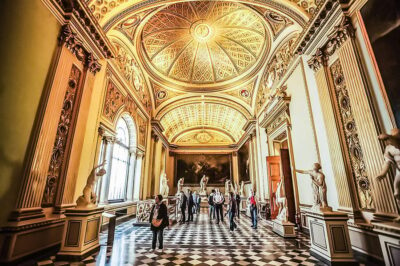
Skip-The-Line Uffizi Gallery Timed Entry Ticket
Read our review →
Vatican Museums & Sistine Chapel Skip-the-Line Entry Ticket
Read our review →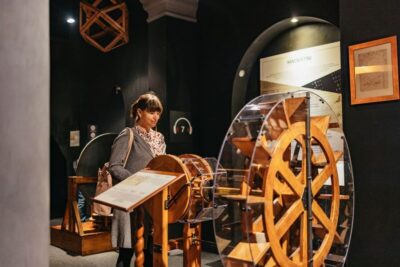
Browse the lists this tour appears in