
Reviewed · TOURS IN NAPLES
Galleria Borbonica Entrance Ticket in Standard Route
Naples keeps a second city below street level. At Galleria Borbonica, you descend into a Bourbon escape route that later served as a wartime shelter, military hospital, and storage area. The old cars, Vespas, household objects, and scarred stone make the past feel close at hand. The WWII air-raid shelter is the most moving part, while the tunnel itself shows how Naples has reused the same underground spaces again and again.
I like this tour for two clear reasons: the guide connects geology, politics, and daily life, and the cool underground temperature gives you a welcome break from hot Naples streets. The main drawback is the start. You face steep, narrow steps, and a large group or a guide who speaks too quickly can make the echoing commentary hard to follow.
Key points to know before you go
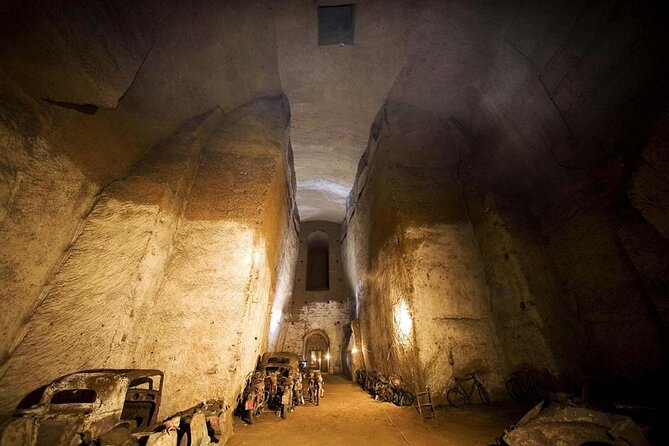
- Descend about 33 yards underground: The standard route begins down a staircase with eight ramps, with some descriptions estimating around 90 steps.
- See a WWII air-raid shelter: The tunnels preserve the spaces where local residents sought safety during bombing.
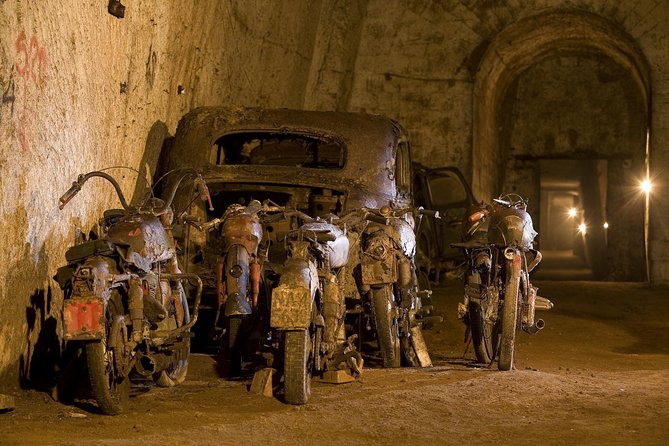
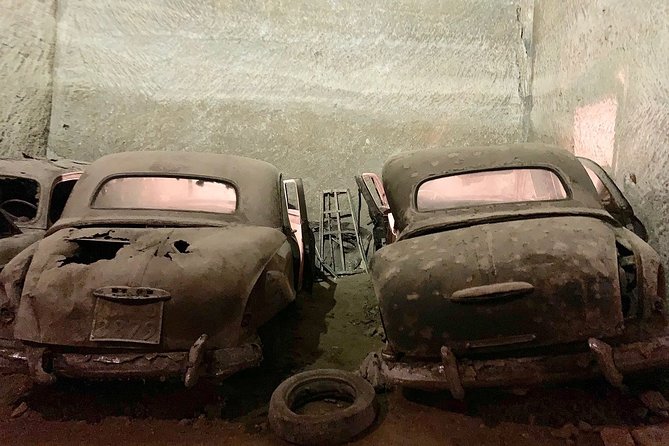
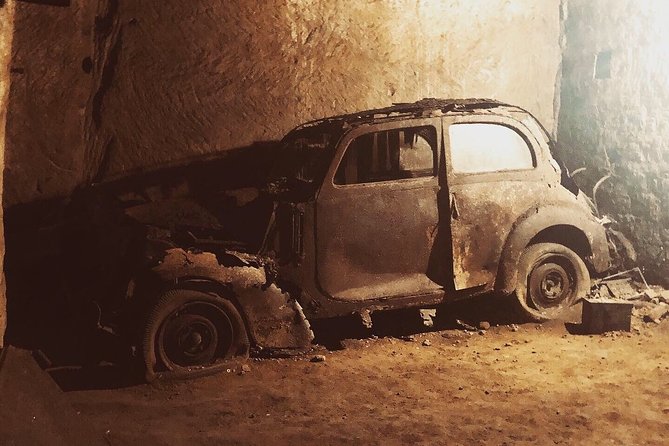
- Look for old cars and Vespas: Abandoned vehicles are among the route’s most memorable objects, but they are only part of the display.
- Hear several centuries of stories: Guides explain Bourbon plans, aqueducts, excavation, wartime use, and the tunnel’s later life.
- Plan for a different exit: The tour can finish at Via Domenico Morelli 40, rather than where you began.
- Wear a sweater and good shoes: The underground route is cool, and the stairs and uneven walking areas call for sensible footwear.
Naples has a secret address below the palace
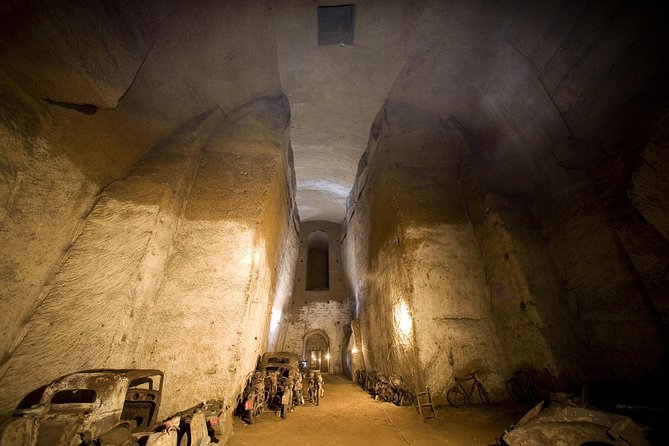
Galleria Borbonica sits at Vico del Grottone 4, roughly 100 meters from Piazza del Plebiscito. The entrance is easy to pair with a walk around the Royal Palace area, though the doorway can take a little finding. Look for the former veterinary laboratory, now used as the entrance to the Bourbon Tunnel.
The route begins with a descent into the Chiaia district. The official description gives the depth as 33 yards, reached by a staircase with eight ramps. Some people describe the descent as close to 90 steps, so do not treat this as a flat museum visit. If you have trouble with stairs or feel uneasy in confined places, entry number 2 is recommended.
That second entrance is at Via Domenico Morelli 40, through the crosswalk of the Quick parking area. Since the tour may end there, this location is also important when you plan the rest of your day. You may need a moment to get your bearings after emerging at a public car park, where signs can be limited.
A few more things to do in Naples
- Naples: Naples Underground Entry Ticket and Guided Tour
★ 4.4 · 21,781 reviews - Naples: Catacombs of San Gennaro Entry Ticket & Guided Tour
★ 4.6 · 7,941 reviews - Naples: Downtown Tour with Veiled Christ & St Clare Tickets
★ 4.9 · 6,462 reviews
Why Ferdinand II ordered the tunnel
The Bourbon Tunnel began in 1853 under Ferdinand II of Bourbon. He feared a rebellion and wanted a private escape route from the Royal Palace to a barracks on Via della Pace, now Via Morelli.
The plan was practical, political, and unfinished. The tunnel never became the complete royal escape route its builder intended, but the partially completed passage still tells you much about Bourbon Naples. Underground construction was not simply a matter of digging a hole. The route connects with older water systems, excavated spaces, and the difficult stone beneath the city.
Your guide explains how the tunnel was built and why it mattered. The better guides bring the setting to life with stories rather than a list of dates. Roberto, Sabrina, and David are among the guides who have been singled out for clear English, lively delivery, and answers to questions, though your guide will depend on the departure.
This is a useful place to see how Naples works as a layered city. A royal project became a civilian refuge. A wartime shelter later became a storage area. The same walls kept changing jobs as the city around them changed.
The first descent is the hardest part
The opening staircase is the part that demands the most from you physically. It is steep, narrow, and twisting, with the main effort concentrated at the beginning. Once you reach the lower sections, the route generally becomes easier to manage, though you still walk through narrow passages and areas where the stone and floor may feel uneven.
I would wear shoes with a firm sole and avoid arriving in anything that makes stairs awkward. A light sweater is also sensible. The underground temperature can feel very different from the street, especially in summer, when the tunnels offer a pleasant break from heat.
The entrance area may not have much space for waiting, and there is no promise of seating or facilities before the tour begins. Arrive ready to stand outside for a short period if your group has not yet entered. This matters more for families, older people, or anyone who needs a place to rest.
Most people can take part, but the route is not ideal for everyone. Children aged 9 and 13 have enjoyed it, while younger children may find the length, darkness, or steps tiring. Free admission applies to ages 0 to 10, with a reduced price of €5 for people over 75 and children aged 11 to 13. The listed adult price is about $18.14 per person.
A bomb shelter with personal stories
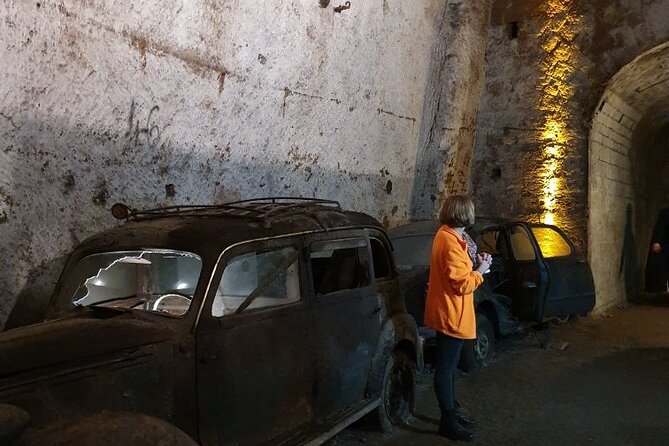
The WWII section gives the tour its strongest emotional weight. During the war, residents of the area used the Bourbon Tunnel as a military hospital and an air-raid shelter. The stone passage was no longer a royal escape plan. It became a place where ordinary Neapolitans waited out attacks and tried to stay alive.
You see the spaces in a practical setting, not through a polished exhibition hall. That is part of the power. The war left marks in the underground rooms, and the guide explains how people used them. You begin to picture families leaving their homes, carrying what they could, and waiting below while the city above faced bombing.
The route also became the Hall Judicial Deposit after the war. Old objects left in the tunnels help explain that later period. The display can include cars, Vespas, cradles, and other items that were stored or abandoned below ground. These objects are not decorative filler. They show how the site shifted from emergency shelter to a place of neglect and storage before being opened as a cultural attraction.
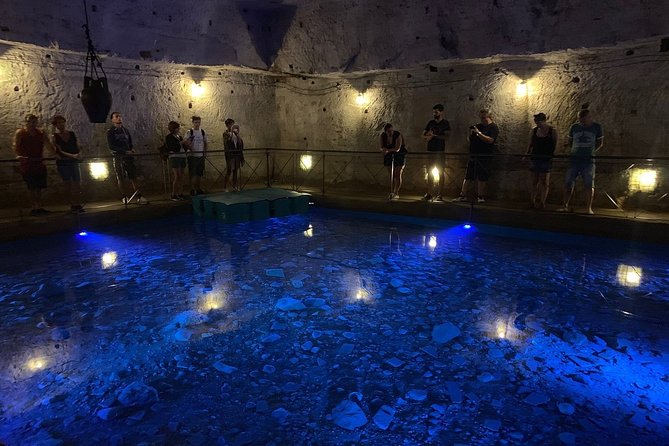
If your main reason for booking is the famous large hall with blue water shown in some images, check which route you are purchasing. The standard route does not necessarily include every room or image associated with other visits to the site. The most reliable expectation here is the tunnel, the shelter, the historical explanation, and the old vehicles.
Same base, a different kind of day:
- From Naples: Pompeii Ruins & Mount Vesuvius Day Tour
★ 4.3 · 11,459 reviews - From Naples: Sorrento, Positano and Amalfi Full-Day Tour
★ 4.6 · 10,988 reviews - From Naples: Sorrento, Positano & Amalfi Coast – Small Group Tour
★ 5.0 · 8,643 reviews - Naples: Pizza-Making Workshop with Drink and Appetizer
★ 4.9 · 5,411 reviews
Old cars, Vespas, and the pleasure of odd details
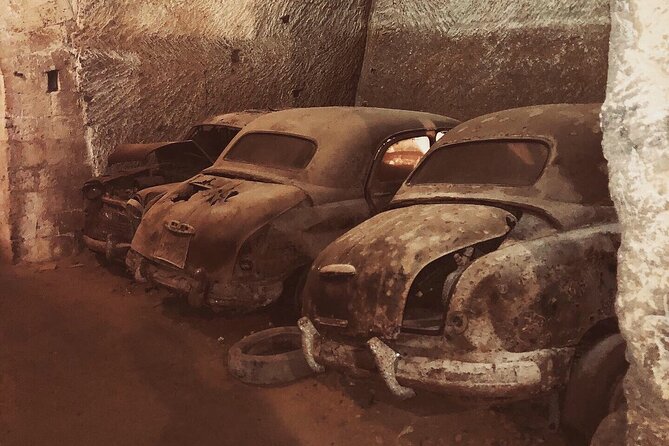
The vehicles are the easy visual highlight. Old cars and Vespas sit in the underground spaces, giving you clear photo subjects and a sense of the tunnel’s later use. They also make the tour work well for people who are less drawn to architectural history.
I like the contrast. One moment you are hearing about Bourbon engineers and aqueducts. The next, you are looking at a rusting vehicle or a forgotten household object. The mixture makes the tour feel less like a formal history lesson and more like an archaeological attic beneath the city.
There is a useful warning here. The vehicles are not the whole attraction, and you should not book this route expecting a huge automobile museum. The strongest experience comes from the combination of objects and setting. Without the guide’s explanation, an old car is simply an old car. With the story of how the tunnel was used, it becomes evidence of the site’s long, strange afterlife.
You may also see an option to go farther into the caves with a helmet. That appears to be a separate or additional element, so do not assume it is included in the standard route. The standard ticket covers the guided visit described here.
How good guiding changes the visit
This tour depends heavily on the guide. A strong English-speaking guide makes the dark passages easy to understand, points out details you might walk past, and connects the tunnel to Naples above. The best examples include David bringing the stories to life, Sabrina explaining the site with energy, and Roberto covering the origins, wartime shelters, cars, and Vespas in clear terms.
The less successful version is still interesting, but less comfortable. Echoes can blur words, particularly in narrow chambers. A guide who speaks quickly or too softly may leave people at the back struggling to follow. One-hour tours move at a steady pace, and the guide may begin speaking before everyone has reached the next stop.
The group limit is up to 50 people, which is large for narrow underground rooms. If the full group is present, stay near the guide and move forward promptly when asked. Ask questions during a clear pause, not while the group is squeezing through a passage.
English is offered, and Italian is also listed as a guide language. Confirm the language and exact meeting point at booking, especially if you are arranging the visit around a train, meal, or another timed attraction.
One hour underground, but allow extra time around it
The guided experience lasts about one hour. That is long enough to cover the tunnel’s main uses without taking over your day. I would allow additional time for finding the entrance, waiting to enter, and getting oriented after the exit.
The start point is Vico del Grottone 4. The second entry is Via Domenico Morelli 40, through the Quick parking crosswalk. The beginning and end may not match, so do not arrange to meet someone at the entrance immediately after the tour.
Transportation to and from the attraction is not included. You make your own way to the site, and the central location near Piazza del Plebiscito makes it a sensible addition to a walking day in Naples. Food and drinks are also not included, though this is not a problem for a one-hour visit. Plan a café stop before or after, not as part of the tour.
The booking pattern suggests that this experience often sells ahead, with reservations made around 13 days in advance on average. I would not wait until the last minute if your Naples schedule is fixed, particularly if you need an English departure on a specific day.
Is $18.14 a fair price?
At about $18.14, I consider the standard route good value for a guided hour in central Naples. You are paying for access to a place you cannot understand fully from the street, plus an explanation of its royal, geological, military, and civilian uses.
The price makes sense if you enjoy unusual historic sites and want something different from churches, palaces, and galleries. It is less convincing if you want a large museum collection or a polished spectacle. Much of the reward comes from the guide and the atmosphere, not from the number of displayed objects.
The high approval level, 4.8 rating from 2,632 ratings, and 97 percent recommendation suggest that the experience usually delivers what it promises. Still, the occasional weak tour can be affected by group size, echo, accent, or fast delivery. That is why I would treat the guide as a major part of the value.
Free cancellation is available if you cancel at least 24 hours before the start time. Changes or cancellations inside that window are not accepted for a refund. Keep that deadline in mind when building a flexible Naples plan.
Who should book the Bourbon Tunnel?
I would choose this tour if you want to understand Naples through the lives of people who used its spaces. It suits history fans, families with older children, photographers interested in unusual objects, and anyone who needs an air-conditioned or underground break from summer heat.
It is also a good choice after visiting Piazza del Plebiscito or the Royal Palace, since the tunnel’s Bourbon connection gives those above-ground sights another layer. The WWII shelter section is especially worthwhile if you want to learn how local residents experienced the war.
I would think twice if steep steps, narrow passages, or echoes will make the visit unpleasant. The alternate entrance may help people with walking issues or claustrophobia, but you should still expect an underground route and ask for clear instructions before arrival.
Should you book it?
Yes, if you want a short, unusual, and fairly priced history experience in central Naples. Book it for the underground story, the WWII shelter, and the chance to see old cars and everyday objects in a setting they were never meant to become a museum.
Choose another activity if your priority is grand architecture, a large art collection, or an easy, fully accessible walk. For everyone else, I would reserve ahead, wear good shoes, bring a sweater, stay close to the English-speaking guide, and confirm both the starting entrance and the exit plan.
FAQ
Where does the Galleria Borbonica tour begin?
The ticket redemption point is Vico del Grottone 4, 80132 Napoli. It is about 100 meters from Piazza del Plebiscito.
Is the tour available in English?
Yes. The experience is offered with a professional guide in English or Italian.
How long does the tour last?
The guided visit lasts approximately one hour.
How far underground does the route go?
The entrance staircase descends about 33 yards underground. It has eight ramps, and some descriptions estimate roughly 90 steps.
What will I see inside the tunnel?
You can expect historical tunnel spaces, a WWII air-raid shelter, wartime areas, aqueduct-related features, old cars, Vespas, cradles, and other stored objects.
Is transportation included?
No. You are responsible for getting to and from Galleria Borbonica.
Are food and drinks included?
No. Food and drinks are not included in the ticket.
Is the tour suitable for people with walking issues?
Most people can participate, but the route includes steep and narrow stairs. Entry number 2 is recommended for people with walking issues or claustrophobia.
Is there a discount for children or older people?
Children aged 0 to 10 enter free. The reduced price is €5 for children aged 11 to 13 and people over 75.
Can I cancel for a refund?
Yes, if you cancel at least 24 hours before the experience begins. Cancellations or changes made less than 24 hours before the start time are not refunded or accepted.
Just added in Naples
- Boat excursion with lunch on board to discover Ischia★ 5.0 · 474 reviews
- Tour of the island of Ischia in schooner★ 5.0 · 208 reviews
- Vesuvius National Park Skip-the-Line Ticket★ 3.8 · 221 reviews
- Naples: The Holy Mile 3-Hour Guided Tour★ 4.9 · 711 reviews
- Procida: Boat Tour with Swimming Stops and Underwater Photos★ 5.0 · 322 reviews
- Pompeii and Vesuvius Full-Day Tour from Amalfi Coast★ 4.4 · 319 reviews
- From Naples: Pompeii and Herculaneum Tour with Lunch★ 4.3 · 444 reviews
- From Naples: Pompeii & Herculaneum with Archaeologist Guide★ 4.8 · 665 reviews
Tours in Naples, compared.
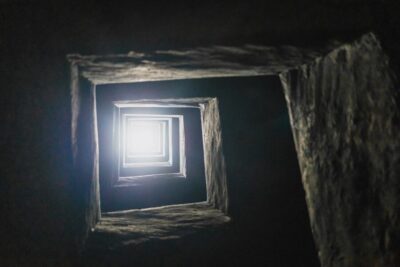
Naples Underground Entry Ticket and Guided Tour
Read our review →
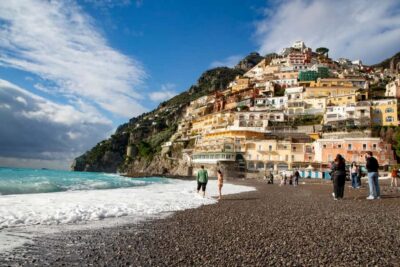
Sorrento, Positano and Amalfi Full-Day Tour
Read our review →
Sorrento, Positano & Amalfi Coast – Small Group Tour
Read our review →
Catacombs of San Gennaro Entry Ticket & Guided Tour
Read our review →
Downtown Tour with Veiled Christ & St Clare Tickets
Read our review →
Pizza-Making Workshop with Drink and Appetizer
Read our review →
Browse the lists this tour appears in