Reviewed · TOURS
Guided Tour of Mosaic Tiles in Ravenna
Ravenna’s mosaics are not just pretty walls. They are glittering records of emperors, bishops, battles, and changing religious power. This walking tour takes you into the Mausoleum of Galla Placidia, Basilica di San Vitale, and the Neonian Baptistery, with guides such as Chiara, Marco, Elisabetta, and Francesca explaining what you are seeing.
I like the prearranged monument entry, which saves you from sorting out tickets on a short visit. I also like the way the guides connect the art to Dante Alighieri, Byzantine rule, and the spiritual ideas behind the pictures. The main concern is practical: groups can reach 20 to 28 people, and one poor audio setup or a hard-to-hear guide can weaken the experience.
Key points to know before booking
- The mosaics are the main event: Expect some of Italy’s finest early Christian and Byzantine art, especially in San Vitale and Galla Placidia.
- The tour puts meaning behind the pictures: Guides explain rulers, religious beliefs, symbols, and the role of Ravenna in late Roman history.
- Entry is included: You do not need to arrange admission separately for the listed monuments.
- It is a walking tour: The route moves through Ravenna’s historic center and includes plenty of standing inside churches and monuments.
- Radio equipment helps in a large group: You can usually hear the guide while looking around, but equipment quality matters.
- The meeting point needs care: Check in inside the Tourist Information Office at Piazza San Francesco 7, not simply somewhere in the square.
Why Ravenna’s mosaics deserve a guided visit
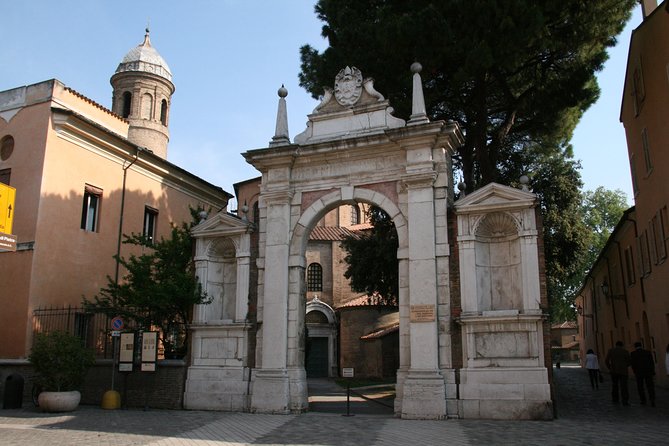
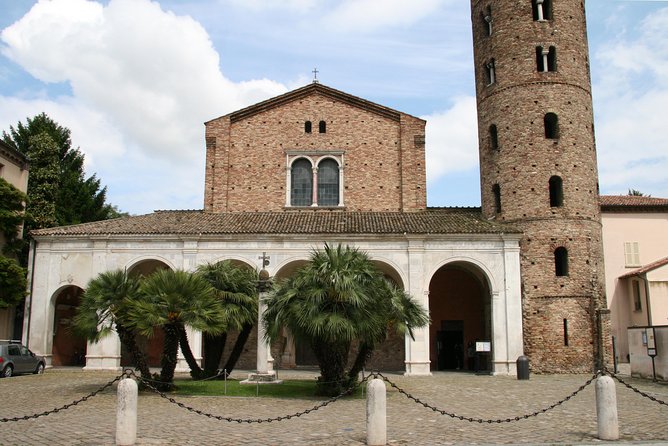
Ravenna can look modest from the outside. Many of its most important buildings have plain brick exteriors, narrow entrances, or restrained facades. Then you step inside and find ceilings and walls covered in colored glass and stone, with gold surfaces that catch the light from every angle.
That contrast is part of the thrill. You do not need a long art-school lecture to appreciate the mosaics, but a guide helps you see why a particular robe, gesture, animal, or procession matters. A good explanation turns a beautiful room into a record of faith and political power.
The tour is priced at $33.86 per person. For that fee, you are paying for a guide, a planned route, and entry to the listed monuments. I consider that fair value for a first visit, especially if you have only a few hours in Ravenna or are coming in for the day from Bologna.
The average booking window is about 30 days, so popular dates can fill ahead of time. The tour is offered in English and usually runs for two to three hours, though the pace and crowd level can push it longer. One outing lasted close to four hours, so avoid scheduling a tight train departure immediately afterward.
A few more things to do in Italy
- Colosseum, Roman Forum & Palatine Guided Tour
★ 4.7 · 63,148 reviews - Vatican Museums, Sistine Chapel & St Peter’s Basilica Guided Tour
★ 4.5 · 39,149 reviews - Rome: Colosseum, Palatine Hill and Roman Forum Guided Tour
★ 4.8 · 32,814 reviews
Beginning at the Mausoleum of Galla Placidia
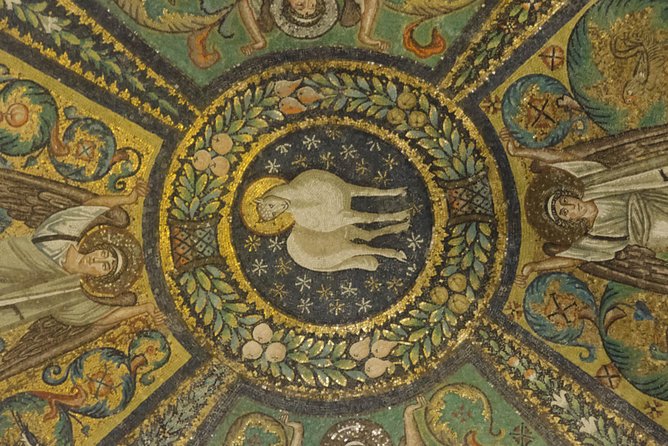
The Mausoleum of Galla Placidia is a small Latin-cross building commissioned around the middle of the fifth century by Galla Placidia, a powerful ruler connected to the Western Roman Empire. From the outside, it looks plain and almost severe. The interior is the surprise.
Inside, the ceiling glows with a field of stars. The effect is intimate rather than grand. You are standing in a relatively small space, but the blue and gold surfaces make the dome seem to open above you. The design is one reason Dante Alighieri admired Ravenna and drew inspiration from its stars for verses in the Divine Comedy.
The scheduled visit here is about 10 minutes, which sounds brief. In practice, that short stop makes sense because the room is small and admission flow may be controlled. You will want to look quickly, then listen closely while the guide points out details that are easy to miss.
This is also where a guide can help you understand the difference between decoration and message. The stars are beautiful, but they also create a spiritual setting. The tour explains the religious ideas behind the imagery instead of treating the mausoleum as a picture gallery.
A practical warning: some historic religious buildings can feel cold, especially in cooler weather. Wear a layer even if the day outside feels mild. One visitor found the extended time in cold conditions difficult, and that is worth remembering if you are sensitive to low temperatures.
Reading the imperial pictures in San Vitale
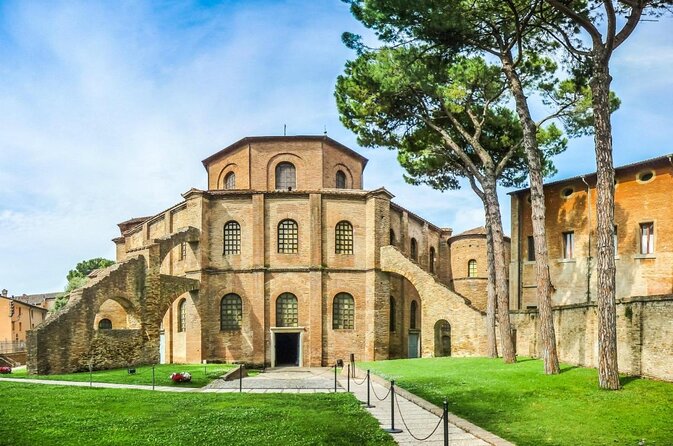
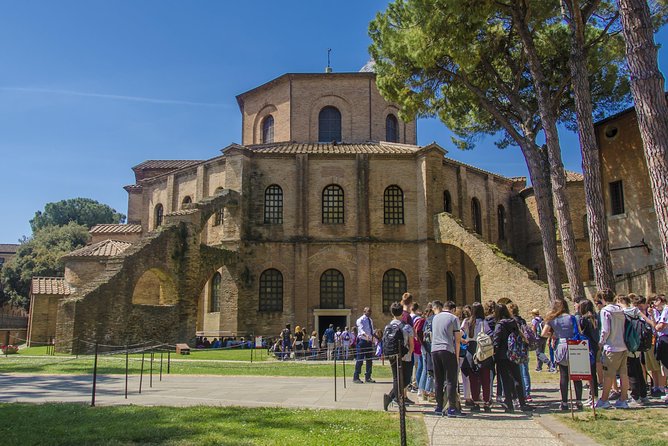
Basilica di San Vitale is the largest and most dramatic stop on the listed route. Built in the sixth century, it has an octagonal plan and a large dome. Its design shows strong eastern influence, reflecting Ravenna’s close ties to the Byzantine Empire.
The first thing you notice is space. After the compact mausoleum, San Vitale feels tall and open. Your eye moves upward through the architecture toward the apse, where the mosaics become a lesson in power, ceremony, and belief.
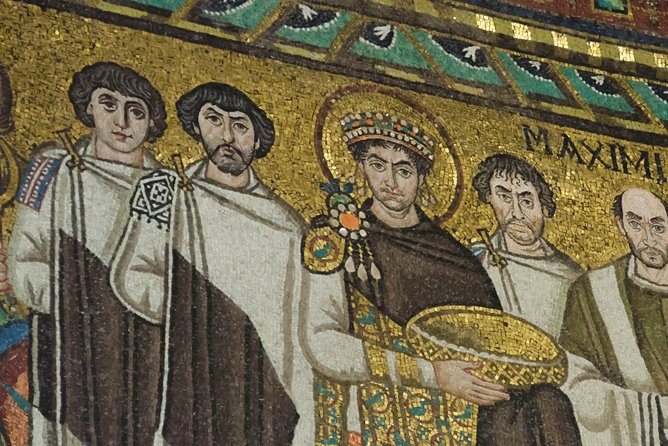
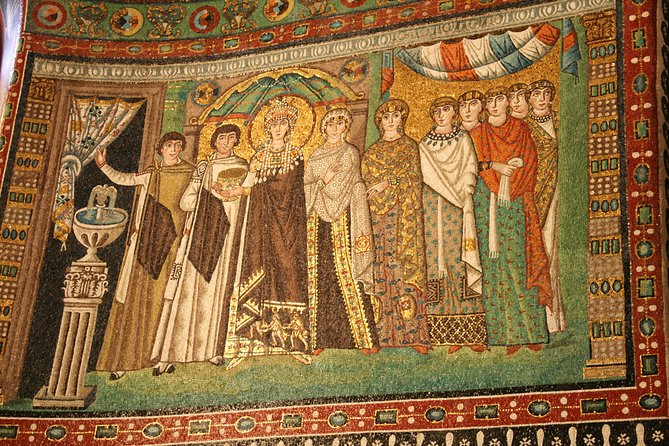
The famous panels of Emperor Justinian and Empress Theodora are the heart of the visit. The imperial couple appears with attendants in formal processions. Their clothing, halos, position, and gestures all carry meaning. This is not casual portraiture. It is a carefully arranged statement about authority and the relationship between imperial rule and the Christian church.
Guides often spend the most time here, and that is appropriate. You will hear about the society that produced the images, the role of the emperor, and the religious setting in which these mosaics were viewed. Some guides focus heavily on symbolism, while others add more about architecture and construction. If the latter subjects interest you, ask directly. The guides are described as willing to answer questions, and that can help shape the visit to your interests.
Allow about 30 minutes inside San Vitale. That is enough for a guided overview, but not enough to study every panel at leisure. If you are passionate about early Christian art, plan to return on your own after the tour if your schedule allows.
Looking up at the Neonian Baptistery
The Neonian Baptistery, also called the Baptistery of the Orthodox, is one of Ravenna’s oldest monuments. The exterior is simple brick, much like the mausoleum. Inside, marble, stucco, and mosaics create a very different impression.
The central image is the Baptism of Christ in the dome. Around it, the twelve Apostles move in a refined procession against a bright blue field of glass tesserae. The design has a clear Hellenistic-Roman influence, which gives the room a graceful, ordered feel.
This is a good place to listen for the connection between architecture and ritual. The building’s octagonal plan and baptismal setting were not random choices. The guide explains how the space worked and why the images were arranged above the ceremony.
The visit lasts around 10 minutes. That is short, but the dome gives you a clear visual focus. Look up before the commentary begins so you understand the full composition, then use the guide’s explanation to pick out the figures and details.
The baptistery also retains a later Renaissance baptismal font and a fifth-century ambo. Those objects help show that the building was not a frozen museum piece. It continued to serve religious needs over time.
Same base, a different kind of day:
- Vatican: Museums & Sistine Chapel Entrance Ticket
★ 4.5 · 144,003 reviews - Vatican Museums & Sistine Chapel Tour with Optional Basilica
★ 4.3 · 67,413 reviews - Milan: Cathedral and Duomo’s Terraces Entrance Ticket
★ 4.6 · 61,054 reviews - Venice: Doge’s Palace Reserved Entry Ticket
★ 4.6 · 42,716 reviews
What the guide adds to the art
The strongest part of this experience is the human explanation. Ravenna’s mosaics can impress you instantly, but it is easy to walk through them without understanding who commissioned them or why the images look the way they do.
Guides including Chiara, Marco, Elisabetta, Francesca, Serena, Silvia, Assunta, and Bardo have been praised for different strengths: clear historical context, humor, organization, lively storytelling, and a willingness to answer questions. That variety matters because the guide assigned to your departure may shape the tone of the entire outing.
The best commentary links three subjects:
- Art: how the images are arranged, colored, and constructed.
- History: the emperors, bishops, rulers, and societies behind the buildings.
- Religion: the beliefs and spiritual messages expressed through the scenes.
You may hear stories about Dante along with explanations of Byzantine authority and Ravenna’s shifting religious life. This makes the tour more than a sequence of church interiors. You begin to see the city as a meeting point between Roman tradition, Christian worship, and eastern imperial culture.
If you have an art background, you may want more discussion of building methods and mosaic construction. Some commentary places greater weight on symbolism. That is not a flaw, but it is a reason to ask questions if your interests lean toward materials, architecture, or restoration.
Group size, headsets, and the walking pace
The maximum group size is 28. Several outings have had roughly 20 to 25 people, which is manageable but not intimate. Churches also require quiet voices, so a large group can make it harder to hear both the guide and your own thoughts.
Radio devices with an earpiece are provided when the group is large. They are a real advantage when they work. You can move a few steps away from the guide to examine a mosaic without losing the explanation. The system also helps you keep up while the group moves through narrow spaces.
Still, check the device at the beginning. One poorly functioning system caused serious frustration, and another participant found the guide difficult to hear even with the equipment. If the sound is weak, tell the guide promptly rather than hoping it improves.
The walking pace is generally moderate. Guides have been praised for keeping a group of more than 20 people together without rushing. You will spend much of the tour on your feet, moving between sites and standing inside the monuments. Comfortable shoes are sensible, and warm clothing can make a major difference in cool weather.
Finding the meeting point and planning your day
The tour begins at Piazza San Francesco 7. The practical detail that matters is that you should enter the Tourist Information Office and check in there. The street address alone can feel vague if you expect to find a guide waiting in the open square.
The tour ends at a different location, though the exact final point is not specified in the supplied information. That makes it easy to continue sightseeing, but you should not assume the end point will be beside your train station or hotel.
Ravenna is easy to reach by public transportation, and the meeting area is near transit. If you are arriving from Bologna for a day visit, leave extra time for the train journey, finding the office, and any delays. A same-day return is possible, but do not plan a departure immediately after the advertised finish.
The experience is available on a mobile ticket. Confirmation arrives at booking. Free cancellation is available until 24 hours before the start time. If you cancel later, the payment is not refunded, and changes made inside that 24-hour window are not accepted.
Is $33.86 a fair price?
For a self-guided visit, you could prefer to buy access separately and spend as long as you like inside each monument. That approach gives you freedom, but you would need to handle tickets and research the symbolism on your own.
At $33.86, this tour makes the most sense if you want structure. Entry to the listed sites is included, and the route puts the three major stops into one organized visit. You also gain background that is difficult to absorb from labels alone.
The value is strongest for a first visit, a short stay, or anyone who wants to understand Ravenna rather than simply photograph it. It is less ideal if you dislike group tours, need long quiet periods in each building, or want a specialist lecture on mosaic technique.
Some descriptions of the experience refer to five mosaic sites, while the detailed route names Galla Placidia, San Vitale, and the Neonian Baptistery. Ask at booking if the exact departure includes additional locations. That small clarification can help you set realistic expectations about the route and duration.
Who should book this Ravenna mosaic tour?
I would choose it for a first-time visitor who wants the essential monuments explained in one morning or afternoon. It also suits anyone making a day trip and trying to use limited time well.
History and art fans will get the most from the links between imperial politics, religious practice, and decoration. The tour also works for curious general sightseers because the guides use stories and visual details rather than relying only on technical terms.
You may want another plan if you need a private experience, have difficulty standing or walking for several hours, or prefer to linger silently in each monument. Most people can participate, but the supplied information does not promise a step-free route or list detailed accessibility arrangements, so ask before booking if that matters to you.
Should you book it?
Yes, if you want Ravenna’s major mosaics placed in context and you value having admission organized ahead of time. The art alone is worth the visit, but a strong guide can show you why Justinian and Theodora appear as they do, how the baptistery dome works as a religious image, and why Dante remembered Galla Placidia’s stars.
Book with two cautions. Confirm the meeting point inside the Tourist Information Office, and allow more than three hours if your schedule is tight. Also check your headset at the start. With a clear guide and working audio, this is a smart, fairly priced introduction to Ravenna’s finest early Christian monuments.
FAQ
Where does the tour begin?
It begins at Piazza San Francesco 7 in Ravenna. You should enter the Tourist Information Office there and check in before the visit starts.
How long does the tour last?
The stated duration is approximately two to three hours. The exact length can vary, and one outing continued close to four hours.
Which monuments are included?
The listed route includes the Mausoleum of Galla Placidia, Basilica di San Vitale, and the Neonian Baptistery, also called the Baptistery of the Orthodox.
Is admission included?
Yes. Admission tickets are included for the listed stops.
Is the tour offered in English?
Yes. The experience is offered in English and uses a mobile ticket.
How large is the group?
The maximum group size is 28 people. Larger groups may use a radio device and earpiece so you can hear the guide.
Can I cancel for a refund?
You can cancel for a full refund up to 24 hours before the experience begins. Cancellations or changes made less than 24 hours before the start time are not accepted for a refund.
Just added in Italy
- Highlights and hidden gems of Milan Bike Tour★ 5.0 · 491 reviews
- Milan Gourmet Tour: A Premium Tasting Experience by Do Eat Better★ 5.0 · 241 reviews
- Private Milan Food Walking Tour of Brera★ 5.0 · 217 reviews
- Leonardo3 The World of Leonardo: Tickets for the Interactive Exhibition★ 4.0 · 220 reviews
- Da Vinci’s Last Supper and Santa Maria delle Grazie Church Tour★ 4.5 · 218 reviews
- Learn to Cook Italian Recipes with an Italian Chef★ 5.0 · 283 reviews
- La Scala Theatre and Museum guided experience★ 4.5 · 664 reviews
- La Scala Theatre and Museum Tour in Milan With Private Guide★ 3.5 · 384 reviews
Tours, compared.
Vatican Museums & Sistine Chapel Tour with Optional Basilica
Read our review →
Colosseum, Roman Forum & Palatine Guided Tour
Read our review →
Vatican Museums, Sistine Chapel & St Peter’s Basilica Guided Tour
Read our review →
Naples Underground Entry Ticket and Guided Tour
Read our review →
Entry Ticket and Guided Tour with an Archaeologist
Read our review →
Colosseum, Forum & Palatine Hill Tour & Optional Arena
Read our review →