Reviewed · TOURS
Small Group Tour of Assisi and St. Francis Basilica
Assisi packs Roman ruins, medieval streets, and some of Italy’s most important religious art into a hill town you can cross on foot. This small-group tour gives you a clear route from the old amphitheater to the Basilica of Saint Francis, with the story of Francis and Clare tying the sights together.
I like the personal scale, with no more than 15 people, and I like the way the walk includes Assisi itself rather than treating the Basilica as the whole show. Guides such as Alessandra, Francesca, Barbara, and Michele have been praised for making the paintings and local history easy to understand.
The main catch is physical. You will walk uphill, descend through old lanes, and manage steep steps. Also, the meeting point remains at the closed Matteotti parking area, so you must read the directions carefully and not assume you can park there.
Key details before you book
- Roman ruins begin the story: See how Assisi’s ancient amphitheater became a medieval stone quarry and later a private neighborhood.
- The route links major churches: Visit Saint Rufino’s Cathedral, Saint Clare’s Basilica, Chiesa Nuova, and Santa Maria sopra Minerva.
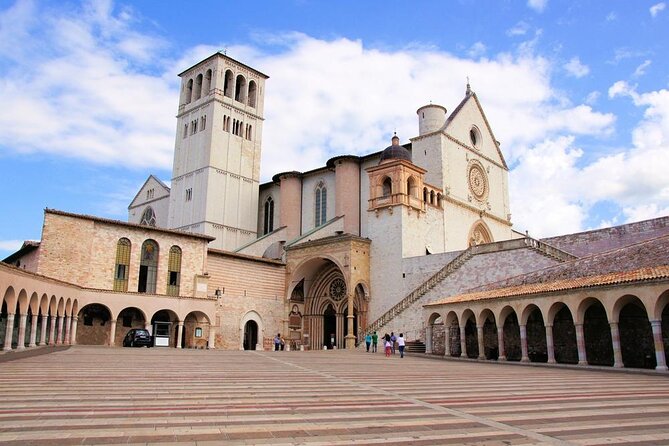
- The Basilica of Saint Francis is the grand finale: The guided visit covers both the shadowy Lower Church and bright Upper Church, including famous 13th and 14th-century frescoes.
- The group stays small: The maximum is 15 people, making it easier to ask questions and keep close to the guide.
- Plan for a serious walk: The route takes about two and a half hours and includes hills, narrow lanes, and stairs.
- Church rules matter: Knees and shoulders must be covered, and special dates can change how the Basilica visit works.
Why this Assisi route works well
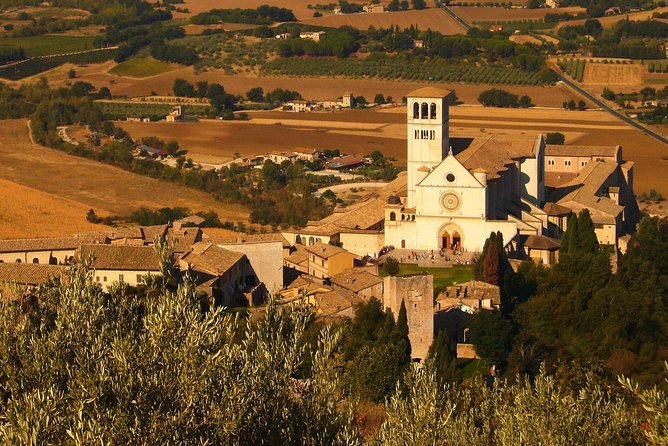
Assisi is easy to admire and surprisingly easy to misunderstand. You see pink stone, flower-filled lanes, old churches, and grand views, but the town makes more sense once you understand how Roman Assisi, medieval Assisi, and the world of Saint Francis overlap.
This tour gives you that framework in the right order. It starts above the main center, moves through the medieval heart, then heads downhill toward the Basilica of Saint Francis. That direction matters. You gradually move from city history to the life of Francis and Clare, then finish with the art created to honor Francis after his death.
The guide is central to the experience. The strongest guides on this tour, including Alessandra, Francesca, Emmanuela, Barbara, and Michele, are praised for clear explanations, warmth, and a strong grasp of the paintings. You are not simply pointed toward a fresco and given its date. You should expect stories about the saints, the churches, and the meaning of the scenes.
The small group also helps. With up to 15 people, you have a better chance of hearing the guide in busy spaces and asking a question without holding up a large crowd. Some departures may use two guides to keep the group in smaller sections.
Other days out people book in Italy:
- Vatican: Museums & Sistine Chapel Entrance Ticket
★ 4.5 · 144,003 reviews - Vatican Museums & Sistine Chapel Tour with Optional Basilica
★ 4.3 · 67,413 reviews - Colosseum, Roman Forum & Palatine Guided Tour
★ 4.7 · 63,148 reviews
Starting at the Roman amphitheater
The meeting time is 10:30 a.m. at Parcheggio Saba Matteotti on Piazza Giacomo Matteotti. Take care here: the parking lot is closed for renovation, and no parking is possible. The meeting point itself remains confirmed, so you should allow time to find the guide on foot.
The first stop is the old Roman amphitheater. Its later life is more interesting than the basic label suggests. In the Middle Ages, local people used the structure as a stone quarry. Houses were built into and around the remains, turning an ancient public building into a private neighborhood.
This is a useful introduction to Assisi because it shows how the town grew by reusing what came before. The amphitheater is not presented as an isolated ruin. It is part of the living town, with medieval homes occupying the space where Roman crowds once gathered.
From here, you get one of the better views toward Rocca Maggiore, Assisi’s medieval castle. The stop also gives you an early look across the valley before the walk turns into the narrow lanes of the historic center.
Saint Clare, Saint Francis, and the old lanes
From the amphitheater, the route works through winding alleys and medieval squares. This is one of the tour’s best features. Assisi is not just a collection of interiors. The streets themselves show how the hill town is shaped, and the views open up at unexpected points.
The Basilica of Saint Clare is built from the pink stone of Mount Subasio. Its single nave leads toward a transept and polygonal apse, and the church contains frescoes from the 12th through 14th centuries.
A key object here is the Crucifix in the side chapel. Tradition holds that it spoke to Saint Francis at San Damiano and called on him to rebuild the Church. The story links Francis’s early spiritual life with the places you are seeing, while Saint Clare’s Basilica gives the tour a second center of gravity beyond Francis himself.
The visit is brief, about 15 minutes, so do not expect a long, quiet study of every chapel. Instead, your guide gives you the essential context and points out the details worth noticing. The church remains an active place of worship, so respectful behavior and suitable clothing are required.
The itinerary also includes Chiesa Nuova, built in 1615 on the site believed to be the birthplace of Saint Francis. It was the home of Pietro di Bernardone, Francis’s father. The church was called Chiesa Nuova because it was the newest church in Assisi at the time.
This stop helps correct a common impression. Francis was not born in a remote rural setting. He came from a wealthy family in a working city, and his decision to abandon that life becomes more striking once you see the setting connected with his early years.
Saint Rufino and Assisi’s main square
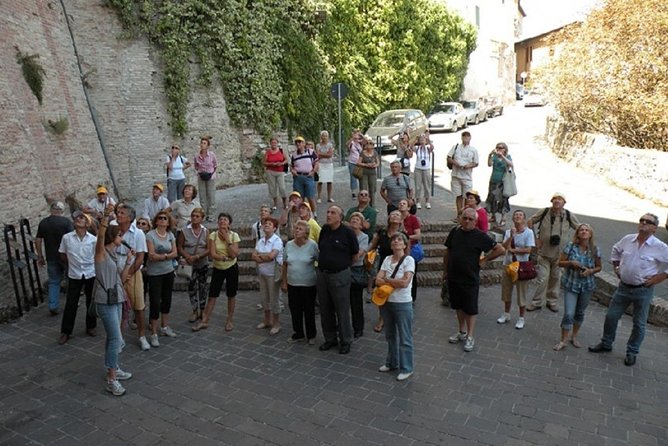
Assisi Cathedral, dedicated to Saint Rufino, is another important stop along the route. It is one of the town’s major churches and connects the religious story to the civic life of Assisi.
The walk then reaches Piazza del Comune, the main city square. This is where ancient Roman Assisi and medieval Assisi meet most clearly.
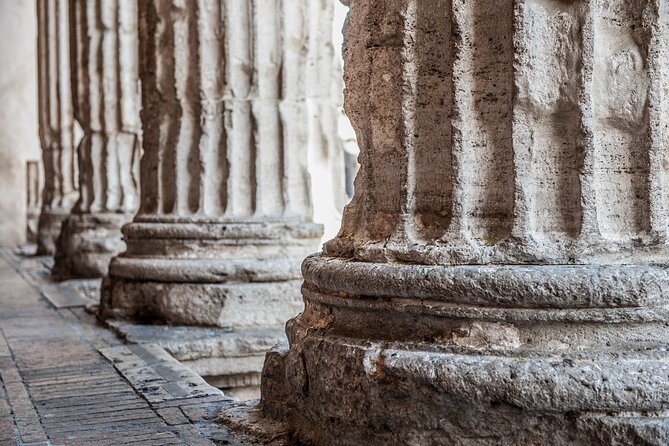
The Temple of Minerva is the square’s showpiece. Built by the Romans, it is among the best-preserved Roman temples in Italy. Its classical columns now front Santa Maria sopra Minerva, a church created in 1539 and later remodeled in Baroque style during the 17th century.
The combination is striking: an ancient temple front, a Christian interior, and medieval government buildings around the same square. Your guide can help you read the layers instead of seeing them as unrelated monuments.
The visit to Santa Maria sopra Minerva lasts about 15 minutes. It is a short stop, but an important one for understanding the way Assisi repeatedly adapted older buildings to new religious and civic purposes.
Same base, a different kind of day:
- Milan: Cathedral and Duomo’s Terraces Entrance Ticket
★ 4.6 · 61,054 reviews - Venice: Doge’s Palace Reserved Entry Ticket
★ 4.6 · 42,716 reviews - Vatican Museums, Sistine Chapel & St Peter’s Basilica Guided Tour
★ 4.5 · 39,149 reviews - Rome: Colosseum, Palatine Hill and Roman Forum Guided Tour
★ 4.8 · 32,814 reviews
Entering the Basilica of Saint Francis
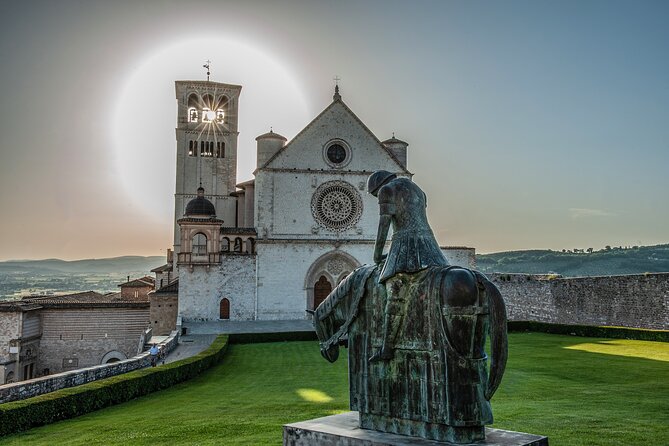
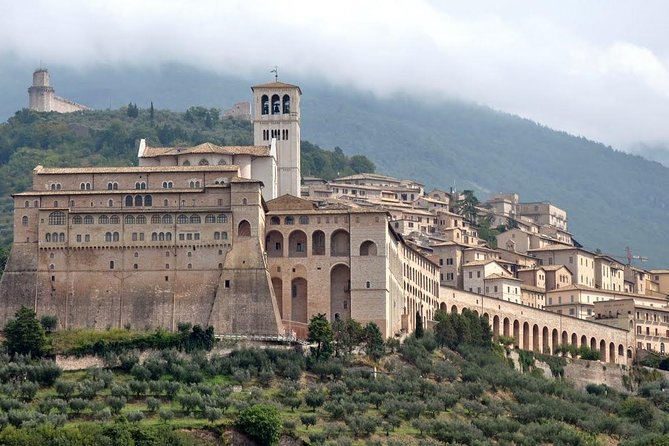
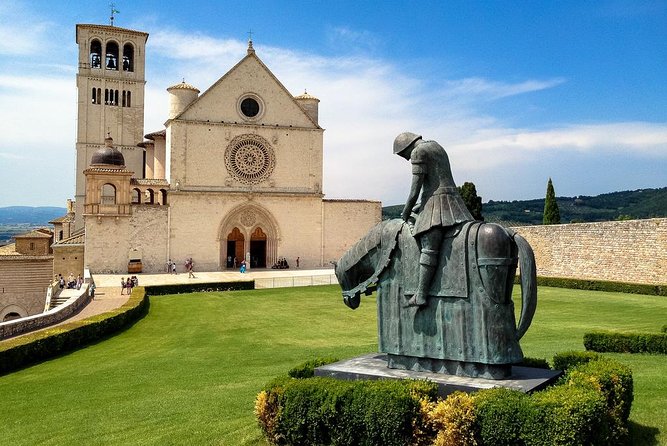
The route heads downhill toward the Basilica of Saint Francis, the tour’s main event. The complex was begun in 1228, only two years after Francis died, under the direction of Brother Elias. It was built to receive Francis’s remains and soon became one of the most important pilgrimage churches in Italy.
The Basilica is a UNESCO World Heritage site, but the official title does not tell you what it feels like inside. The two levels have very different moods.
The Lower Church is solemn and dim. Its atmosphere encourages quiet and reflection, and the architecture feels close and weighty. The Upper Church is almost the opposite. It rises into a brighter Gothic space with French influence, cross vaulting, a polygonal apse, and a more open feeling.
The tour includes about 30 minutes in the Basilica and another 30 minutes focused on the upper church. That is enough time for a guided introduction, but not enough to inspect every chapel or painting at leisure. If you are passionate about art, plan to return on your own after the tour, if opening conditions allow.
The frescoes are the reason this stop carries such weight. Artists from the 13th and 14th centuries worked here, including Giotto, one of the most famous names in Italian art. A good guide explains not only who painted the scenes but also how to read the gestures, figures, and visual storytelling.
Barbara, Alessandra, and other guides have received especially strong praise for explaining the meaning behind the paintings. That kind of help makes a real difference. Without it, you may see a wall of beautiful color. With it, you begin to understand how the frescoes taught religious stories to people who could not read.
What the $72.59 price includes
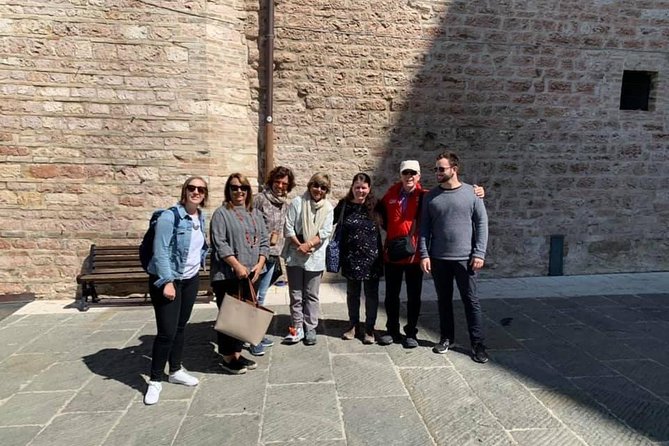
At $72.59 per person, this is not the cheapest way to walk around Assisi. You are paying for an English-speaking official guide, a planned route, and entrance to the Basilica of Saint Francis.
The price makes the most sense if you want a structured first visit. In two and a half hours, you cover the Roman amphitheater, Saint Clare’s Basilica, Chiesa Nuova, Saint Rufino’s Cathedral, Piazza del Comune, the Temple of Minerva, and both levels of the Basilica of Saint Francis. Doing all that alone would require preparation and a clear plan.
The value is also tied to the guide’s art and historical explanations. If you only want to photograph the streets and churches, you could explore Assisi independently for less. If you want the frescoes to make sense and prefer asking questions as you walk, the fee is easier to justify.
Tips are not included. There may also be a small separate charge in one sanctuary, so carrying a little cash in euros is sensible. Audio equipment has caused some confusion. The Basilica may require you to purchase a headset, and the tour does not necessarily provide headsets for the entire route. If hearing the guide clearly is important to you, ask about the audio setup at the start.
Walking conditions, clothing, and timing
You should treat this as an active walking tour. The route includes uphill streets, downhill sections, narrow lanes, and steep stairs. One person with a bad back had to leave before the end, so this is not a good choice if hills or uneven walking are a serious problem.
Most people can participate, but the tour is not designed around mobility assistance. Wear supportive shoes and keep your daypack light. The walk is long enough that poor footwear will become a problem before you reach the Basilica.
Church dress rules are strict. Men and women must cover their knees and shoulders. Shorts and sleeveless tops can lead to refused entry, so dress for the churches even if the weather is warm.
The Basilica visit also changes on certain dates. On Sundays, major Catholic holidays, and national holidays, guided tours inside the Basilica are forbidden. The guide explains the church from outside, and you enter alone in silence. The Basilica is closed on October 4.
Access to the Basilica is also suspended from February 15 through April 6, 2026, because of the public display of Saint Francis relics. During that period, the guide explains the site from outside. Check your date carefully before booking if the Basilica is your main reason for taking the tour.
Who will get the most from this tour
I would choose this tour for a first visit to Assisi, especially if you have only a few hours. It gives you the town’s main churches, its Roman background, its medieval streets, and its most important artwork in one compact route.
It also suits families with older children and teenagers. The two and a half hours can work well for young people when the guide tells stories instead of giving only dates and names. Very young children may find the length and hills tiring.
Art lovers will appreciate the Basilica explanations, while religious visitors will value the connections between Francis, Clare, San Damiano, and the churches associated with their lives. The tour also works for people who want local suggestions. Guides have offered ideas for places to eat, which can help after the walk.
I would hesitate if you need a slow pace, have trouble with steep streets, or want a completely private experience. A group of 15 is small by tour standards, but it is still a group. You will follow the guide’s timing rather than linger wherever you wish.
Should you book the Assisi small-group tour?
Book it if you want a well-shaped introduction to Assisi and Saint Francis, with the Basilica’s frescoes explained by an English-speaking guide. The strongest part is the combination of town walking and art interpretation. You see how Assisi developed, then understand why the Basilica matters.
Before booking, make three checks: confirm the date allows an inside guided visit, plan suitable church clothing, and make sure you can manage the hills and stairs. Also read the meeting instructions closely because the Matteotti parking lot is closed.
For most first-time visitors with limited time, I think the $72.59 fee is fair for the route and the Basilica access. It is best used as your orientation to Assisi, leaving you free to revisit Saint Clare’s Basilica, the Piazza del Comune, or the Basilica of Saint Francis at your own pace afterward.
FAQ
How long does the Assisi tour last?
The tour lasts approximately 2 hours and 30 minutes.
What time does the tour begin?
The tour starts at 10:30 a.m.
Where does the tour meet?
The meeting point is Parcheggio Saba Matteotti, Piazza Giacomo Matteotti, Assisi.
Where does the tour finish?
The tour ends at the Papal Basilica and Sacred Convent of Saint Francis in Assisi, Piazza Inferiore di S. Francesco 2.
Is the tour conducted in English?
Yes. The tour includes an official English-speaking guide.
How large is the group?
The maximum group size is 15 people.
Is entrance to the Basilica of Saint Francis included?
Yes. Admission to the Basilica of Saint Francis is included. A separate headset purchase may be required inside the Basilica, and another small sanctuary fee may apply.
What should I wear for the tour?
You must cover your knees and shoulders to enter places of worship and selected museums. Shorts and sleeveless tops are not allowed for men or women.
Can I take the tour on a Sunday or holiday?
On Sundays, major Catholic holidays, and national holidays, guided tours inside the Basilica are forbidden. The guide explains the church from outside, and you enter alone in silence. The Basilica is closed on October 4.
Just added in Italy
- Highlights and hidden gems of Milan Bike Tour★ 5.0 · 491 reviews
- Milan Gourmet Tour: A Premium Tasting Experience by Do Eat Better★ 5.0 · 241 reviews
- Private Milan Food Walking Tour of Brera★ 5.0 · 217 reviews
- Learn to Cook Italian Recipes with an Italian Chef★ 5.0 · 283 reviews
- Leonardo3 The World of Leonardo: Tickets for the Interactive Exhibition★ 4.0 · 220 reviews
- Da Vinci’s Last Supper and Santa Maria delle Grazie Church Tour★ 4.5 · 218 reviews
- La Scala Theatre and Museum guided experience★ 4.5 · 664 reviews
- La Scala Theatre and Museum Tour in Milan With Private Guide★ 3.5 · 384 reviews
Tours, compared.
Vatican Museums & Sistine Chapel Tour with Optional Basilica
Read our review →
Colosseum, Roman Forum & Palatine Guided Tour
Read our review →
Vatican Museums, Sistine Chapel & St Peter’s Basilica Guided Tour
Read our review →
Naples Underground Entry Ticket and Guided Tour
Read our review →
Entry Ticket and Guided Tour with an Archaeologist
Read our review →
Colosseum, Forum & Palatine Hill Tour & Optional Arena
Read our review →