
Reviewed · CYCLING TOURS
Rome: Top Highlights & Hidden Gems Tour by Cannondale E-Bike
Rome is much easier to understand when its great monuments are connected by the streets between them. This four-hour Cannondale E-bike tour takes you from the Colosseum to the Pantheon, Villa Borghese, the Jewish Ghetto, and several quieter lanes without asking you to march across the city all day.
I like the small group of no more than 10 people, and I like the route’s balance of famous sights and lesser-seen corners. The bikes are well maintained, the guides are attentive, and names such as Oscar, Bita, Chris, Zac, and Meghan come up often for good reason. The main caution is simple: Rome has traffic, crowds, rough patches, and impatient drivers, so this is not a carefree cycle through an empty park.
Key points to know
- 14 kilometres in four hours: You cover a large section of central Rome without exhausting yourself on foot.
- A smart mix of sights: The route includes the Colosseum, Roman Forum, Trevi Fountain, Spanish Steps, Pantheon, Jewish Ghetto, and Villa Borghese.
- Quiet lanes help: Guides use smaller streets where possible, though city riding still requires focus.
- Cannondale E-bikes do the hard work: Electric assistance is especially useful on Rome’s hills and in warm weather.
- Good for a first day: You get a broad look at Rome, then can return later to the places you want to explore slowly.
- Family arrangements are available: Children can use a seat, tag-along extension, or their own correctly sized E-bike, depending on age.
Why an E-bike is a smart way to see Rome
Rome’s center is compact on a map but tiring in real life. The Colosseum, Trevi Fountain, Spanish Steps, Piazza Navona, Pantheon, and Villa Borghese are not lined up neatly along one pleasant pedestrian street. You can walk between them, but your feet will pay the bill.
An E-bike changes the calculation. You still pedal, but the motor helps with Rome’s hills and long stretches between sights. One rider described the bikes as easy enough to make the city’s seven hills feel manageable, while another specifically appreciated the stronger assistance on uphill sections.
The tour covers about 14 kilometres, or 8.5 miles, in four hours. That sounds like a modest distance, but it includes many stops, explanations, photographs, and short rides through central streets. You are not racing from monument to monument.
The electric assistance also helps in hot weather. One useful tip from the feedback is to consider an afternoon departure, such as 4 p.m., when the temperature may be kinder than at midday. Your exact start time depends on availability, but the tour runs in different time slots.
Other rides around Rome:
- Rome EBike Tour: Appian Way, Catacombs & Roman Aqueducts
★ 5.0 · 1,766 reviews - Rome: Appian Way, Catacombs, & Roman Aqueducts E-bike Tour
★ 4.9 · 1,421 reviews - Rome City Small Group Bike Tour with quality Cannondale EBike
★ 5.0 · 1,380 reviews
Starting near the Colosseum on Via Labicana
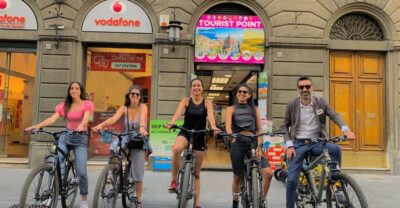
You meet at the operator’s shop at Via Labicana 49, a few minutes on foot from the Colosseum. This is a practical starting point because the first major sight is close, and you do not waste the opening part of the tour crossing town.
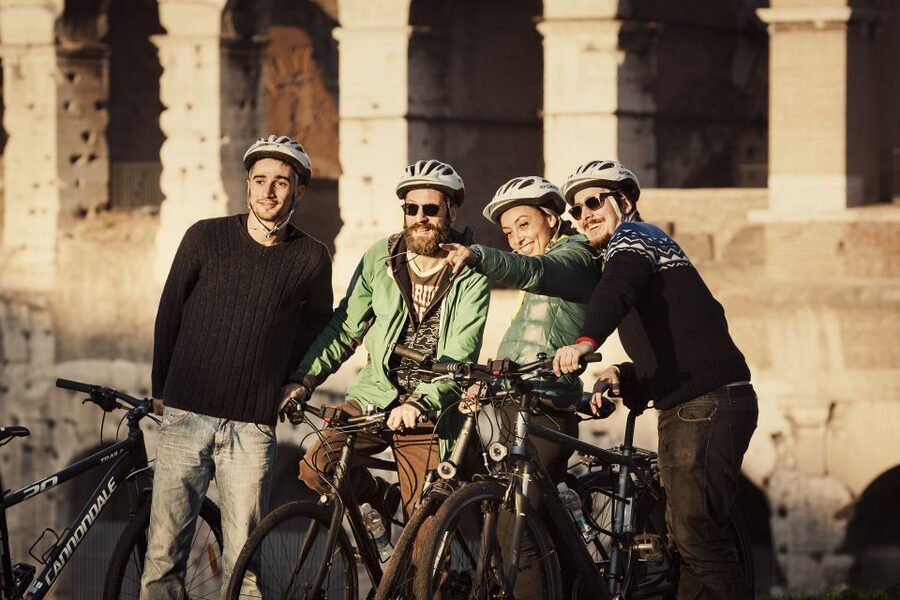
At the shop, you receive a Cannondale E-bike, helmet, handlebar bag, and a biodegradable bottle of water. The bikes have anti-puncture tires, and several riders praised their condition and ease of use. Staff help match you with the right bike size, which matters more than it may sound. A comfortable fit makes the rest of the ride much better.
The helmet is mandatory. You should also listen closely to the guide’s riding instructions before leaving. One rider offered a very specific tip about the brakes, but the larger lesson is to become familiar with your bike before joining the group in the street.
The group is limited to 10 people. That is small enough for the guide to keep an eye on the riders, explain things without a microphone, and stop when the group needs to regroup. It is not a private tour, but it has a more personal feel than a large bus outing.
Colosseum and Roman Forum: Rome’s powerful opening
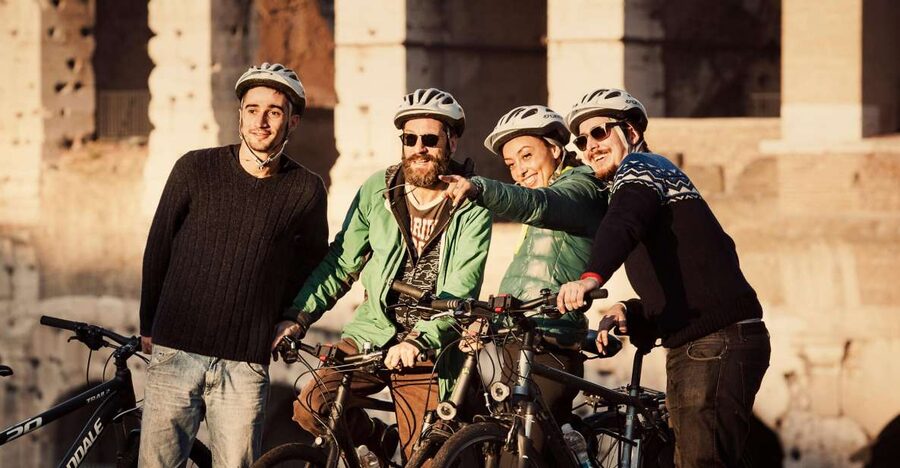
The tour begins with the Colosseum, Rome’s most recognizable monument. You see it from outside and hear the guide explain its place in the city before continuing toward the Roman Forum and Imperial Fora.
This is an important distinction: the experience is a sightseeing ride, not an entry ticket to the Colosseum or Forum. If you want to walk inside either site, arrange a separate timed visit. The bike tour works well as an overview because it gives you the setting and context before you return for a longer visit.
The Imperial Fora add another layer. These broad archaeological remains once formed the political and commercial heart of ancient Rome. From a bike, you can connect the ruins with the streets and monuments around them instead of treating each site as an isolated stop.
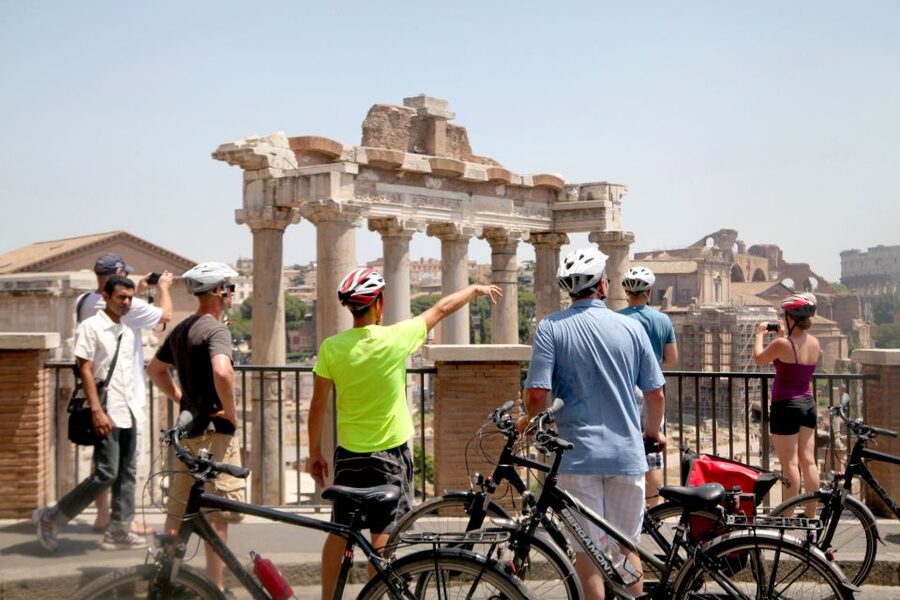
The route later includes a panoramic view of the Roman Forum. That viewpoint is especially useful because the Forum is difficult to grasp from ground level. From above, the columns, temples, and broken walls begin to make sense as part of a large urban center.
Piazza Venezia and the road toward Trevi
From the ancient center, the route moves toward Piazza Venezia and the Vittoriano monument. The scale changes quickly here. Ancient ruins give way to grand avenues, government buildings, and the broad white monument that dominates the square.
Your guide can help explain how Rome’s old and modern identities overlap. This is one of the advantages of traveling by bike: you see the transition between districts instead of stepping out of one attraction and into another.
The ride continues to the Trevi Fountain. This is one of the busiest points on the route, and you should expect a crowd around the fountain. The bike is used to reach the area, but you will likely stop and walk or stand with the group rather than ride through the packed square.
You get time for photographs and a look at the fountain’s theatrical Baroque design. The stop is shorter than a dedicated Trevi Fountain visit, so save a coin toss, detailed inspection, or quiet early morning return for another time.
Other electric-bike rides around Rome:
- Rome:Appian Way E-bike Tour with Catacombs, Aqueducts & Food
★ 4.9 · 1,210 reviews - Rome: E-Bike Night Tour with Food and Wine Tasting
★ 4.9 · 1,131 reviews - Rome: Appian Way E-Bike Tour Catacombs, Aqueducts & Picnic
★ 4.6 · 727 reviews - Rome: Appian Way & Catacomb Sunset E-bike Tour with Aperitif
★ 4.5 · 682 reviews
Spanish Steps and Piazza del Popolo
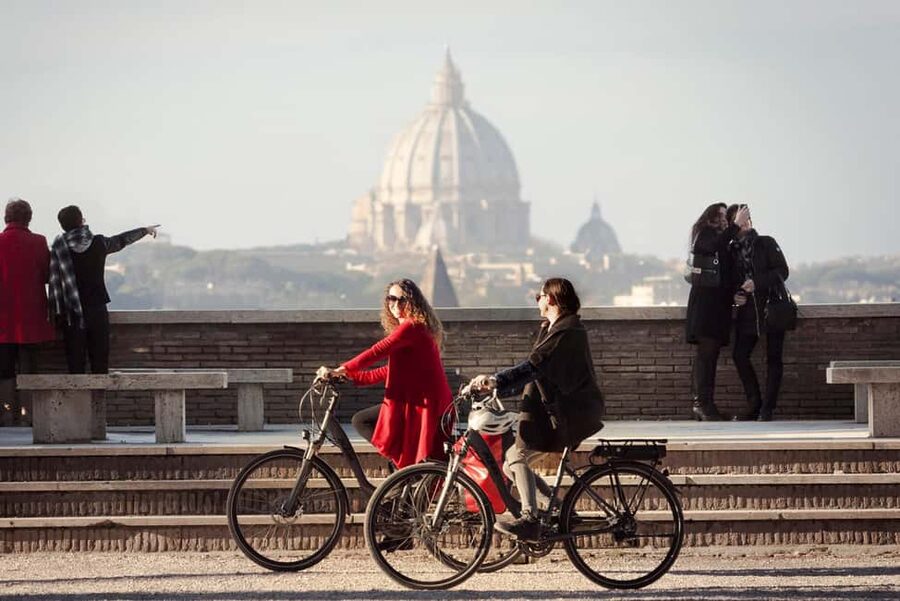
The Spanish Steps bring another famous Roman setting. The staircase itself is for looking, not cycling, and the group pauses nearby. From here, the guide can point out the surrounding streets and explain why this part of Rome has long attracted shoppers, artists, and visitors.
The route then reaches Piazza del Popolo, a broad open square marked by an Egyptian obelisk and twin churches. Compared with the tight streets around Trevi, the piazza gives the group more room to gather.
I like this sequence because it shows two different versions of central Rome. The Spanish Steps feel enclosed and theatrical, while Piazza del Popolo opens toward the northern approach to the city. You get more than a checklist of monuments. You begin to see how Rome’s public spaces were designed and used.
Villa Borghese and the Pincio view
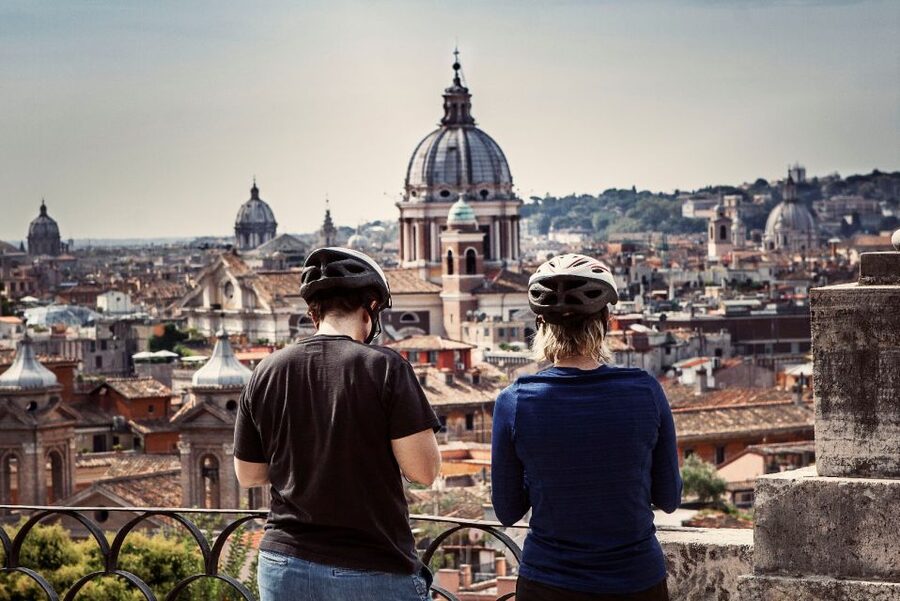
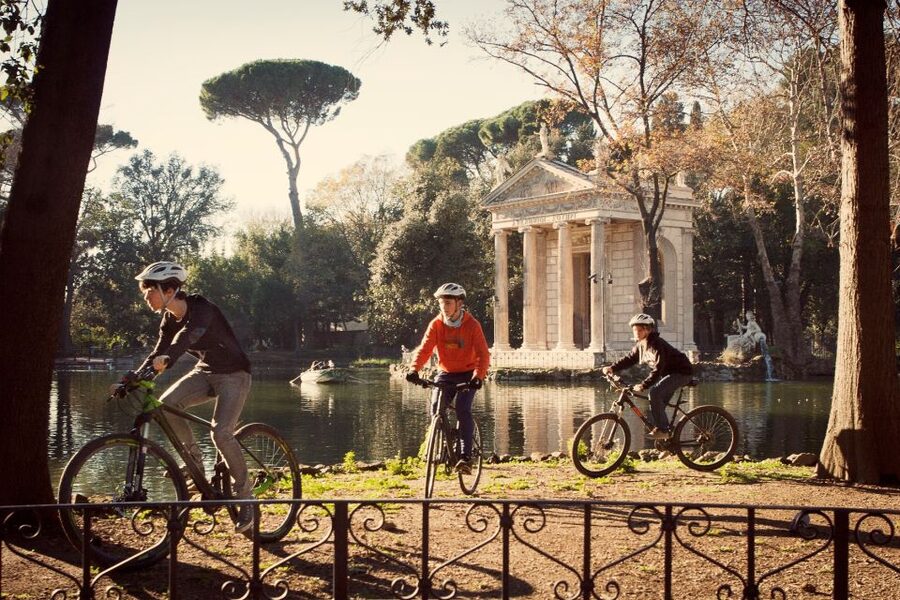
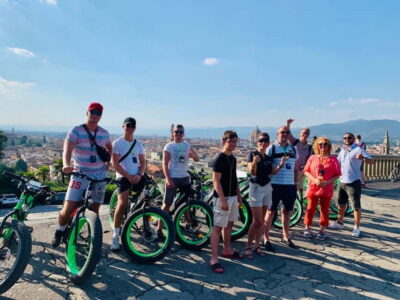
Villa Borghese offers the ride’s most welcome change of pace. The park gives you a break from stone streets, crowds, and traffic. The route reaches the Pincio terrace, where you can look across Rome from above.
The view is one of the tour’s strongest moments. You can pick out domes, rooftops, and the broad shape of the historic center. Several people specifically valued being brought to this park and viewpoint because it is easy to miss when you are moving between the standard sights on foot.
This stop also shows why the E-bike is useful. Rome is not flat, and reaching the park can involve an uphill stretch. The electric motor removes much of the strain, leaving you more alert for the view and the guide’s explanation.
Do not expect a long park ride or a full visit to the Borghese Gallery. The tour uses Villa Borghese as part of the city route and viewpoint, not as an art museum visit. If you want the gallery, book that separately.
Piazza Navona and the Pantheon
The route returns to the historic center for Piazza Navona. The square follows the footprint of the Stadium of Domitian, and its long oval shape still reflects that earlier purpose.
This is a good place to hear how ancient Roman structures were reused and reshaped over the centuries. The fountains, churches, cafés, and open space make Piazza Navona one of Rome’s most enjoyable places to pause, but it can also be crowded. Keep your attention on the guide and your bike when entering and leaving.
The Pantheon follows. Its massive dome and open central oculus make it one of Rome’s most impressive buildings, even before you know the engineering story. The exterior is often easier to view with a group than the interior, where crowds and lines may affect the stop.
Again, treat this as an introduction rather than a replacement for a full visit. The guide gives you useful context and points out details you might otherwise miss. You can then return when you have time to stand inside and study the space without watching the clock.
The Jewish Ghetto and Theatre of Marcellus
The Jewish Ghetto gives the tour a more local, layered feel. This part of Rome contains small streets, restaurants, historic buildings, and remnants of the city’s Jewish past. It is a useful contrast to the major imperial monuments.
You also visit the Portico di Ottavia, an ancient colonnaded structure connected with the area’s Roman past. The remains are not as instantly famous as the Colosseum, but they reward attention. This is the type of stop that can disappear from a first-time itinerary if you only follow the biggest attractions.
Nearby, the Theatre of Marcellus shows how Roman architecture continues to live inside the modern city. Its ancient lower structure is surrounded by later buildings, creating one of those layered views that make Rome so unusual.
These stops are particularly valuable by bike because the route can link small squares and side streets that are awkward to fit into a walking day. You move through the city at street level, close enough to notice changes in architecture and daily life.
The final Imperial Fora view and return
The return leg brings the group back toward the Imperial Fora and the starting point near Via Labicana. The final panorama of the Roman Forum gives you one more broad look at the ancient center before the tour ends.
By this point, you have seen the city from several angles: street level, park height, open piazzas, ancient ruins, and busy central lanes. That variety is the real value of the itinerary. It does not give every monument a long visit, but it helps you decide where to spend your next day.
Guides also often offer practical suggestions for the rest of your stay. One rider received restaurant advice, and several people valued tips about places to revisit. The usefulness of that help depends on the individual guide, but the tour’s guides are consistently praised for clear explanations, humor, and attention to group safety. Zac, Oscar, Chris, Bita, Fabio, Meghan, and Pablo are among the guides singled out for their warmth, storytelling, and care.
Safety, traffic, and the actual riding
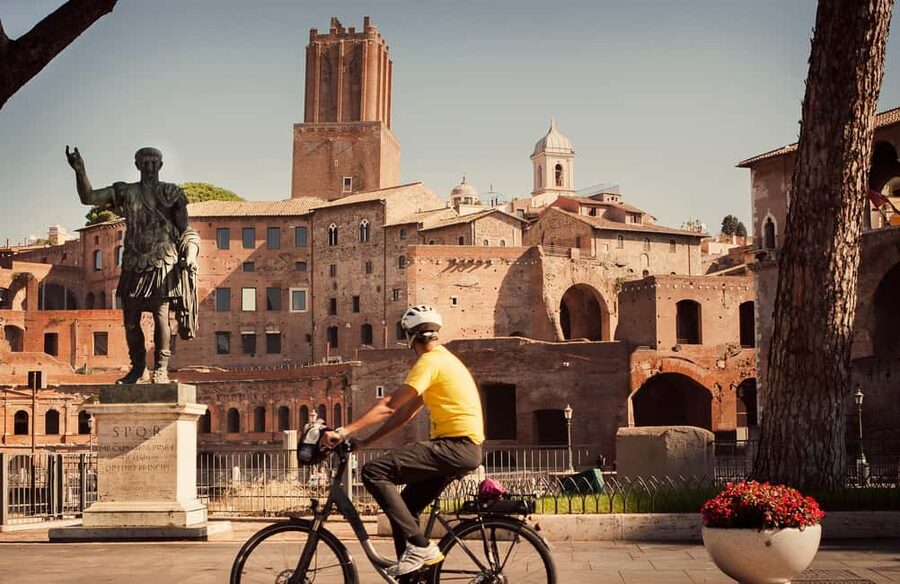
The tour is described as leisure pace, but that does not mean effortless in every sense. Rome has cars, scooters, pedestrians, uneven surfaces, and crowded streets. You need to be comfortable steering, braking, stopping, and following directions.
The route uses smaller alleys and back streets where possible. That reduces time on major roads, but it cannot remove city traffic altogether. One person called the streets a little crazy, while still feeling well looked after by the guide. Another praised the guide for keeping the group together during a busy evening.
This is why the small group matters. The guide can watch the rear of the line, choose safe places to stop, and regroup after an intersection. Still, you should not treat the ride like a protected cycle path.
The difficulty level is leisure for standard riders. With a child seat or tag-along extension, it becomes more like an intermediate outing because of the added weight and handling. Wear comfortable clothing and shoes, carry only what you need, and keep both hands available for riding.
Families, children, and body-size limits
The tour can work well for families, but the age rules matter. Babies under one year are not allowed. Children aged one to four can ride in a child seat with a maximum load of 22 kilograms, or 49 pounds, and join free of charge.
Children aged five to eight use a tag-along extension. From age nine, children can ride their own appropriately sized E-bike. The equipment has a total weight limit of 136 kilograms, or 300 pounds.
I would choose this outing for children who can follow instructions and remain attentive around traffic. The ride is not a quiet family cycle in a park. The guide’s care helps, but parents still need to judge their child’s confidence and stamina.
Is $85 a fair price?
At $85 per person, the tour sits above a basic bike rental but includes much more than the bicycle. You receive a four-hour route, a local guide, helmet, handlebar bag, water, and a carefully planned connection between major sights and smaller streets.
The value is strongest if you want to see a lot in one morning or afternoon. A walking route covering the same ground would take longer and leave you more tired. A bus can cover distance, but it cannot reach many of the narrow lanes and small squares included here.
The price is less attractive if you already know Rome well, dislike group activities, or want long interior visits at each monument. The tour is an overview with explanation, not a series of museum entries.
Free cancellation is available up to 24 hours before the tour, and you can reserve without paying immediately. A minimum of four participants applies. If that number is not reached, you are offered an alternative or a full refund. Public celebrations or city events can also force changes to the route.
Who should book this Rome bike tour?
I would recommend it to first-time visitors who want to get their bearings quickly. It is also a good choice for active adults, families with suitable children, and anyone who wants to cover central Rome without spending the whole day on foot.
Book it early in your stay if you can. The route helps you choose which places deserve a return visit, and the guide’s suggestions may help shape the rest of your plans.
You should think twice if you are nervous around traffic, unable to ride confidently, or mainly interested in entering the Colosseum, Pantheon, or Roman Forum. Those visits require separate time and tickets.
For most reasonably comfortable riders, the combination of strong bikes, a compact group, careful routing, and lively guides makes this a very efficient introduction to Rome. You see the major names, but you also get the small streets and viewpoints that give the city its character.
FAQ
Where does the Rome E-bike tour begin and end?
The tour starts and returns to the operator’s shop at Via Labicana 49, a few minutes’ walk from the Colosseum.
How far does the tour travel?
The route covers about 14 kilometres, or 8.5 miles, over four hours.
Are monument entry tickets included?
No. The experience provides sightseeing stops and guide commentary. Entry tickets for the Colosseum, Roman Forum, Pantheon, or other attractions are not listed as included.
What languages are available?
The live guide may be available in Spanish, French, German, Dutch, Italian, or English. Check the available language when choosing your time.
Can children join the tour?
Yes. Infants under one year are not allowed. Children aged one to four can use a child seat, ages five to eight can use a tag-along extension, and children aged nine and above can ride an appropriately sized E-bike.
Is the helmet required?
Yes. Wearing a helmet is mandatory for every participant.
Just added in Rome
- Civitavecchia Private Transfer: From the Port to Rome Airport★ 5.0 · 309 reviews
- Civitavecchia Shore Excursion: Best of Rome Private Tour★ 5.0 · 247 reviews
- Civitavecchia Private Transfer from ship to FCO airport or Rome★ 5.0 · 245 reviews
- Food Tasty and History Tour in Civitavecchia★ 5.0 · 256 reviews
- Palatine Hill and Roman Forum Tour with Fast-Track Entrance★ 4.2 · 417 reviews
- Tivoli: Villa D’Este & Villa Adriana Pass & App Audioguide★ 4.4 · 364 reviews
- Tivoli: Villa D’Este Entry Ticket and App Audio Guide★ 4.3 · 191 reviews
- Vatican Museums & Sistine Chapel Skip-the-Line Guided Tour★ 4.6 · 254 reviews
Cycling Tours, compared.

Rome EBike Tour: Appian Way, Catacombs & Roman Aqueducts
Read our review →
Appian Way, Catacombs, & Roman Aqueducts E-bike Tour
Read our review →
Rome City Small Group Bike Tour with quality Cannondale EBike
Read our review →
Tuscany Bike Tours Through the Chianti Hills with Wine Tasting
Read our review →
Browse the lists this tour appears in