
Reviewed · WALKING TOURS
Lucca: 2-Hour City Center Walking Tour
Lucca’s old town is best understood on foot, and this two-hour walking tour gives you a clear route through its churches, towers, piazzas, and famous walls. You’ll see how the city’s Roman beginnings, medieval towers, Renaissance defenses, and modern café life fit together. I like the relaxed pace and the local stories, especially the small details about food, customs, and Lucca’s people that help the stones feel less like a museum display.
I also like the price: $17 per person is a fair deal for a licensed local guide and a useful first look at town. The main consideration is the bilingual format. Your guide speaks English and Italian during the same walk, so some explanations may take a little longer. Comfortable shoes matter, and the €3 Cathedral entrance is extra.
Key points to know before you book
- A gentle route through Lucca’s main sights: See Piazza San Michele, Piazza Napoleone, Via Fillungo, the two famous towers, Piazza Anfiteatro, San Frediano, and the old walls.
- Local guides make the difference: Guides including Roberta, Lucia, Vittoria, Paola, Giorgio, and Anna have been praised for warm storytelling, humor, and strong command of Lucca’s past.
- The walls are part of the city, not just a photo stop: You’ll learn why Lucca’s sixteenth-century fortifications still shape daily life.
- The tour is conducted in English and Italian: This works well for mixed-language groups, but the presentation moves in two languages.
- The Cathedral visit is optional: The tour reaches Lucca Cathedral, and you can join your guide inside by paying the €3 entrance fee.
- Good for a first visit: Use the walk to choose where to return for a longer look, a meal, shopping, or a sunrise walk on the walls.
Why a walking tour works so well in Lucca
Lucca is an easy city to walk, but its compact size can be deceptive. A narrow street may follow the line of a Roman road, a church façade may conceal centuries of rebuilding, and a quiet piazza may have been the center of political life long before cafés filled its edges.
A guide gives you the links between these places. Instead of simply checking off San Michele, the towers, and the amphitheater, you get a sense of how Lucca kept its independence for centuries through cautious politics. You also learn why the city escaped the worst destruction of war and retained such a strong collection of Tuscan art and architecture.
I would take this tour early in a stay. It gives you a map in your head, along with practical ideas for what to revisit. Several guides have also shared tips about local food, shops, nearby sights, and the best way to approach the walls. That kind of advice can shape the rest of your time in Lucca.
Other walks around Pisa:
- Livorno: Florence Optional Walking Tour and Accademia Entry
★ 4.3 · 671 reviews - Discover Lucca’s Secrets on a Guided Walking Tour
★ 4.5 · 485 reviews - Pisa: Guided Walking Tour with Optional Leaning Tower Ticket
★ 3.8 · 225 reviews
Meeting at Porta San Donato
The walk begins at the Tourist Information Office at Vecchia Porta San Donato, in Piazzale Giuseppe Verdi. This is a practical meeting point just inside the old city area, and it puts you near the western edge of Lucca’s historic center.
Arrive ready to walk rather than expecting a seated introduction. The old town is made for a slow stroll, but you’ll spend two hours on stone streets and paved squares. Wear shoes you can comfortably use for that length of time.
The tour is wheelchair accessible, though the exact ease of each section can depend on the route and the surfaces encountered. If access is important for your group, confirm the day’s route with the operator before booking.
Piazza San Michele and the Church with a thousand-year story
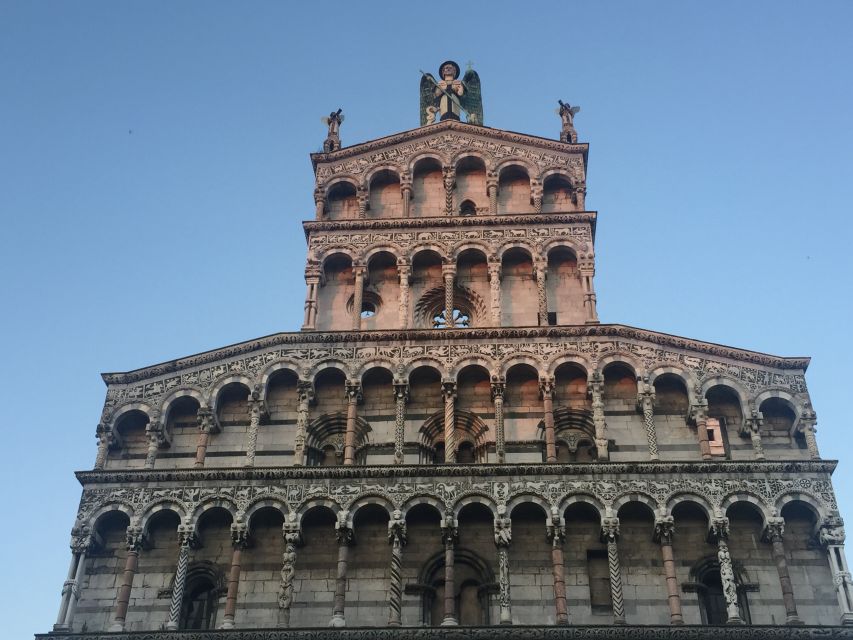
One of the first major sights is Piazza San Michele, centered on the Church of San Michele in Foro. The church is more than 1,000 years old, and its position is tied to Lucca’s Roman forum, the political and commercial heart of the ancient city.
This is a good place for a guide to explain how Lucca developed in layers. You can look at the church as a work of art, but you can also read it as evidence of the city’s long civic life. Details on the façade and the surrounding buildings make more sense when someone points out their place in Lucca’s past.
The piazza is also a useful introduction to the tour’s style. You won’t just hear dates. Guides such as Lucia, Roberta, and Vittoria have been praised for adding anecdotes and humor, while Giorgio has been noted for his warmth and enthusiasm for his home city. The best moments here are likely to come from that mix of architecture and personality.
Piazza Napoleone and Lucca’s public face
Piazza Napoleone offers a change of scale. Compared with Lucca’s tighter lanes and smaller squares, this open space gives you a clearer sense of the city’s public and political life.
Your guide explains the role of the piazza and its connection to Lucca’s period under Napoleonic rule. The name is a reminder that Lucca did not remain untouched by wider European politics, even during the long period when it guarded its independence.
This stop is useful because it keeps the tour from becoming a string of medieval churches. You see how different rulers and eras left their mark, while the city’s basic street plan remained surprisingly coherent.
A few more things to do in Pisa
- Rome: City Sightseeing Hop-on Hop-off Bus with Audioguide
★ 4.0 · 16,045 reviews - Milan: City Sightseeing Hop-On Hop-Off Bus with Audio Guide
★ 4.0 · 6,256 reviews - City Sightseeing Rome Hop-On Hop-Off Bus Tour
★ 3.5 · 5,446 reviews - Bologna: City Center Walking Tour
★ 4.5 · 3,478 reviews
Via Fillungo, Lucca’s main shopping street
Via Fillungo runs through the center of town and is one of the best places to watch present-day Lucca at work. Shops, cafés, and old buildings share the same narrow street, giving you a feel for the city beyond its formal monuments.
A guide can point out architectural clues that are easy to miss while you’re browsing. You may also get advice about places to shop or eat, which makes this stop more useful than a simple walk from one church to another.
The street can be busy at times, and it is not the place for a long pause with the whole group. Stay close to your guide and listen carefully. In a bilingual tour, street noise combined with two languages can make it harder to catch every word.
Torre delle Ore and Torre Guinigi
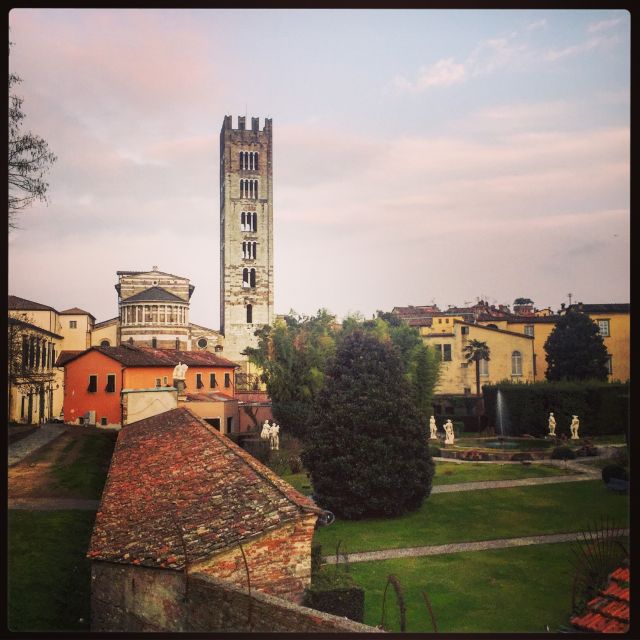
Lucca is famous for its towers, and the tour includes both Torre delle Ore and Torre Guinigi. They tell two different stories about the city’s medieval character.
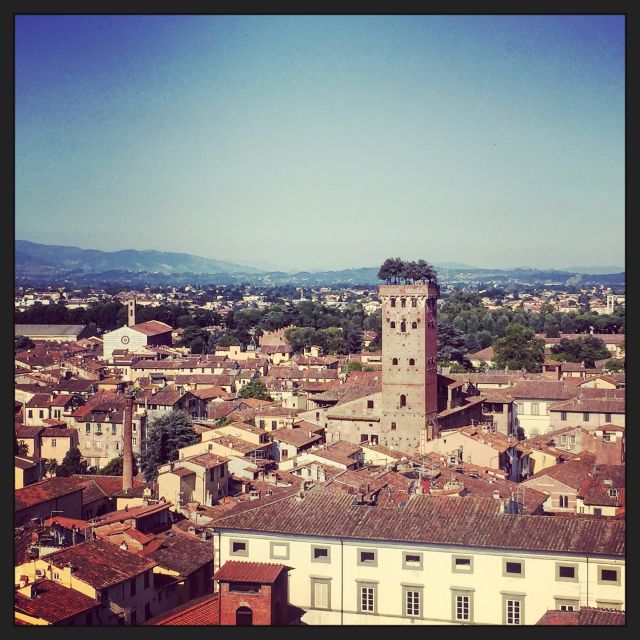
Torre delle Ore, the Clock Tower, reflects the practical side of urban life. A clock visible above the rooftops helped organize the day and marked the importance of civic time. Torre Guinigi is more distinctive in appearance, with its trees growing at the top. It is one of Lucca’s most recognizable sights.
The walking tour does not promise a climb of either tower, so think of these stops as orientation and explanation rather than a tower ascent. You’ll have a better idea of which sights deserve a separate visit later, if you want to explore them more closely.
San Frediano and Piazza Anfiteatro
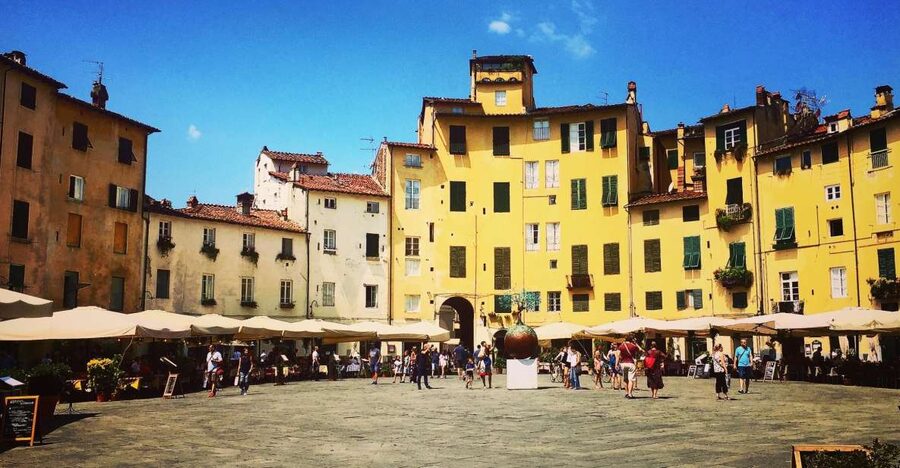
The route continues toward San Frediano and Piazza Anfiteatro, two places that show Lucca’s layered past particularly well.
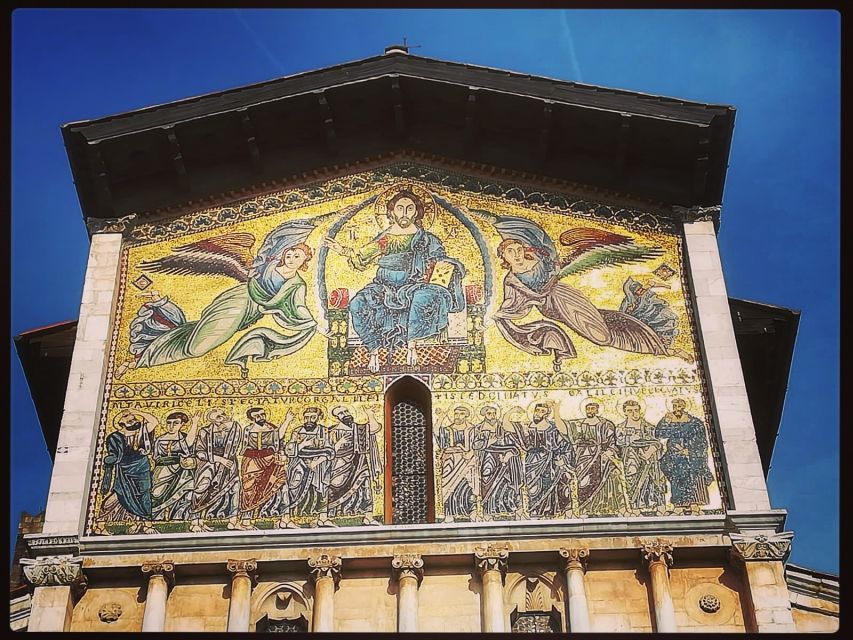
The Church of San Frediano is known for its large mosaic façade and its place in the city’s religious story. Your guide helps you look beyond the surface and understand how churches worked as landmarks, gathering places, and signs of civic pride.
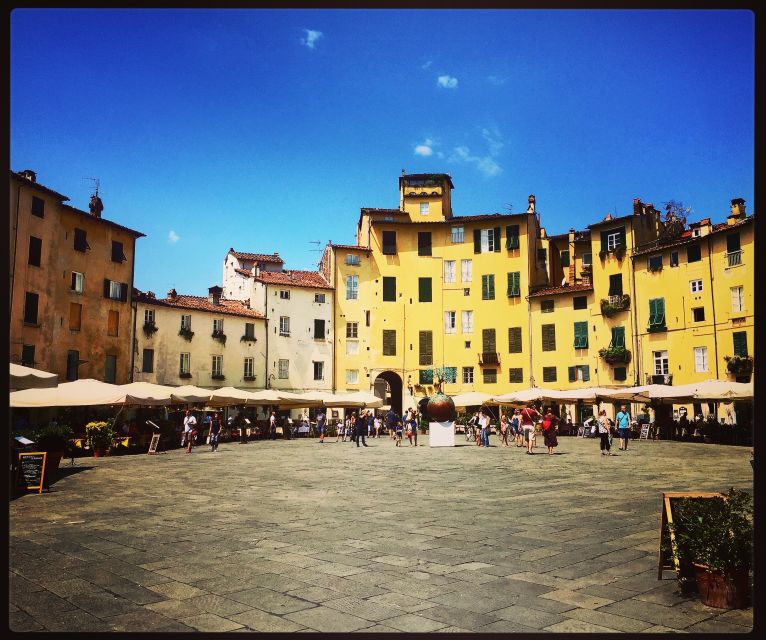
Piazza Anfiteatro is one of Lucca’s most memorable spaces. Its oval shape follows the outline of the Roman amphitheater that once occupied the site. Restaurants and cafés now fill the buildings around the piazza, but the old form remains easy to read.
I like this stop because it connects ancient Rome with everyday Lucca. After the tour, you can return for a drink or an outdoor meal. One especially useful follow-up is to eat within the oval of the former amphitheater, where the shape of the Roman building remains part of the experience.
Walking the sixteenth-century walls
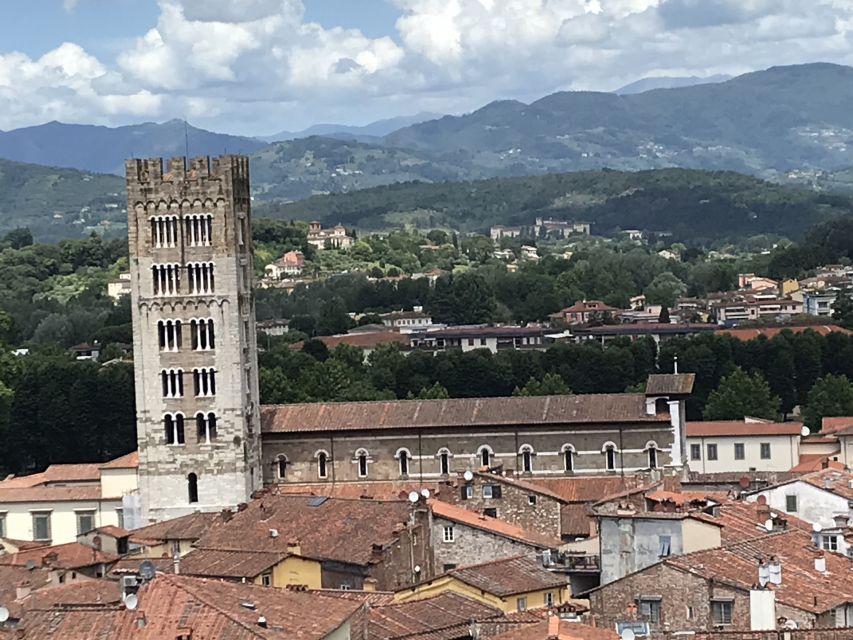
Lucca’s walls are not just a preserved defense system. They are one of the city’s most enjoyable public spaces, and the tour includes them as part of the story of Lucca’s independence and survival.
The sixteenth-century fortifications encircle the old town and give you a fresh view of the rooftops, towers, and church domes. Even a short stretch helps explain why the walls matter. They protected the city, controlled access, and later became a place for walking and enjoying the town from above street level.
One useful tip is to return to the walls on your own after the tour. A past participant used the guided walk as a starting point, then came back at sunrise the next morning. That is a good way to see more of the circuit at your own pace, without having to listen and walk at the same time.
The route is described as a gentle stroll rather than a fast march. Still, you should expect regular walking, pauses in public squares, and time spent standing while the guide speaks.
Finishing at Lucca Cathedral
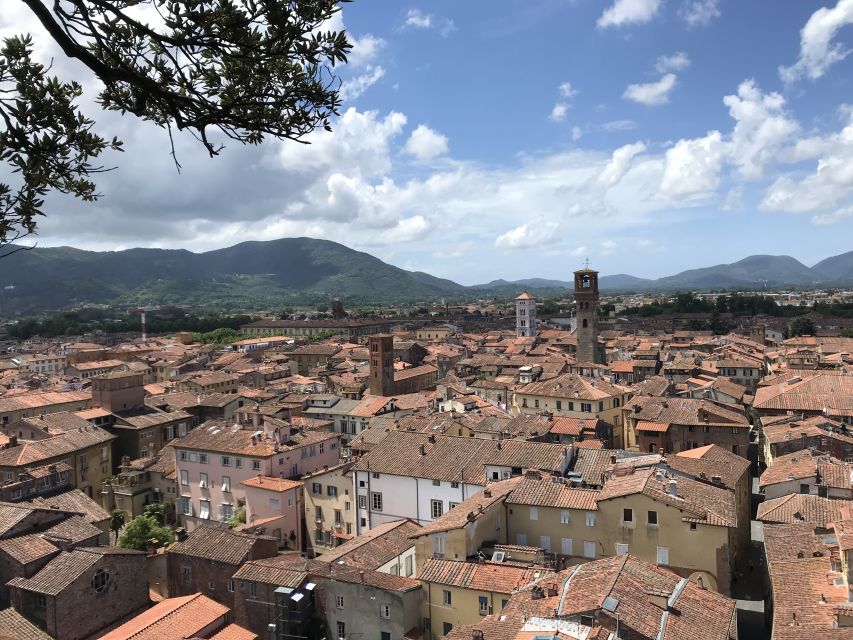
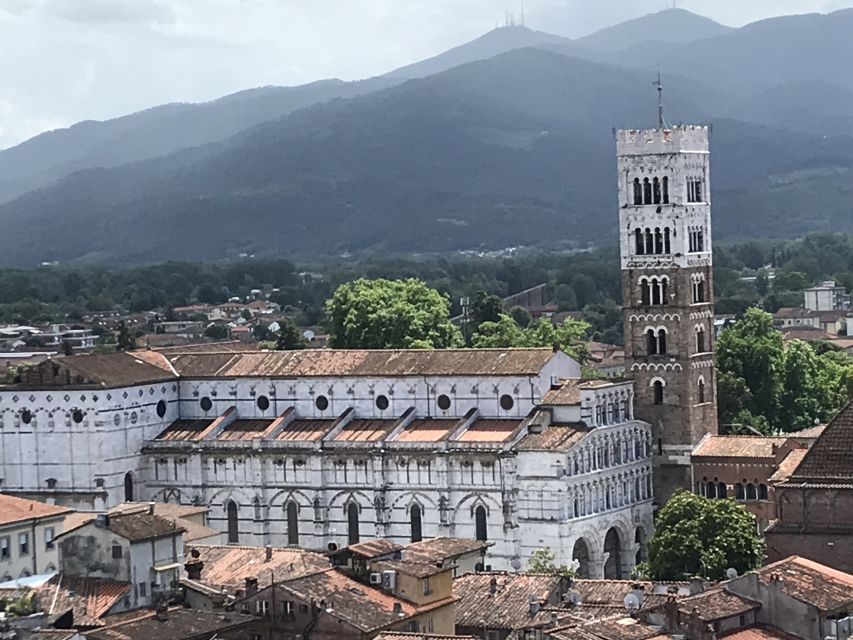
The tour finishes at Lucca Cathedral, officially the Cathedral of San Martino. This is a fitting final stop because it brings together the city’s religious art, architecture, and long civic story.
The Cathedral interior is not included in the tour price. If you want to continue with your guide, pay the small €3 entrance fee and the guide will show you inside. If you prefer to finish after the outdoor portion, you can stop at a café or continue exploring independently.
The tour details describe the route as ending at the Cathedral, while the meeting information also lists the activity as ending back at the starting meeting point. Confirm the exact end point when you arrive, especially if you have a train, meal reservation, or another scheduled activity.
The guides and the bilingual format
The quality of this experience depends heavily on the guide, and the names associated with it include Roberta, Lucia, Vittoria, Paola, Giorgio, Anna, Marta, Nadia, and Gregorio. Their styles differ, but the strongest qualities are clear: local pride, humor, easy explanations, and a willingness to answer questions.
Roberta has been especially effective at blending history with stories about cuisine and local life. Lucia has been praised for making sure the group stays entertained while explaining the people connected with Lucca. Vittoria is known for bringing art, architecture, and practical city tips into the walk.
The tour runs in English and Italian at the same time. That makes it useful for mixed-language groups and helps keep the price low, but you should expect each major explanation to be repeated or shared across both languages. If you want a fast, single-language lecture, this may feel slower. If you enjoy a social walk with a local guide, the format works well.
Group size is not fixed in the information provided. One group was described as modest in size, around 15 people, which made it easy to hear the guide. Your group may differ, so stay near the guide in busy streets and ask questions during pauses.
What the $17 price really buys you
At $17 per person, this is a low-cost way to get an organized introduction to Lucca. The value comes from the route and the guide’s interpretation, not from included admissions. Most of the major sights are viewed from the outside, and the Cathedral costs another €3 if you choose to enter.
Two hours is long enough to cover the central highlights without turning the walk into an all-day commitment. It is also short enough to fit into a day trip from Florence or another Tuscan base. One past booking paired a train trip from Florence with a walk along the walls, the guided tour, and dinner at Piazza Anfiteatro. That makes a full day in Lucca quite manageable.
Some guides may spend extra time with the group, but you should book on the basis of the advertised two hours. Any added time is a bonus, not something to count on.
Free cancellation is available up to 24 hours before the activity, and you can reserve now while paying later. Those terms are helpful if your Tuscany schedule is still shifting.
Who should book this Lucca walk?
I would recommend it to first-time visitors, day trippers, couples, families who want a clear introduction, and anyone who enjoys learning the story behind a city’s buildings. It is also a good choice if you have only a few hours and do not want to waste time deciding which streets and sights matter most.
You’ll get the most from it if you like local anecdotes, art, architecture, and a calm walking pace. It suits people who want both famous sights and useful orientation for later exploring.
I would think twice if you dislike bilingual tours, cannot comfortably walk for two hours, or want long interior visits at every church. This is an overview, not a full art-history course or a tower-climbing excursion.
Should you book the Lucca City Center Walking Tour?
Yes, if you want a well-priced first look at Lucca with a local guide who can connect the city’s churches, walls, towers, and streets. The strongest part is the human touch. Guides such as Roberta, Lucia, Vittoria, and Giorgio have made the walk lively with humor, local pride, and stories that help you notice more afterward.
Book it early in your visit, wear comfortable shoes, and leave time to return to the walls or Piazza Anfiteatro on your own. Add the €3 Cathedral entrance if you want the interior explanation. For $17, this is a practical way to get your bearings and turn a pretty Tuscan town into a place you understand.
FAQ
How long is the Lucca walking tour?
The tour lasts two hours. Starting times vary, so check availability when booking.
Where does the tour begin?
It begins at the Tourist Information Office, Ufficio Informazioni, at Vecchia Porta S. Donato, Piazzale Giuseppe Verdi, 55100 Lucca, Italy.
What sights are included?
The route includes Piazza San Michele, Piazza Napoleone, Via Fillungo, Torre delle Ore, Torre Guinigi, San Frediano, Piazza Anfiteatro, the sixteenth-century walls, and Lucca Cathedral.
Is the Cathedral entrance included?
No. Entry to Lucca Cathedral costs €3. You can pay the fee if you want your guide to continue inside with you.
What languages is the tour offered in?
The guide speaks English and Italian. Both languages are used during the same tour.
Is the tour wheelchair accessible?
Yes, the activity is listed as wheelchair accessible.
What should I bring?
Bring comfortable shoes for two hours of walking through the city center and along the historic walls.
Can I cancel the tour?
Yes. You can cancel up to 24 hours in advance for a full refund. The reserve-now, pay-later option is also available.
Just added in Pisa
- Lucca Bikes and Bites with food tastings for Small Groups or Private★ 5.0 · 249 reviews
- Tuscan Wine Tour in Lucca by van★ 5.0 · 200 reviews
- Lucca: Wine Tasting Experience – Tenuta Adamo Winery★ 5.0 · 400 reviews
- Livorno Shore Excursion: Pisa & Florence in One Day★ 4.5 · 342 reviews
- Livorno Shore Excursion to Lucca & Pisa optional Leaning Tower Ticket★ 4.5 · 196 reviews
- Discover Lucca’s Secrets on a Guided Walking Tour★ 4.5 · 485 reviews
- Full day shore excursion to Florence and Pisa from Livorno with tasting★ 4.5 · 968 reviews
- From Livorno to Pisa on your own with optional Leaning Tower Ticket★ 4.0 · 219 reviews
Walking Tours, compared.
Guided Walking Tour & Last Supper Visit with Ticket
Read our review →
Rialto Bridge & Offbeat Unusual Venice Walking Tour
Read our review →
Private 3 hrs Venice Tour: St Mark’s, Walking tour & Boat tour
Read our review →
Skip the line: Uffizi and Accademia Small Group Walking Tour
Read our review →Browse the lists this tour appears in