
Reviewed · ITALY
Venice: Explore San Giorgio Island with Ticket & Audio Guide
San Giorgio Maggiore gives you a quiet counterpoint to central Venice. In one hour, you can see the elegant courtyards of the Giorgio Cini Foundation, a former Benedictine complex, or visit the unusual Vatican Chapels set in the island’s wood. The libraries and refectory are the stars of the Foundation route, while the chapel route offers newer, more experimental architecture.
I like the small group limit of 25 and the useful multimedia guide, which is available in several languages. I also like the chance to see Palladio’s work, Buora’s Renaissance courtyard, and Longhena’s grand staircase without spending half a day in a large museum.
The main catch is that the vaporetto ride to San Giorgio is not included, and the visit itself lasts only one hour. Some areas, including the maze, gardens, or bell tower, may not be part of your booked route, so check exactly which option you are buying.
Key points to know before you book
- Two very different routes: Choose the Giorgio Cini Foundation for cloisters, the refectory, staircase, and library, or the Wood and Vatican Chapels for modern architecture.
- A quiet island setting: San Giorgio Maggiore is only a short boat ride from Piazza San Marco, but it feels far removed from the busiest lanes.
- Video guide included: Commentary is available in English, French, German, Italian, Russian, and Spanish.
- Small escorted group: A multilingual staff member guides groups of no more than 25 people through the complex.
- Transport costs extra: Your admission does not include the vaporetto journey to the island.
- Allow for uneven access: This experience is not suitable for people with mobility impairments.
Why San Giorgio Maggiore is worth your time
Most first visits to Venice stay focused on San Marco, the Rialto Bridge, and the grand palaces along the Canal Grande. San Giorgio Maggiore gives you a different view of the city. From the island, Venice becomes a broad composition of domes, water, rooftops, and church façades rather than a maze of narrow streets.
The island is home to the Basilica of San Giorgio Maggiore and the monumental complex of the Giorgio Cini Foundation. The Foundation occupies a former Benedictine monastery, and its buildings bring together several important periods of Venetian architecture. You are not just looking at one church or one gallery. You are moving through cloisters, a refectory, a staircase, and a library shaped by different architects and uses.
The experience lasts about one hour, so it works best as a focused visit rather than a full afternoon outing. I would treat it as a calm architectural stop to add to a day around San Marco. The short boat ride gives you a small change of pace, and the island itself offers a break from the tight crowds of central Venice.
A few more things to do in Italy
- Vatican: Museums & Sistine Chapel Entrance Ticket
★ 4.5 · 144,003 reviews - Milan: Cathedral and Duomo’s Terraces Entrance Ticket
★ 4.6 · 61,054 reviews - Venice: Doge’s Palace Reserved Entry Ticket
★ 4.6 · 42,716 reviews
Choosing between the Foundation and the Vatican Chapels
You need to choose your route when booking. The two choices are not alternate versions of the same tour.
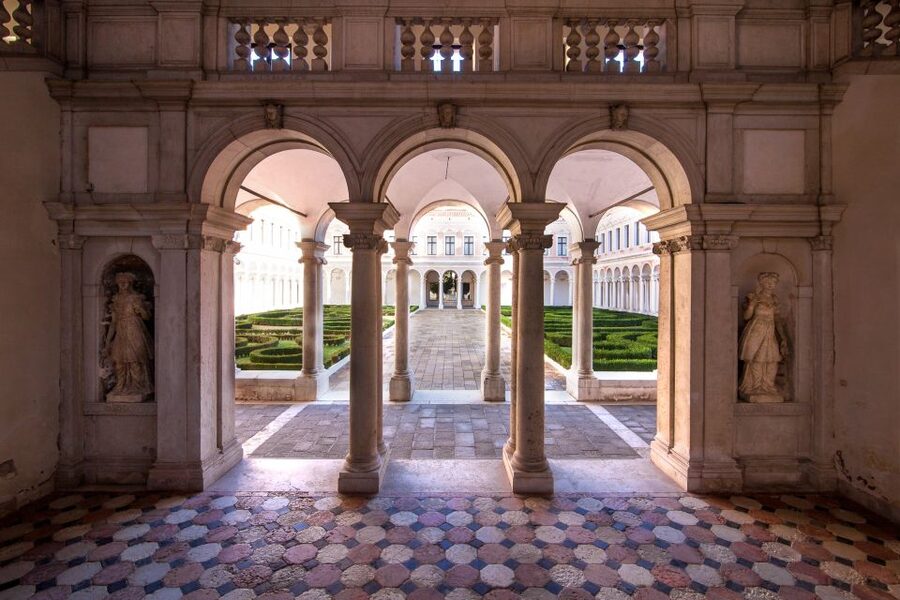
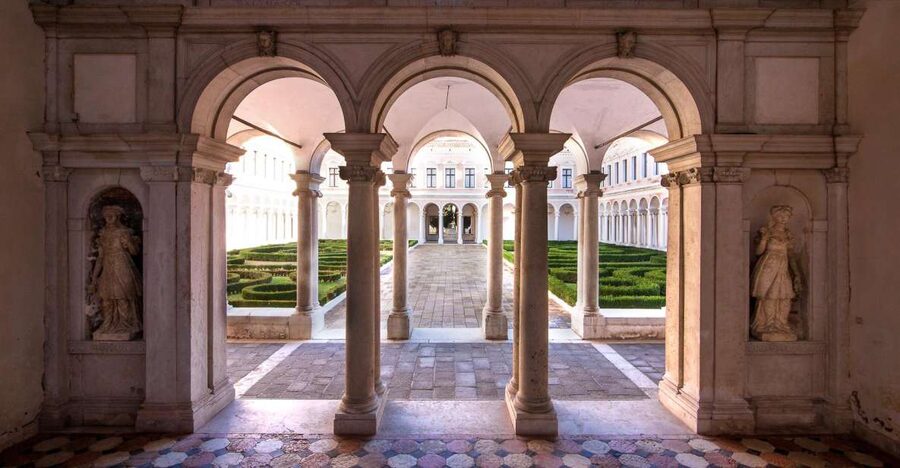
The Giorgio Cini Foundation route is the better fit if you enjoy historic architecture, old libraries, religious buildings, and the way a place changes over time. You will visit the major spaces of the complex, including the Cloister of Palladio, the Cloister of the Buora family, the Palladian cenacle, Longhena’s Grand Staircase, and the Nuova Manica Lunga library.
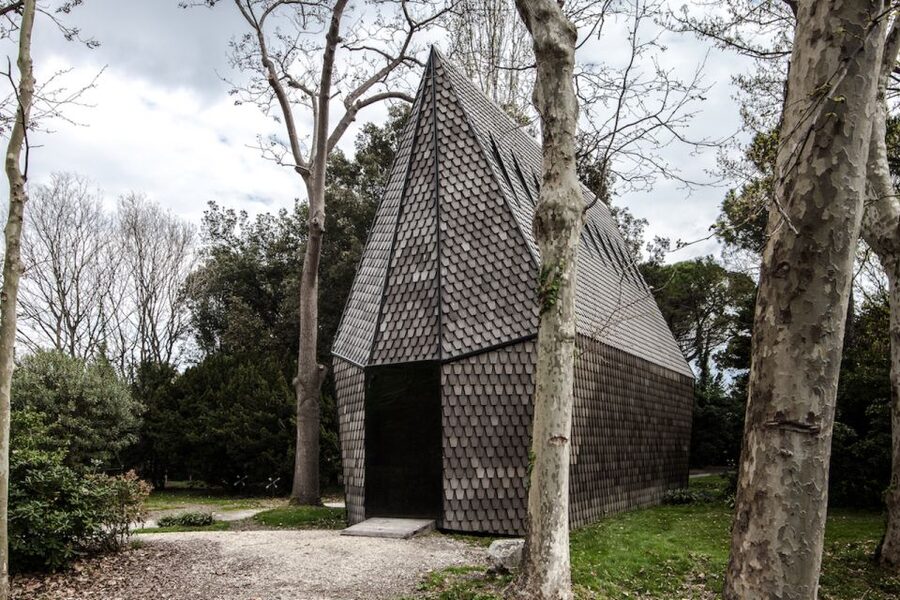
The Vatican Chapels route is more modern and idea-driven. It takes you through the Wood of the island to see 10 chapels designed by 10 internationally known architects. The focus is on the chapel project, its drawings and models, and the different ways each architect interpreted a small sacred building.
I would choose the Foundation if this is your first visit to San Giorgio or if you want classic Venetian architecture. Choose the Vatican Chapels if you have already seen the major historic sights and want something more unusual. Do not assume that booking one route gives you access to both.
Inside the Giorgio Cini Foundation
The Foundation route begins with the courtyards, where the architectural story is easiest to read. The Cloister of Palladio was completed after Andrea Palladio’s death in the 17th century. Its measured forms and orderly design show why Palladio remains such a major name in European architecture.
This is not a stop where you simply walk in, snap a picture, and leave. The multimedia guide helps point out the structure and gives context to what you are seeing. Since a staff member escorts the group, you also have a clear route through the complex instead of wandering through spaces that may have restricted access.
Next comes the Cloister of the Buora family, an early Renaissance work associated with Giovanni and Andrea Buora. It offers a useful contrast with the Palladian spaces. You can see how the design language shifts from the earlier Renaissance approach to Palladio’s later, more controlled style.
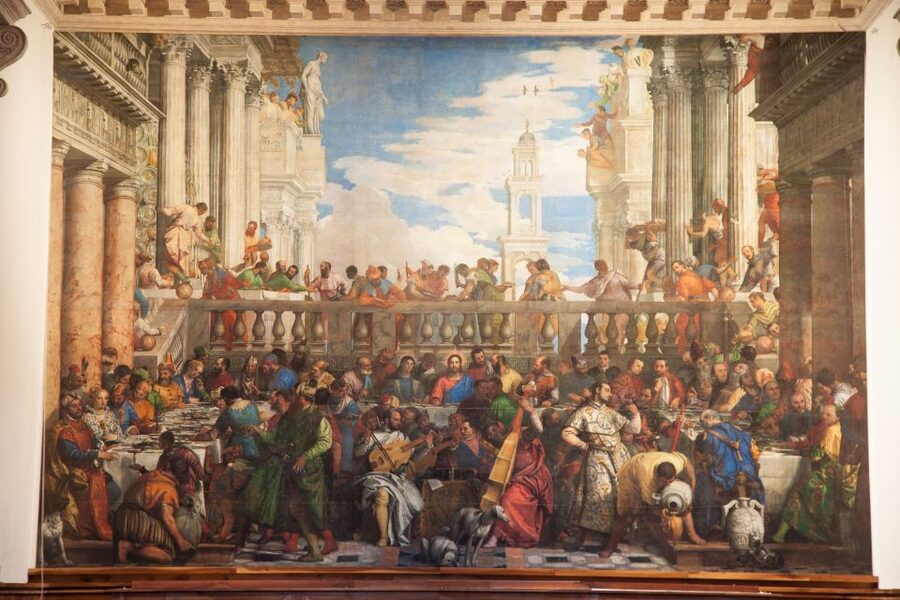
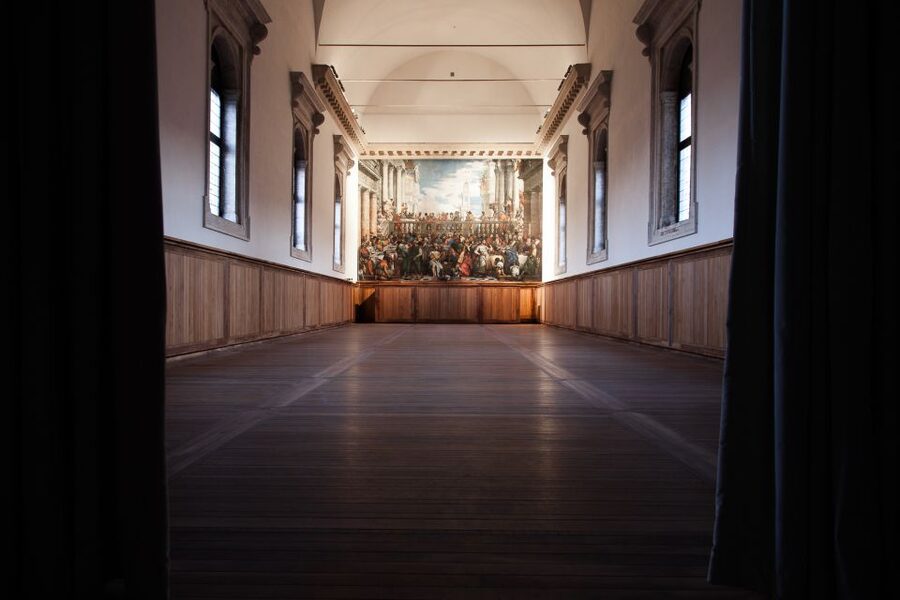
The Palladian cenacle is one of the most important rooms on the route. It was once a Benedictine refectory, where monks would have gathered for meals. Paolo Veronese painted The Wedding in Cana here, although the original painting is now in the Louvre.
You will not see Veronese’s original in Venice, but the room still matters. The size and setting help you understand how a painting made for a refectory worked in its original surroundings. This is a good example of why the Foundation visit offers more than a list of famous names. The building gives the artwork its proper context, even when the painting itself has moved elsewhere.
Longhena’s staircase and the Nuova Manica Lunga
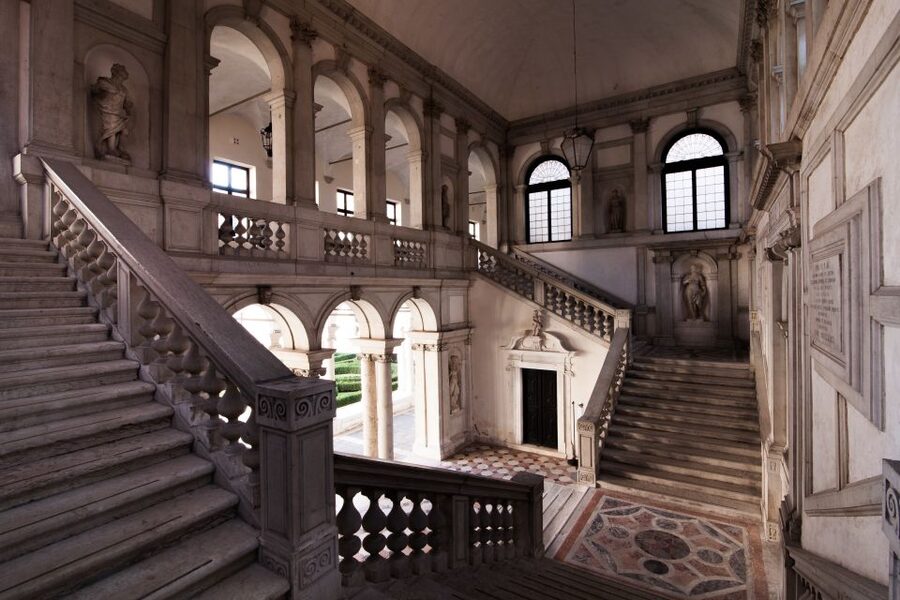
Longhena’s Grand Staircase is one of the route’s most memorable architectural details. Completed in 1671, it connects the two cloisters and once led toward the library and the abbots’ apartments.
The staircase is furnished with wooden bookcases by Franz Pauc. That combination of movement, books, and polished wood makes the space feel less like a grand entrance and more like a working passage through a monastery. You can picture how the building’s daily life once revolved around study, worship, and administration.
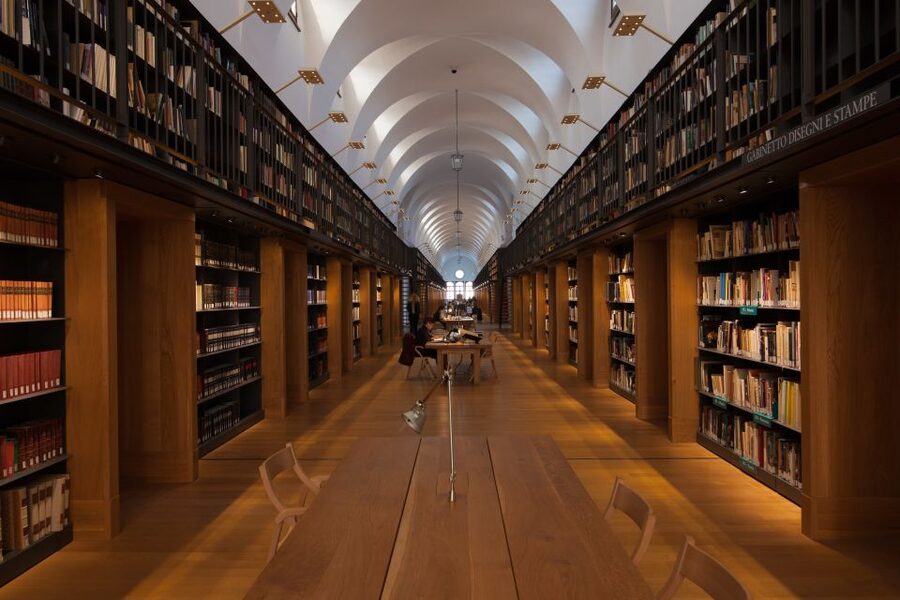
The final major Foundation stop is the Nuova Manica Lunga, the former dormitory of the Benedictine fathers. It has been transformed into a library filled with light. This is likely to be the part that stays with you longest if you enjoy interiors.
The library gives the complex a living purpose. You are not only seeing preserved architecture. You are seeing an old monastic space adapted for study and research. The combination of long proportions, daylight, and wooden furnishings gives the room a quiet force without relying on flashy decoration.
Access can vary. Concerts, activities, and other events may close parts of the complex, and not every garden feature is necessarily included. The maze, in particular, may belong to another route rather than this one. If the maze is important to you, ask before setting out.
Same base, a different kind of day:
- Vatican Museums & Sistine Chapel Tour with Optional Basilica
★ 4.3 · 67,413 reviews - Colosseum, Roman Forum & Palatine Guided Tour
★ 4.7 · 63,148 reviews - Vatican Museums, Sistine Chapel & St Peter’s Basilica Guided Tour
★ 4.5 · 39,149 reviews - Rome: Colosseum, Palatine Hill and Roman Forum Guided Tour
★ 4.8 · 32,814 reviews
The Wood and the 10 Vatican Chapels
The Vatican Chapels route leads into the island’s Wood. Its central idea is simple but unusual: 10 architects were invited to design 10 separate chapels.
The multimedia presentation includes an introduction from H. Em. Gianfranco Ravasi, along with drawings and models connected with the project. You will also learn about the architects and how each chapel was conceived.
The Asplund chapel is part of this story, represented through drawings and models of the Chapel in the Wood. The route is less about a single grand monument and more about comparing different design responses. Each chapel offers another interpretation of how architecture can frame silence, worship, nature, and small-scale human space.
This option is best for you if you like modern architecture or want to see a side of Venice that does not depend on Renaissance and Baroque decoration. It is also a good pick for repeat visitors who have already spent days inside traditional churches and palaces.
The drawback is that the Vatican Chapels route may feel less immediately rewarding if you want famous paintings, grand historic rooms, or classic Venetian ornament. The tour is built around concepts, models, and contemporary design, so the experience depends more on your interest in architecture than on the fame of individual artworks.
How the audio guide works
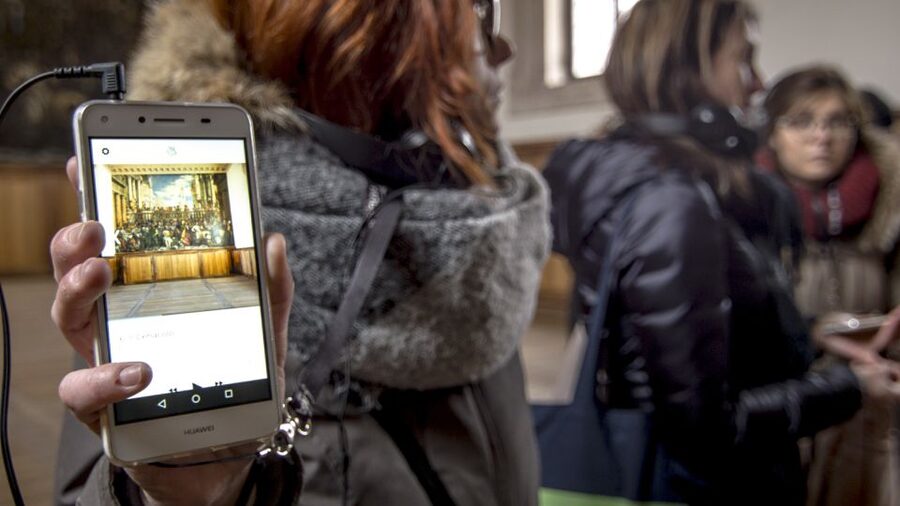
The audio guide is included in the admission price, but this is not a private guided tour. A multilingual staff member escorts the group, while the video guide supplies the detailed explanation.
The listed audio languages are English, French, German, Italian, Russian, and Spanish. The host or greeter service is listed in English and Italian. You will need a valid identity document to collect the video guide, so keep your passport or other accepted ID with you.
I like this arrangement for a short visit. A live specialist guide can offer more flexibility, but a multimedia guide lets you set your own pace within the fixed route and language you choose. It also helps when a room has several layers of history, as with the cenacle and the former dormitory library.
The one-hour limit means you should not expect a long question-and-answer session or time to study every detail. Think of the guide as a clear framework for a compact visit. If you want an extensive art-history lesson, you may find the format too brief.
Getting there and planning your hour
The meeting point is the ticket office on the left side of the Basilica of San Giorgio Maggiore. You must make your way to the island independently. The vaporetto fare is not included, an important point when you calculate the real cost of the outing.
The island is only a few minutes by boat from Piazza San Marco, but leave enough time to find the correct vaporetto and reach the meeting point before your reserved slot. A late arrival could be more troublesome here than at a flexible sightseeing stop because entry is tied to a specific time.
The ticket provides priority access, so you can avoid the ticket line at the complex. That matters most if you are fitting San Giorgio between other timed plans. Still, priority admission does not mean every part of the complex will be open. Events, concerts, and other activities can affect access.
The tour price is listed at $17 per person, though the final amount may appear in another currency when you book. The admission is reasonable if you value the architecture and the organized access. It is less attractive if you are paying mainly for a quick look and also need to add vaporetto fares for your party.
One practical way to judge the value is to ask which route you want. For the Foundation option, the library, staircase, cloisters, and refectory make the ticket more worthwhile than a simple church visit. For the Vatican Chapels option, the value comes from seeing a concentrated modern architecture project that is not part of the usual Venice circuit.
Who will enjoy this experience most
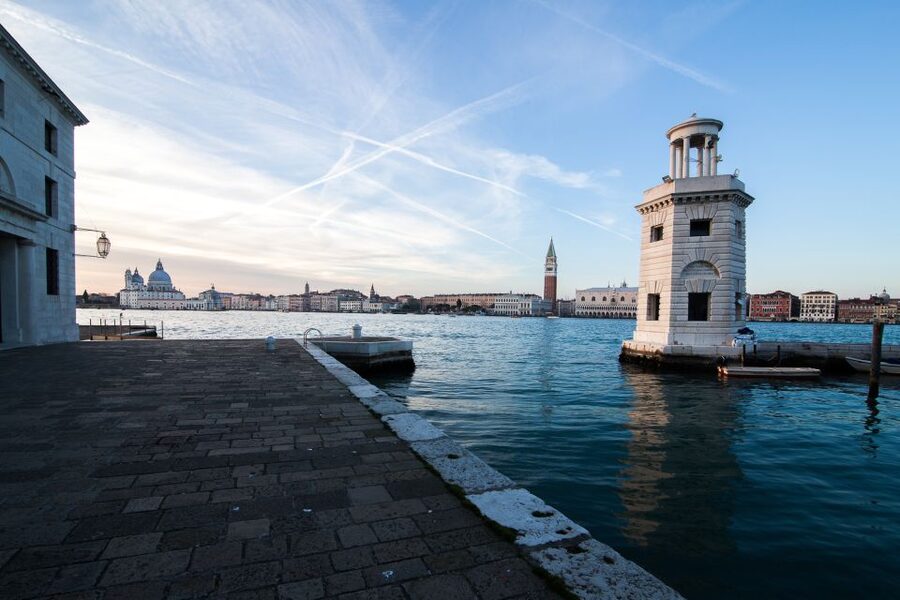
I would recommend the Foundation route to anyone who enjoys historic buildings more than crowded picture stops. It suits visitors who want to understand how a monastery developed across several architectural periods, and it gives you a calm hour away from the tight lanes around San Marco.
The Vatican Chapels route is a better match for modern architecture fans, design students, and repeat visitors looking for something outside the standard Venetian list. The models and drawings are useful because they explain ideas that may not be obvious from simply walking around the chapels.
Families may appreciate the short duration, though the content is architectural and the group follows a set route. People with mobility impairments should not book, since the activity is specifically listed as unsuitable for them.
This is also a good choice for a rainy-day plan if you are comfortable with the boat ride and the portions of the visit that take place outdoors. The exact experience can change if activities or concerts close parts of the complex.
Should you book the San Giorgio Island tour?
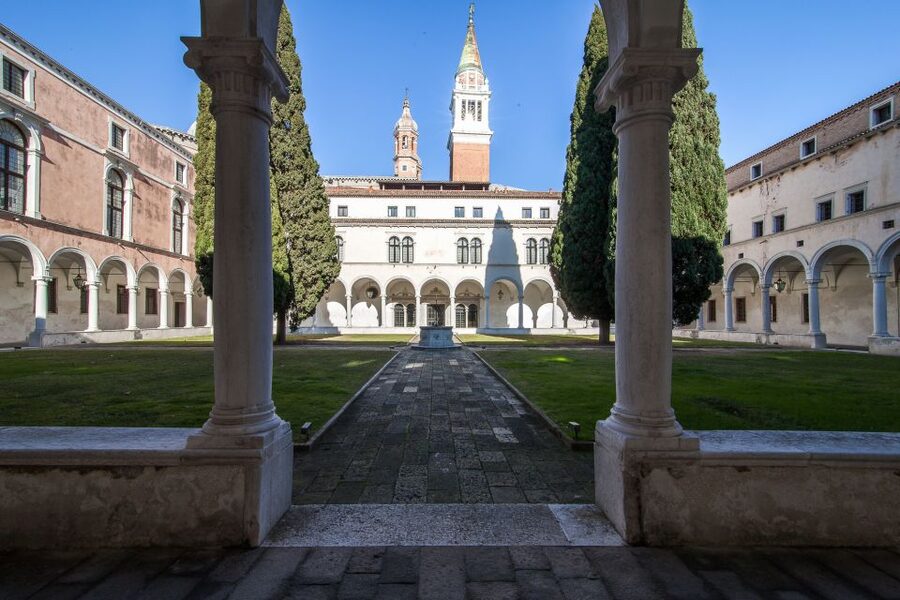
Book it if you want a quiet architectural visit with clear explanations and you are happy to choose one route. The Foundation option offers the strongest all-around introduction, with Palladian courtyards, the former refectory, Longhena’s staircase, and the striking library.
Choose the Vatican Chapels if contemporary design interests you more than historic interiors. Skip the tour if you mainly want the bell tower, maze, or full garden access, since those features are not guaranteed by this one-hour admission.
For most visitors, the key decision is not the ticket price alone. It is the added transport cost and the fact that the visit is compact. If those limits fit your plans, San Giorgio Maggiore gives you an elegant, quieter hour that central Venice rarely offers.
FAQ
How long does the San Giorgio Island experience last?
The tour lasts one hour. You should also allow extra time for the vaporetto journey to and from San Giorgio Maggiore Island.
What can I visit on the tour?
You can choose between the monumental complex of the Giorgio Cini Foundation and the Foundation’s Wood with its Vatican Chapels. The two options cover different parts of the island complex.
Is transportation to San Giorgio Island included?
No. The vaporetto ride to the island is not included in the admission price.
Which languages are available for the audio guide?
The audio guide is available in English, French, German, Italian, Russian, and Spanish.
Is a live tour guide included?
A multilingual staff member escorts the group, but a private tour guide is not included. The detailed commentary comes through the included audio and video guide.
What do I need to bring to collect the video guide?
You need a valid identity document to collect the video guide. Discounted ticket holders must also provide proof of eligibility for the reduced fare.
Just added in Italy
- Highlights and hidden gems of Milan Bike Tour★ 5.0 · 491 reviews
- Milan Gourmet Tour: A Premium Tasting Experience by Do Eat Better★ 5.0 · 241 reviews
- Private Milan Food Walking Tour of Brera★ 5.0 · 217 reviews
- Leonardo3 The World of Leonardo: Tickets for the Interactive Exhibition★ 4.0 · 220 reviews
- Da Vinci’s Last Supper and Santa Maria delle Grazie Church Tour★ 4.5 · 218 reviews
- Learn to Cook Italian Recipes with an Italian Chef★ 5.0 · 283 reviews
- La Scala Theatre and Museum guided experience★ 4.5 · 664 reviews
- La Scala Theatre and Museum Tour in Milan With Private Guide★ 3.5 · 384 reviews