
Reviewed · WALKING TOURS
The Best of Florence Walking Tour in a Small Group
Florence’s great story unfolds on the pavement here, from the Medici family’s church and palaces to Brunelleschi’s huge dome, the Uffizi, and Ponte Vecchio. The route gives you a useful first look at the city’s power, art, and daily life without asking you to spend hours inside a museum. The Medici thread ties the walk together nicely.
I like the small-group limit of 15, which gives a guide room to answer questions and adjust the pace. I also like the local advice: Manuel, Simona, Camilla, and other guides bring up food, side streets, shops, and small details you could easily miss alone. The main consideration is simple: this is an outside orientation walk, not a museum tour, and most admission tickets are not included.
Key points to know before you book
- Fourteen central Florence stops: The route covers San Lorenzo, the Medici Chapels, the Duomo, Signoria, the Uffizi, Ponte Vecchio, and Palazzo Pitti.
- A clear Medici storyline: You see how one banking family shaped churches, palaces, art, and government in Florence.
- Small group, capped at 15: This is a more personal setup than a large city walk.
- English with a whisper system: The audio device helps you follow the guide in crowded streets.
- Useful first-day advice: Guides share suggestions for food, sights, shops, and places to return to later.
- Good value for a quick introduction: At $59.26, the price makes the most sense if you use the walk to plan the rest of your Florence visit.
A compact route through Medici Florence
The meeting point is Caffè Scudieri Firenze at Piazza di San Giovanni 19R. The start time is 12:15 pm, and the walk lasts about 1 hour and 45 minutes. You finish near Ponte Vecchio, although the exact endpoint can vary slightly within that area.
This route is built for orientation. You stop often, usually for about five minutes, while the guide explains a building or square. That format keeps you moving through the historic center, but it also means you should not expect long visits inside the churches or museums.
The tour’s strongest theme is the Medici family. Florence can feel like a catalogue of famous names and grand façades until someone explains how the pieces connect. Here, the Medici appear as bankers, patrons, political rulers, collectors, and builders. That story gives shape to the walk.
Other walks around Florence:
- Florence: Guided Walking Tour
★ 4.5 · 3,334 reviews - Skip the line: Uffizi and Accademia Small Group Walking Tour
★ 4.5 · 3,135 reviews - Florence: Guided Walking Tour
★ 4.6 · 1,602 reviews
San Lorenzo and the Medici family’s mark
The first stop is the Basilica di San Lorenzo, one of Florence’s largest churches. It sits in the city’s market district and is closely tied to the Medici family, whose principal members were buried here from Cosimo il Vecchio through Cosimo III.
You get about five minutes at the stop, with admission not included. The value here is the context. San Lorenzo is not just another old church. It helps you see how a family could turn religious buildings into a public statement of influence.
Nearby, the Biblioteca Medicea Laurenziana introduces a different side of Medici ambition. The library was supported by Medici pope Clement VII and held books and manuscripts from the family’s private collection. Michelangelo designed its celebrated architecture, which is associated with the Mannerist style.
The stop is short, so you will mainly hear why the library mattered. It was meant to show that the Medici were more than successful merchants. They wanted to be seen as educated, cultured, and connected to the church.
The Cappelle Medicee continues that story. These chapels were built in the 16th and 17th centuries as additions to Brunelleschi’s earlier church. The Sagrestia Nuova, or New Sacristy, was designed by Michelangelo.
The chapels are a strong example of how art and family power worked together in Florence. You do not get an included interior visit, so plan a separate admission if you want to see the chapels at close range.
Palazzo Medici Riccardi and the move toward the Duomo
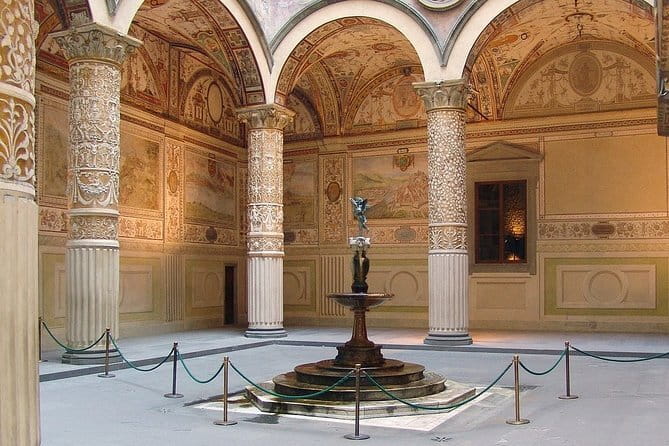
Palazzo Medici Riccardi was built for Cosimo de’ Medici between 1444 and 1484. It was the family’s urban home and an important early sign of its position in Florence.
At this point, the guide can help you picture Florence as a city where business, politics, art, and private life were tightly linked. The five-minute stop will not cover every detail of the palace, but it gives you a reason to return if the Medici story grabs you.
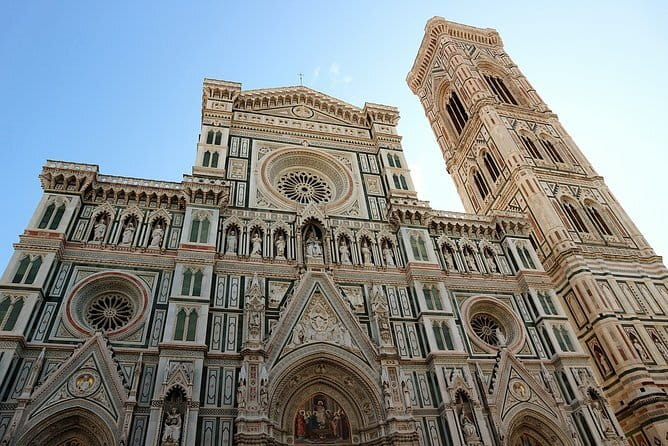
The walk then reaches the Duomo complex, one of Florence’s essential sights. The Cathedral of Santa Maria del Fiore began in 1296 in the Gothic style, based on a design by Arnolfo di Cambio. Its white, green, and pink marble exterior is immediately striking, but a guide adds the names, rivalries, and engineering problems behind the façade.
The cathedral stop is listed as free, while the other nearby attractions generally do not include admission. Treat this part of the tour as an outside visit and orientation. The short stop is enough to help you understand the layout, but not enough for a full look at the cathedral interior.
Across the piazza, the Baptistery of San Giovanni is one of Florence’s oldest buildings. It was built between 1059 and 1128 in the Florentine Romanesque style. Its position opposite the cathedral and Campanile makes the whole square easier to read once someone explains how the buildings relate.
The Baptistery is another place where admission is not included. That is not a problem if you want a city walk first, but it matters if you are trying to combine this tour with several interior visits on the same day.
Brunelleschi’s dome and Giotto’s tower
The Cupola del Brunelleschi receives about ten minutes, longer than most stops. That extra time makes sense. The dome was once the largest in the world and remains the largest brick dome ever built.
The guide’s job here is to make the engineering understandable from street level. You can look up at the structure, hear why it was such a difficult project, and decide if you want to book a separate climb or interior visit. The dome admission is not included.
Giotto’s Campanile rises beside the cathedral and Baptistery. It is a showpiece of Florentine Gothic design, with sculpture and bands of colored marble. The stop is short, but the tower adds another angle to the Duomo complex. From the square, you are comparing three different buildings, each with its own role and style.
The route returns briefly to Santa Maria del Fiore, giving you another look at the cathedral façade. That may sound repetitive on paper, but the second viewpoint can help you notice details after the guide has explained the wider complex.
The walk works best if you resist trying to see every detail at once. You are collecting a map of Florence, not completing the Duomo in five minutes.
Same base, a different kind of day:
- Florence: Skip-The-Line Uffizi Gallery Timed Entry Ticket
★ 4.5 · 27,832 reviews - Tuscany Day Trip from Florence: Siena, San Gimignano, Pisa and Lunch at a Winery
★ 5.0 · 21,634 reviews - Florence: Timed Entrance Ticket to Michelangelo’s David
★ 4.6 · 16,983 reviews - Florence: Michelangelo’s David Skip-the-Line Entry Ticket
★ 4.5 · 12,764 reviews
Signoria, Palazzo Vecchio, and the Uffizi
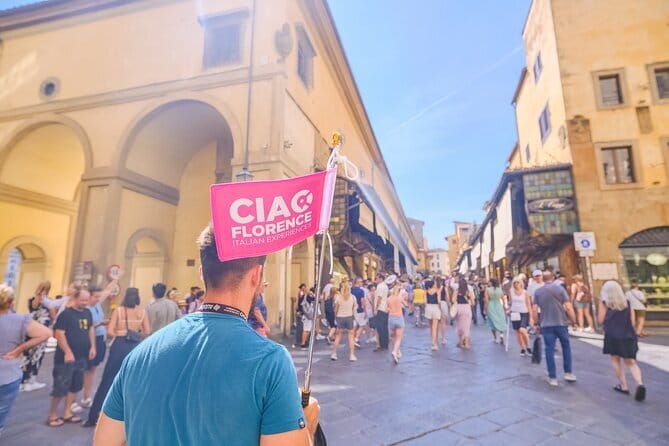
Piazza della Signoria changes the mood. It is Florence’s civic square, an L-shaped open space in front of Palazzo Vecchio and near the Uffizi. It remains one of the city’s key meeting places and acts as a gateway between the central streets and the river.
The square is free to see, and it rewards a pause even after the tour ends. The guide can explain how the buildings and statues turn a public space into a record of Florentine politics.
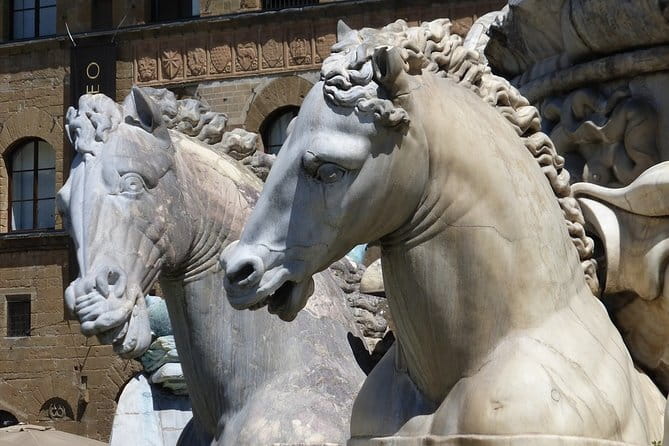
Palazzo Vecchio is the city hall, built like a fortress-palace. Outside, you see the copy of Michelangelo’s David and the statues in the adjacent Loggia dei Lanzi. The palace interior and museum are not included, so keep this stop focused on the exterior and the role of the building.
Next comes the Uffizi Gallery. The building began in 1560 under Giorgio Vasari for Cosimo I de’ Medici. Its original purpose was to house the offices of Florentine magistrates, which explains the name Uffizi, meaning offices.
Today, the Uffizi is one of Italy’s leading art museums, especially for Renaissance works. The tour does not include entry, and the five-minute stop is best understood as a preview. If you plan to visit the gallery, this walk can help you understand its place in the city before you spend several hours inside.
One practical benefit of having a guide here is learning what deserves a return visit. The walk can help you decide if your remaining time should go toward the Uffizi, the Duomo interiors, the Medici Chapels, or other sights.
Ponte Vecchio and Palazzo Pitti
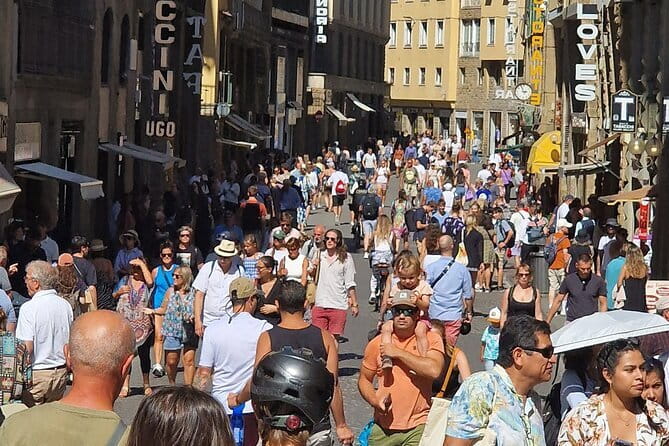
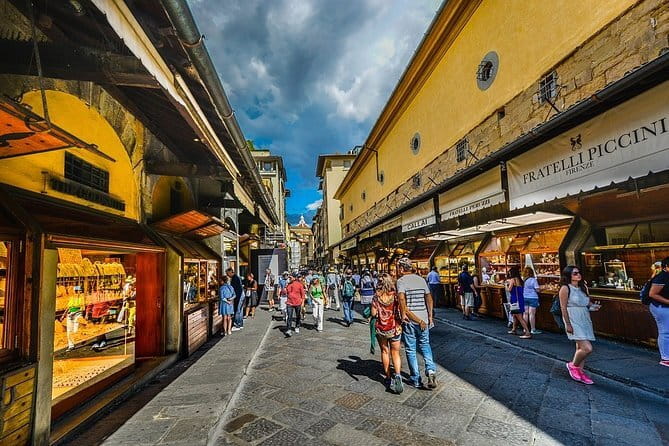
The route ends at Ponte Vecchio, Florence’s medieval bridge over the Arno. It is the oldest bridge over the river in Florence and is lined with shops. Butchers, tanners, and farmers once occupied these spaces. Jewelers and art dealers now fill them.
The bridge is free to cross, so it makes a useful finish. You can continue toward the river, linger over the view, or use the guide’s suggestions to plan your next meal and walk.
The final listed sight is Palazzo Pitti. The Medici bought the palace in 1549, and it became the main residence of the ruling families of the Grand Duchy of Tuscany. Later generations filled it with paintings, plates, jewelry, and luxury goods.
The palace is not an included interior visit. That distinction matters because the route covers a remarkable number of major buildings, but the ticket price does not cover their museums or chapels.
What the guide adds to the walk
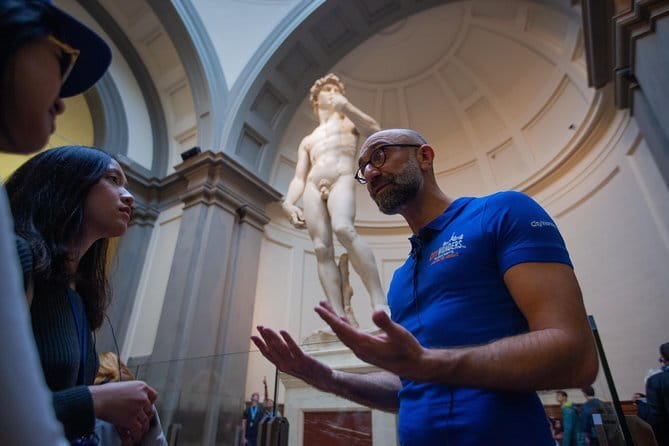
The licensed English-speaking guides are the heart of this experience. Manuel is described as personable, funny, and good at shaping the walk around a group, including keeping children engaged. Simona brings humor, personal stories, and close attention to the city’s art and architecture. Camilla focuses on history, design, favorite side streets, shops, churches, and places to eat.
The strongest part of the guiding style is the connection between famous sights and ordinary city life. You may hear about street food, a backstreet shop, a church you could easily pass, or a detail in a building that is easy to overlook.
The whisper system is a practical advantage. Florence’s center can be noisy and crowded, and a small earpiece lets you look at the building instead of standing shoulder to shoulder with the guide. One caution: the group is capped at 15, but it may not always be smaller. One account describes a slightly larger-feeling group, even though the experience remained enjoyable.
Is $59.26 a fair price?
At $59.26 per person, this is not the cheapest way to walk around Florence. You are paying for a licensed guide, a planned route, a small group, and local recommendations rather than a self-guided stroll.
The value is strongest on your first day. In under two hours, you get the main city center, a basic understanding of the Medici, and a list of places to explore later. That can prevent wasted time, especially in a city where the biggest sights sit close together but demand very different amounts of time.
The value is weaker if you already know Florence well or plan to book several paid interiors during the same afternoon. Tickets are not included for the Medici Chapels, Laurentian Library, Palazzo Medici Riccardi, the dome, Campanile, Palazzo Vecchio, Uffizi, or Palazzo Pitti. Group discounts may be available, which can improve the price for larger parties.
Pace, comfort, and who should book
The pace is described as comfortable, and the route covers a lot without turning into a race. You should still expect continuous walking through central streets and piazzas, with frequent stops. Most people can participate, and service animals are allowed.
I would choose this for a first visit, a short stay, or a day trip from Rome or another Italian base. It also suits families if your guide is Manuel or another guide willing to adapt the presentation to children. It is less suitable if your main goal is a long interior visit or a deep look at Renaissance paintings.
Book it early if your dates are fixed. It is often reserved well ahead, with an average booking time of about 59 days. The tour is offered in English and begins at midday, so you can pair it with a morning museum visit or a relaxed lunch.
Free cancellation is available up to 24 hours before the 12:15 pm start. Weather or minimum-group requirements can cause a cancellation, in which case you are offered another date or a full refund.
Should you book this Florence walk?
Book it if you want a fast, well-organized introduction to Florence that connects the Medici, the Duomo, the Uffizi, and the riverfront. The small group, whisper system, and strong guide personalities make it more useful than simply following a list of buildings.
Skip it if you want included museum admission, a cathedral climb, or long time inside each landmark. For most first-time visitors, though, the route gives you a solid city map and practical ideas for the rest of your stay. At the end, Florence should feel less like a collection of famous façades and more like a city with a story you can follow.
FAQ
How long does the walking tour last?
The tour lasts approximately 1 hour and 45 minutes.
What time does the tour begin?
It begins at 12:15 pm.
Where does the tour start?
The meeting point is Caffè Scudieri Firenze, Piazza di San Giovanni, 19R, Florence.
Where does the tour end?
The listed endpoint is near Ponte Vecchio. The exact finishing point can vary slightly within the indicated area.
How many people can join the group?
The group has a maximum of 15 travelers.
Is the tour offered in English?
Yes. The experience is offered in English.
Are museum and monument tickets included?
Most admission tickets are not included. The tour includes outside stops at places such as the Medici Chapels, Uffizi Gallery, Palazzo Vecchio, Palazzo Pitti, the Laurentian Library, the dome, and the Campanile. The cathedral stop is listed with free admission.
Is a guide included?
Yes. A licensed tour guide is included, along with a whisper system.
Can I cancel for a full refund?
Yes, if you cancel at least 24 hours before the local start time. Cancellations or changes made less than 24 hours before the start are not refunded. If poor weather or an insufficient number of participants cancels the experience, you are offered another date or a full refund.
Just added in Florence
- Wine Tasting Experience in Ponte Vecchio: Best Tuscany selection!★ 5.0 · 197 reviews
- Wine Experience In Chianti Hills from Florence★ 4.5 · 195 reviews
- Florence Sunset Food Tour with Wine & Dine at a Tuscan farmhouse★ 5.0 · 194 reviews
- Walking Food Tour of Florence with Tastings and Wine★ 5.0 · 518 reviews
- Uffizi and Accademia Small Group Guided Tour★ 4.5 · 449 reviews
- Val d’Orcia Brunello Wine Tour with Montalcino and Montepulciano★ 4.5 · 359 reviews
- Uffizi Gallery Timed Entry Admission Tickets★ 4.0 · 392 reviews
- Uffizi Gallery Small Group Tour with Guide★ 4.5 · 879 reviews
Walking Tours, compared.
Guided Walking Tour & Last Supper Visit with Ticket
Read our review →
Rialto Bridge & Offbeat Unusual Venice Walking Tour
Read our review →
Private 3 hrs Venice Tour: St Mark’s, Walking tour & Boat tour
Read our review →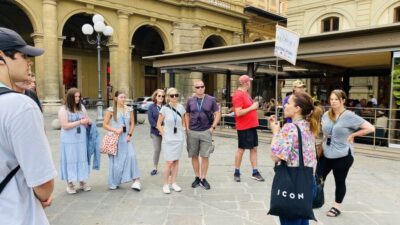
Skip the line: Uffizi and Accademia Small Group Walking Tour
Read our review →Browse the lists this tour appears in