
Reviewed · TOURS IN CATANIA
Benedictine Monastery of Catania – English Guided Tour
The most surprising part of Catania’s Benedictine Monastery is how many lives it contains under one roof. You move from Roman remains to monastic kitchens, from grand late-baroque rooms to a working university library, with lava-built cellars adding a very Sicilian twist.
I like the access to areas you would likely miss alone, especially the Roman house and the old cellar now used by the University of Catania. I also like the guides’ style. Carmen, Giovanni, and Nicola are repeatedly praised for clear English, humor, and lively answers.
The one thing to keep in mind is that this is a short, guided visit, not a wander-at-your-own-speed museum. Some areas, including a viewing platform, may not be included on every departure, so ask before you begin if that sight matters to you.
Key points to know before you go
- Two thousand years in 75 minutes: Roman remains, the Benedictine era, earthquake rebuilding, and the modern university all fit into one compact tour.
- The monastery is still useful today: Part of the complex houses the University of Catania’s Department of Humanities and its library.
- Look for the lava below: The cellar was built on volcanic lava and offers a cooler, more atmospheric stop in hot weather.
- The guides make the difference: Carmen, Giovanni, and Nicola are noted for strong English, humor, and patient answers.
- You get more than a facade: The route includes cloisters, kitchens, dining rooms, the novices’ garden, corridors, and areas not normally open to the public.
- Good value at $11: For a 75-minute guided visit with access to restricted parts, the price is modest by Sicilian sightseeing standards.
Why this monastery is more than a pretty baroque building
The Benedictine Monastery of San Nicolò l’Arena is enormous by monastery standards. Its scale reflects the money and influence once held by the Benedictine order, but the building’s real appeal is the way several eras sit on top of one another.
You are not simply shown a polished church interior or a line of decorated rooms. The visit moves through a working complex shaped by Roman construction, religious life, volcanic geology, rebuilding, and modern education. The monastery is now tied to the University of Catania, so students and scholars use parts of the building that once served monks.
That mixture gives the tour its purpose. You see grand architecture, but you also learn what the rooms did. A kitchen tells you about daily routines. A dining room suggests the size and organization of the community. A library shows how the building continues to serve the city.
I find that more useful than a stop based only on decoration. You leave with a clearer sense of how Catania changed over time, not just a collection of attractive photographs.
A few more things to do in Catania
- Mount Etna: Guided Volcano Summit Hiking Tour with Cable Car
★ 4.7 · 3,784 reviews - Etna Volcano: South Side Guided Summit Hike
★ 4.7 · 1,545 reviews - Catania: Mount Etna Adventurous Tour with a Volcano Guide
★ 4.7 · 736 reviews
Finding the meeting point at Piazza Dante
Enter through the main gate on Piazza Dante. Once inside the courtyard, look for the information point on the right. This is the meeting place, and baggage storage is available there, which helps if you are carrying luggage or shopping bags.
The monastery sits a little outside Catania’s tightest central sightseeing cluster, though it is not far from the main area. Allow a few extra minutes to find the entrance and courtyard rather than arriving at the last second.
The tour lasts 75 minutes and returns to the monastery entrance. It is offered in English, with a live guide. The activity is wheelchair accessible, and the ticket includes access to parts of the complex that are not normally open to the public.
Skip-the-line entry is included, but the tour still runs at a set time. Check the available starting times when booking. You can also reserve now and pay later, with free cancellation up to 24 hours before the tour.
The two cloisters: a calm start inside a giant complex
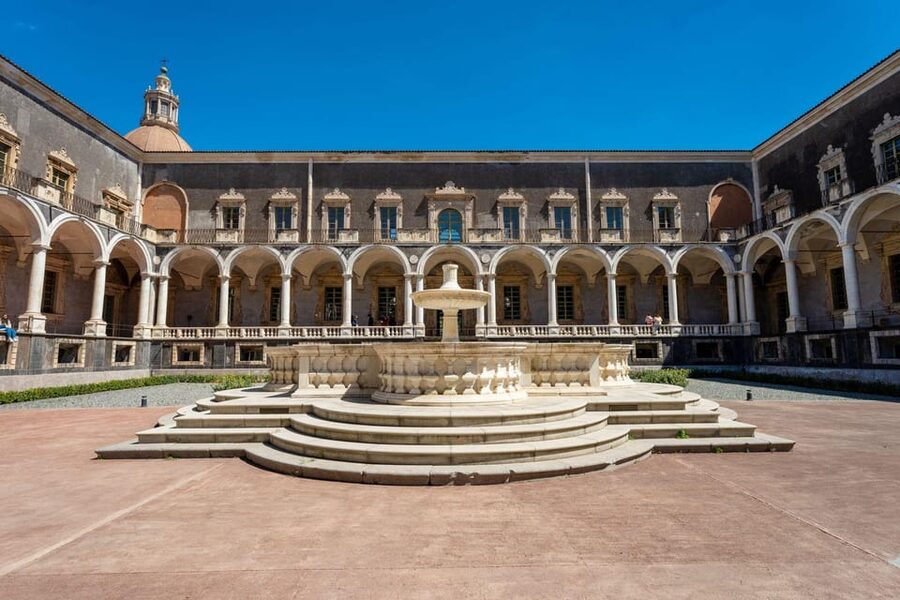
The cloisters are among the first places that help you understand the size of the monastery. These open courtyards break up the long corridors and provide a sense of order inside a building that can otherwise feel like a maze.
Your guide gives the cloisters context rather than leaving you to admire columns and paving in silence. Pay attention to how the open spaces connect with the rooms around them. In a religious complex, the cloisters were not just decorative courtyards. They helped organize movement, work, prayer, and quiet.
The monastery’s late-baroque design is especially striking here. It reflects the wealth available to the Benedictine order, while the sheer scale hints at how many people and functions the complex once supported.
The route does not rush you through every room. Several people find the pace relaxed, with enough time to look around, but the 75-minute limit means you should listen closely when the guide explains why a room matters. This is a story-led tour, not an open house.
Roman remains below the university library
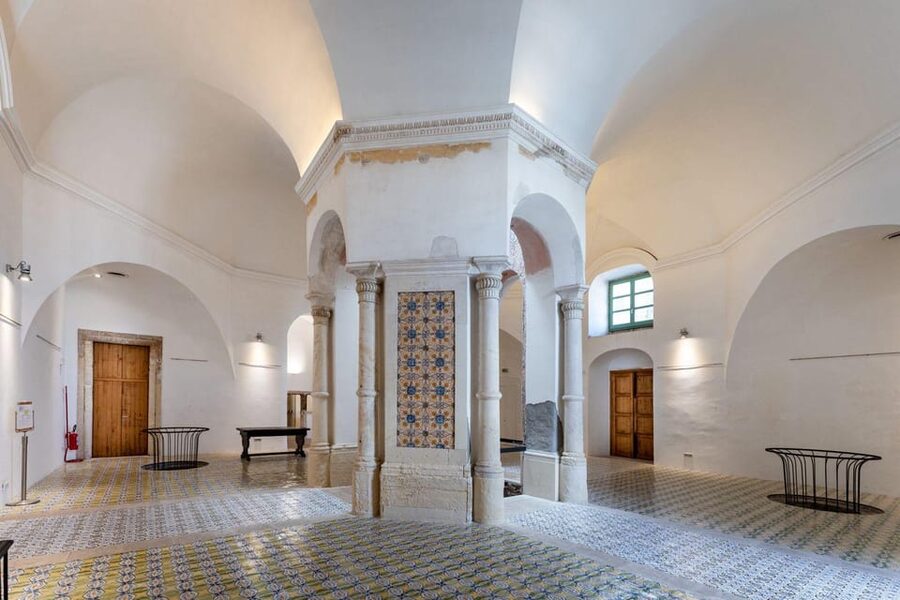
One of the strongest moments comes when the tour reaches the Roman House. It can be seen beneath a modern mezzanine used by students as part of the library.
That pairing is unusually effective. Ancient remains are not sealed away in a separate archaeological display. They sit beneath a modern academic space, showing how Catania has built over its own past while continuing to use the site.
The Roman section also gives the tour a firm starting point in time. The story is not limited to the monastery’s religious period. You are shown how the site reaches back to the Roman age, then moves through the monastery’s later development and into its present university role.
For me, this is exactly the kind of detail that makes a guided visit worthwhile. Without an explanation, you might see old stone beneath a mezzanine and move on. With the guide, the contrast between ancient construction and modern study becomes one of the monastery’s central ideas.
Same base, a different kind of day:
- Catania: Mount Etna Morning or Sunset Day Trip with Tasting
★ 4.8 · 4,028 reviews - Catania: Sunset Jeep Tour of Mount Etna and Lava Flow Caves
★ 4.8 · 2,113 reviews - Mount Etna: Trek to 3000m with cable car and jeep
★ 4.7 · 1,978 reviews - Mount Etna: Summit Crater Trek with Cable Car
★ 4.8 · 1,875 reviews
The novices’ garden and the practical side of monastic life
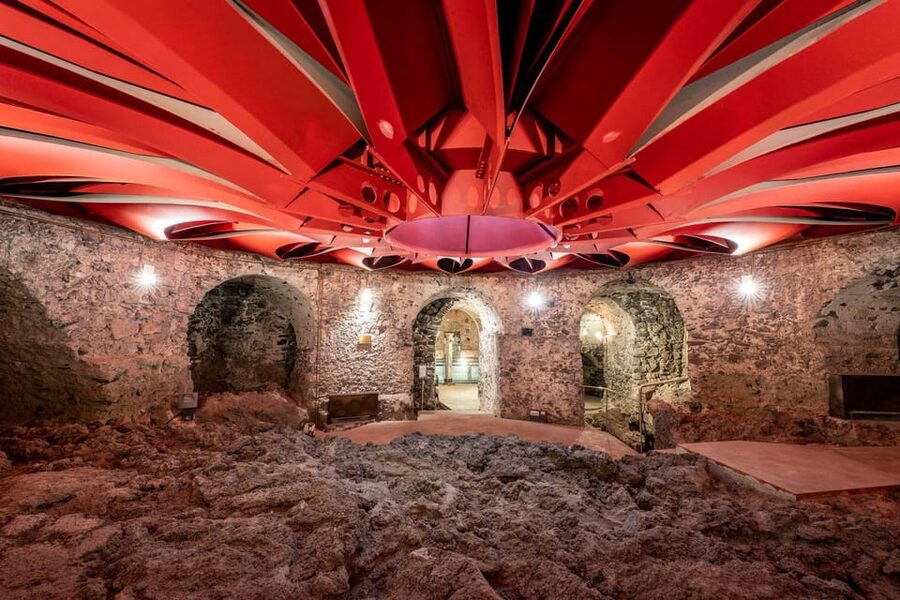
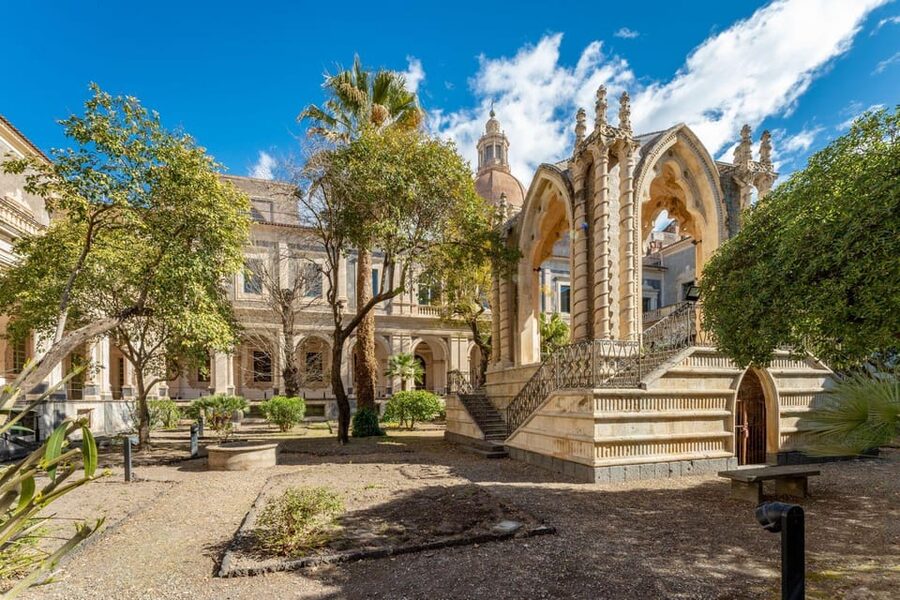
The Garden of the Novices adds a more personal scale to the visit. Large monasteries can feel grand but impersonal, especially when you focus only on staircases and decorative details. A garden connected with novices helps you picture the people who lived and trained inside the complex.
The tour also reaches dining rooms, kitchens, and service areas. These spaces explain how the monastery functioned day by day. They are valuable because they move the experience beyond formal architecture and toward ordinary life: preparing food, eating together, moving supplies, and maintaining a large community.
The famous 18th-century kitchens are a highlight for many people. Their size and design help show the resources available to the order. You can read the wealth of the monastery not only in its grand rooms, but also in the facilities needed to feed and manage its residents.
This is where a good guide earns the $11 ticket. Guides such as Giovanni and Nicola are praised for telling stories about the rooms rather than listing dates. Carmen is also noted for clear explanations and a presentation that keeps the material moving without overloading you.
The cellar built on Catania’s lava
The cellar is one of the most distinctive parts of the route. It was built on lava, a reminder that Catania’s architecture is tied closely to Mount Etna and the volcanic ground beneath the city.
The lower level also gives you a break from the open-air heat during summer. One account describes the underground area as especially refreshing on a hot day, though temperature is not the main reason to visit. The cellar helps explain how the monastery adapted to its setting and how older building layers remain part of the present complex.
Today, this 16th-century cellar is used as the Library of the Department of Humanities at the University of Catania. That change of use is one of the monastery’s strongest themes. A room that once supported monastic life now supports research and teaching.
You may want to pause here and look at the contrast between the old masonry and the modern library function. It is a good example of the restoration approach: preserve the building’s character while allowing it to remain useful.
Vaccarini, the monumental staircase, and the baroque scale
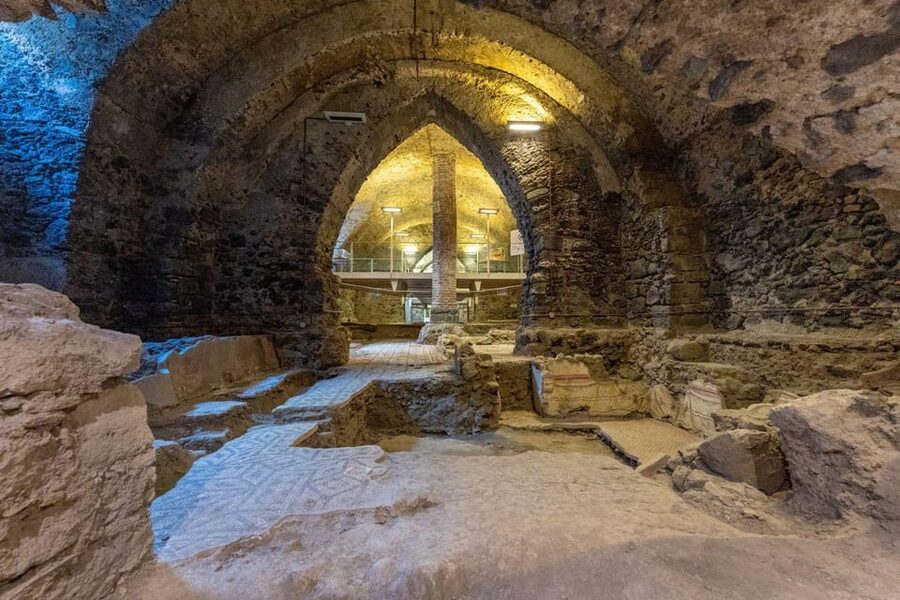
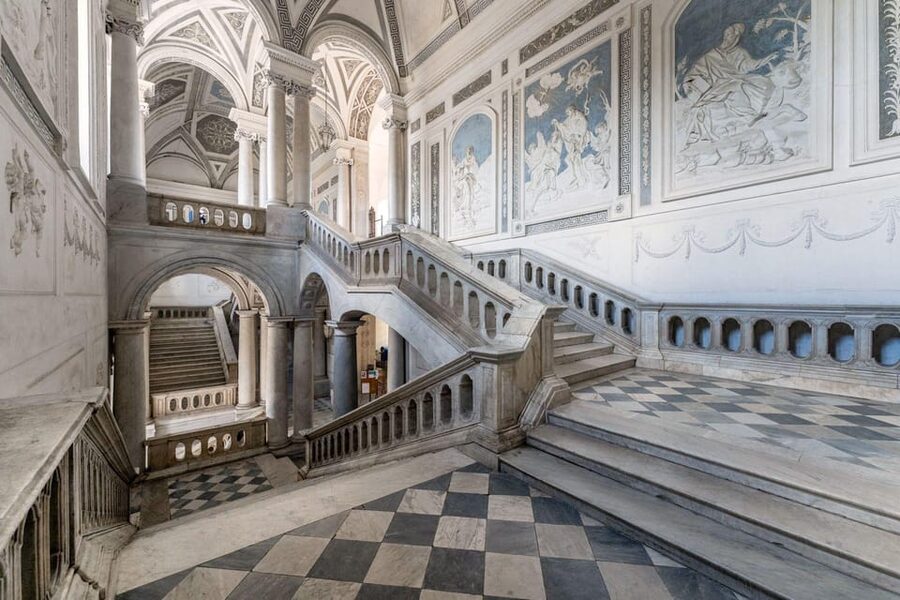
The tour includes work by the architect Vaccarini, along with the monumental staircase. These details show how the monastery was shaped during Catania’s great period of rebuilding and late-baroque design.
The staircase is a visual high point, but it also says something about status. A practical staircase could connect floors. A monumental one makes movement part of the building’s display. It signals that the monastery was a major institution with the money and ambition to create an impressive setting.
You will also pass through labyrinthine corridors and imposing rooms. That maze-like quality is part of the experience, but it can make the building hard to understand without help. The guide keeps linking one space to the next, so the monastery feels less like a series of disconnected sights.
The route’s architectural detail should satisfy people who enjoy design, but the tour is not only for specialists. Guides explain the buildings in plain English and connect the architecture with Catania’s wider story.
A restoration lasting more than 30 years
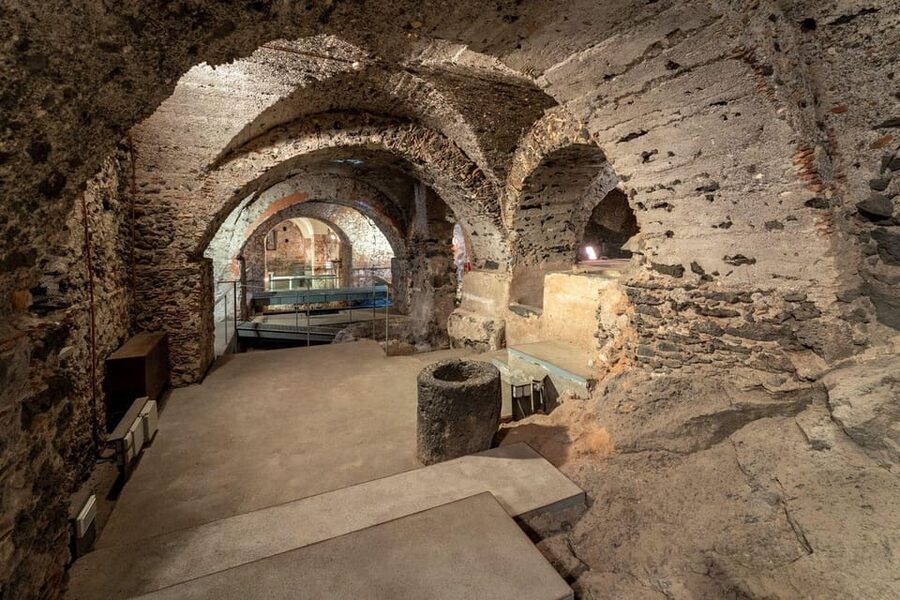
The monastery’s current form owes much to a contemporary refurbishment project led by architect Giancarlo De Carlo. The restoration lasted more than 30 years, which gives you a useful measure of the building’s complexity.
Restoring a huge historic complex is not the same as repainting a single room. The project had to deal with ancient remains, later construction, modern university needs, and the need to preserve the character of the site. The result allows old and new functions to exist together.
This is one of the tour’s most important lessons. You are not seeing a monastery frozen in time. You are seeing a historic place that has been altered, repaired, and given a new public role.
That approach will appeal to you if you like architecture that shows its layers. If you prefer a perfectly restored period interior with every room arranged as it once was, the modern university elements may feel less atmospheric. I see them as a strength because they keep the complex connected to daily life.
What the guides add to the experience
The guide is central here. The building is large, and some of its best details are easy to miss without someone explaining what you are looking at.
Carmen is noted for excellent English, clear delivery, and a good sense of humor. Giovanni is praised for making the history lively and fun, while Nicola is described as engaging and entertaining. Names and assignments can vary, but these examples give you a sense of the style to expect.
The strongest guides do more than recite the monastery’s timeline. They answer questions, explain the lives of the monks, connect the building with Catania, and add small stories about individual rooms. You may also hear broader Italian history alongside the monastery’s own story.
English is the tour language. If English is not your main language, written translations in French or Spanish can be provided. That is useful for travelers who can follow spoken English but want help with dates or architectural terms.
Is $11 good value for 75 minutes?
Yes, particularly if you care about context. At $11 per person, the tour costs little compared with many guided attractions, yet it includes entry, a live English guide, baggage storage, and access to parts of the monastery not normally open to the public.
The value comes from the combination of scale and explanation. You could admire the exterior or enter a limited public area on your own, but you would have a harder time understanding the Roman House, the university library, the restoration, and the monastery’s working spaces without guidance.
The main limitation is the fixed 75-minute format. You will not have unlimited time for every corridor, photograph, or question. If you like to linger for hours, this will feel brisk. If you want a focused introduction that fits neatly into a day in Catania, the length is useful.
The tour also works well as a first stop. It gives you background about the city, Etna’s influence, architecture, and Catania’s layers before you visit other sights.
Who should book this monastery tour?
I would choose this for anyone interested in architecture, archaeology, religious history, or the way old buildings are reused. It is also a smart choice if you have only a short time in Catania and want a substantial indoor visit.
Families and mixed-interest groups should find the range helpful. The Roman remains, underground cellar, gardens, kitchens, grand staircase, and university setting give the guide several ways to keep the visit moving.
It is less suitable if you want total freedom to explore alone or if you dislike guided explanations. The monastery is complex enough that independent wandering may leave you with attractive rooms but little sense of how they fit together.
Ask about the viewing platform at the start if it is important to you. Access may depend on the departure time, and one morning tour did not include it. That small check can prevent disappointment.
FAQ
How long does the Benedictine Monastery tour last?
The guided tour lasts 75 minutes and begins and ends at the Benedictine Monastery of San Nicolò l’Arena.
What is the price?
The price is $11 per person.
What language is the tour in?
The live tour is conducted in English. Written translations in French or Spanish can be provided if English is not your main language.
Where do I meet the guide?
Pass through the main gate on Piazza Dante. The information point is in the courtyard on the right.
What areas are included?
The tour includes the two cloisters, the 16th-century cellar, the Roman House, the Garden of the Novices, the kitchens, dining rooms, corridors, Vaccarini’s architectural work, and the monumental staircase.
Is the monastery still used today?
Yes. Parts of the complex are used by the University of Catania, including the Library of the Department of Humanities.
Is the tour wheelchair accessible?
Yes, the activity is listed as wheelchair accessible.
Can I cancel the booking?
You can cancel up to 24 hours in advance for a full refund. Reserve now and pay later is also available.
Should you book it?
Book this tour if you want to understand Catania through one remarkable building. The $11 price is easy to justify, especially because you see areas that are not normally accessible and get a clear explanation of the monastery’s Roman, religious, architectural, and university chapters.
I would make it a priority for a first visit to Catania, particularly on a hot day when the cellar offers a cooler pause. Just remember that the route is guided and time-limited, and ask about the viewing platform before setting your expectations.
For a short visit with strong guides, unusual underground remains, and a building that still serves the city, this is one of Catania’s most worthwhile cultural stops.
Just added in Catania
- The Godfather Movie Tour★ 5.0 · 275 reviews
- Tour Etna & Wine Tasting★ 5.0 · 317 reviews
- The Original Catania Street Food and Market Tour by Streaty★ 5.0 · 345 reviews
- Etna and Alcantara Gorges Excursion★ 4.5 · 256 reviews
- Etna, Wine and Alcantara Tour – From Taormina★ 5.0 · 464 reviews
- Syracuse, Ortigia and Noto walking tour from Catania★ 5.0 · 273 reviews
- Etna Tour in 4×4★ 5.0 · 583 reviews
- Mt Etna and Wine tasting tour from Catania★ 5.0 · 282 reviews
Tours in Catania, compared.
Mount Etna Morning or Sunset Day Trip with Tasting
Read our review →
Mount Etna: Guided Volcano Summit Hiking Tour with Cable Car
Read our review →
Sunset Jeep Tour of Mount Etna and Lava Flow Caves
Read our review →
Mount Etna: Trek to 3000m with cable car and jeep
Read our review →
Mount Etna: Summit Crater Trek with Cable Car
Read our review →
Etna and Alcantara Gorges Full-Day Tour with Lunch
Read our review →
Mount Etna: Roundtrip Cable Car and 4×4 Bus Ticket
Read our review →
Browse the lists this tour appears in